

#196 – Jonathan Birch on the edge cases of sentience and why they matter

#196 – Jonathan Birch on the edge cases of sentience and why they matter

"In the 1980s, it was still apparently common to perform surgery on newborn babies without anaesthetic on both sides of the Atlantic. This led to appalling cases, and to public outcry, and to campaigns to change clinical practice. And as soon as [some courageous scientists] looked for evidence, it showed that this practice was completely indefensible and then the clinical practice was changed. People don’t need convincing anymore that we should take newborn human babies seriously as sentience candidates. But the tale is a useful cautionary tale, because it shows you how deep that overconfidence can run and how problematic it can be. It just underlines this point that overconfidence about sentience is everywhere and is dangerous." —Jonathan Birch

In today’s episode, host Luisa Rodriguez speaks to Dr Jonathan Birch — philosophy professor at the London School of Economics — about his new book, The Edge of Sentience: Risk and Precaution in Humans, Other Animals, and AI. (Check out the free PDF version!)

Links to learn more, highlights, and full transcript.

They cover:

  • Candidates for sentience, such as humans with consciousness disorders, foetuses, neural organoids, invertebrates, and AIs
  • Humanity’s history of acting as if we’re sure that such beings are incapable of having subjective experiences — and why Jonathan thinks that that certainty is completely unjustified.
  • Chilling tales about overconfident policies that probably caused significant suffering for decades.
  • How policymakers can act ethically given real uncertainty.
  • Whether simulating the brain of the roundworm C. elegans or Drosophila (aka fruit flies) would create minds equally sentient to the biological versions.
  • How new technologies like brain organoids could replace animal testing, and how big the risk is that they could be sentient too.
  • Why Jonathan is so excited about citizens’ assemblies.
  • Jonathan’s conversation with the Dalai Lama about whether insects are sentient.
  • And plenty more.

Chapters:

  • Cold open (00:00:00)
  • Luisa’s intro (00:01:20)
  • The interview begins (00:03:04)
  • Why does sentience matter? (00:03:31)
  • Inescapable uncertainty about other minds (00:05:43)
  • The “zone of reasonable disagreement” in sentience research (00:10:31)
  • Disorders of consciousness: comas and minimally conscious states (00:17:06)
  • Foetuses and the cautionary tale of newborn pain (00:43:23)
  • Neural organoids (00:55:49)
  • AI sentience and whole brain emulation (01:06:17)
  • Policymaking at the edge of sentience (01:28:09)
  • Citizens’ assemblies (01:31:13)
  • The UK’s Sentience Act (01:39:45)
  • Ways Jonathan has changed his mind (01:47:26)
  • Careers (01:54:54)
  • Discussing animal sentience with the Dalai Lama (01:59:08)
  • Luisa’s outro (02:01:04)


Producer and editor: Keiran Harris
Audio engineering by Ben Cordell, Milo McGuire, Simon Monsour, and Dominic Armstrong
Additional content editing: Katy Moore and Luisa Rodriguez
Transcriptions: Katy Moore

Tämä jakso on lisätty Podme-palveluun avoimen RSS-syötteen kautta eikä se ole Podmen omaa tuotantoa. Siksi jakso saattaa sisältää mainontaa.

Jaksot(334)

#226 – Holden Karnofsky on unexploited opportunities to make AI safer — and all his AGI takes

#226 – Holden Karnofsky on unexploited opportunities to make AI safer — and all his AGI takes

For years, working on AI safety usually meant theorising about the ‘alignment problem’ or trying to convince other people to give a damn. If you could find any way to help, the work was frustrating an...

30 Loka 20254h 30min
#225 – Daniel Kokotajlo on what a hyperspeed robot economy might look like

#225 – Daniel Kokotajlo on what a hyperspeed robot economy might look like

When Daniel Kokotajlo talks to security experts at major AI labs, they tell him something chilling: “Of course we’re probably penetrated by the CCP already, and if they really wanted something, they c...

27 Loka 20252h 12min
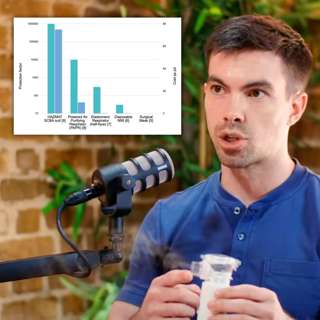
#224 – There's a cheap and low-tech way to save humanity from any engineered disease | Andrew Snyder-Beattie

#224 – There's a cheap and low-tech way to save humanity from any engineered disease | Andrew Snyder-Beattie

Conventional wisdom is that safeguarding humanity from the worst biological risks — microbes optimised to kill as many as possible — is difficult bordering on impossible, making bioweapons humanity’s ...

2 Loka 20252h 31min
Inside the Biden admin’s AI policy approach | Jake Sullivan, Biden’s NSA | via The Cognitive Revolution

Inside the Biden admin’s AI policy approach | Jake Sullivan, Biden’s NSA | via The Cognitive Revolution

Jake Sullivan was the US National Security Advisor from 2021-2025. He joined our friends on The Cognitive Revolution podcast in August to discuss AI as a critical national security issue. We thought i...

26 Syys 20251h 5min
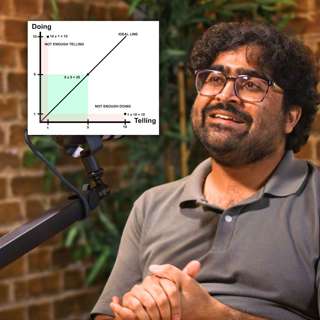
#223 – Neel Nanda on leading a Google DeepMind team at 26 – and advice if you want to work at an AI company (part 2)

#223 – Neel Nanda on leading a Google DeepMind team at 26 – and advice if you want to work at an AI company (part 2)

At 26, Neel Nanda leads an AI safety team at Google DeepMind, has published dozens of influential papers, and mentored 50 junior researchers — seven of whom now work at major AI companies. His secret?...

15 Syys 20251h 46min
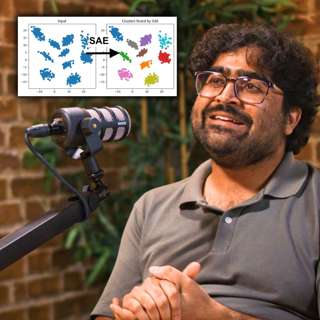
#222 – Can we tell if an AI is loyal by reading its mind? DeepMind's Neel Nanda (part 1)

#222 – Can we tell if an AI is loyal by reading its mind? DeepMind's Neel Nanda (part 1)

We don’t know how AIs think or why they do what they do. Or at least, we don’t know much. That fact is only becoming more troubling as AIs grow more capable and appear on track to wield enormous cultu...

8 Syys 20253h 1min

#221 – Kyle Fish on the most bizarre findings from 5 AI welfare experiments

#221 – Kyle Fish on the most bizarre findings from 5 AI welfare experiments

What happens when you lock two AI systems in a room together and tell them they can discuss anything they want?According to experiments run by Kyle Fish — Anthropic’s first AI welfare researcher — som...

28 Elo 20252h 28min

How not to lose your job to AI (article by Benjamin Todd)

How not to lose your job to AI (article by Benjamin Todd)

About half of people are worried they’ll lose their job to AI. They’re right to be concerned: AI can now complete real-world coding tasks on GitHub, generate photorealistic video, drive a taxi more sa...

31 Heinä 202551min

Suosittua kategoriassa Koulutus

rss-murhan-anatomia
psykopodiaa-podcast
voi-hyvin-meditaatiot-2
adhd-podi
rss-rahamania
rss-arkea-ja-aurinkoa-podcast-espanjasta
rss-niinku-asia-on
taytta-tavaraa
kesken
rss-hereilla
rss-liian-kuuma-peruna
rahapuhetta
rss-duodecim-lehti
rss-valo-minussa-2
rss-tietoinen-yhteys-podcast-2
rss-narsisti
kehossa
dear-ladies
psykologia
rss-tyohyvinvoinnin-aakkoset