069 [Ask Inna] More Answers to Your Hashimoto’s Questions (Part 2)

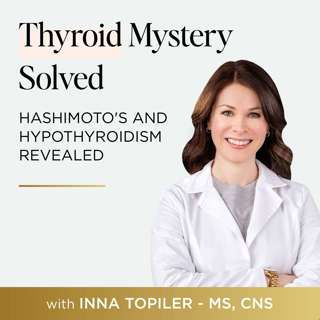
069 [Ask Inna] More Answers to Your Hashimoto’s Questions (Part 2)

Last week I shared some of the questions you wanted answered about Hashimoto’s. I covered topics like the relationship between heavy metals and Hashimoto’s, the role the adrenals play in Hashimoto’s, the relationship between Epstein-Barr Virus (EBV) and Hashimoto’s and how to reduce the risk for kids of people with Hashimoto’s. All of them were very important questions that have a lot to do with the triggers of Hashimoto’s. If you missed it, here is a link to episode 068.

In this episode, I answer more of your questions about Hashimoto’s.

Question #1: With Hashimoto’s, is TSH a reliable indicator of the body’s thyroid hormone needs? If not, what else can we use to know what the body needs?

This can be very confusing for anyone with Hashimoto’s. The short answer is, no. TSH is not a reliable indicator. The ranges for TSH are very broad (typically between about 4.5 - 5 depending on where you live. This range is not really optimal. The optimal range for TSH is between 1.8-3 (if you’re on thyroid medication this shifts a bit).

But, TSH is only one indicator and you need to look at the big picture including your total T4, free T4, total T3, free T3, and reverse T3. This is because TSH is not actually created in the thyroid - it's the thyroid stimulating hormone created in the pituitary gland. So, only looking at TSH doesn’t tell us which hormones the thyroid is producing and at which ratio. And, it doesn’t tell us how well the body (primarily the liver and the gut) are converting these hormones or how the hormones are actually utilized. Essentially, TSH shows a very very small part of a much bigger picture and that is why its not nearly complete. With Hashimoto’s you also want to track your antibody levels so that you can determine which triggers (listen to episode 068 for more on the four triggers) are affecting you and your levels.

I’ve listed the various tests I recommend to get the whole picture of your thyroid functionality and optimal levels for each in the show notes for episode 027. If you are looking for a lab to do these tests, here is a link to a helpful resource and lab.

I’m in the process of creating my thyroid course which is going to get way more in depth about this and how you can figure out your pattern and exactly what to do about it. The course will launch this fall. Add your name to the wait list if you’d like to be personally invited to join.

Question #2: Why does someone with Hashimoto's feel tired all day long? How can we help this and what can we do to wake up feeling refreshed and have more energy throughout the day?

While Hashimoto’s is an issue, we need to look at the root cause of the fatigue. It’s true that Hashimoto’s causes the immune system to attack the thyroid and often causes hypothyroidism which has a common symptom of fatigue. So, the first step is to make sure that you are supporting thyroid function optimally with what your body needs (foods, supplements or if necessary thyroid medication that is dosed appropriately) and you are also by avoiding Hashimoto triggers (noted in last week’s episode).

If you are doing these things and continue to feel tired, then you may want to consider the role your adrenal glands may be playing in your fatigue. The adrenals and the thyroid are very interrelated. Stress is a key trigger for Hashimoto’s and it can also impact adrenal function.

Clean eating is also recommended but if you continue to feel tired, you may be having some issues with absorption which could be caused by a gut issue. This could be the real cause of the fatigue as well

And finally, check that you are not deficient in nutrients that help us feel more energized like iron, B12 and other B vitamins. As you can see, feeling tired is quite multi faceted so we have to look at it from all angles.

Question #3: My diagnosis of Hashimoto's only came after being on thyroid medication for years. Can this medication be contributing to Hashimoto's?

In my opinion, I don’t think it did. What often happens is that the Hashimoto’s is undiagnosed for many years. Conventional doctors will often stop looking for answers once they diagnose hypothyroidism. So, the Hashimoto’s may have been there or been developing all along. I don’t think that the medication could cause Hashimoto’s because whether you’re taking a synthetic hormone or a natural, desiccated hormone, you’re just replacing the hormone that the body is failing to produce. One thing that could be setting off the immune system is a sensitivity to corn. Some medications are made with cornstarch so a small amount, everyday could be causing a reaction from the immune system so that is something to look into and perhaps change to a compounded medication with no fillers can help.

Question #4: Do you have to eat after taking Levothyroxine? And, can it be taken when doing a water-fast?

Levothyroxine or L-thyroxine is a T4 medication prescribed to some people with low thyroid function. It is meant to be taken on an empty stomach and you don’t need food later to help it absorb. So, in the case of a water-fast, it should not impact the effectiveness. However, water-fasts should be done under the guidance of a health practitioner so make sure they know you’re taking Levothyroxine.

Question #5: How can you lose (or gain) weight when you have Hashimoto’s

I had multiple people ask me about this - both people looking to lose weight and people struggling to maintain or gain weight.

We know that the thyroid has a big effect on metabolism. Once again, it’s important to look at the full hormone picture (not just TSH levels) to determine if the thyroid is not functioning optimally. If everything looks good, then the next place to look is at the food you’re eating - specifically any foods that you may have a sensitivity to. Food sensitivities can cause inflammation resulting in water weight gain. Hormonal imbalances may also be impacting the metabolism.

The other big thing to consider is your metabolic type. We have different metabolic types, some people are protein or fat types and some are carb types. The protein types tend to do better with higher protein and fat whereas the carb types tend to do better with some carbs and less fat. If you are eating counter to your type (even if it’s super healthy) you may struggle to lose or gain weight. Also if you combine too much fat with too many carbs (even if they are good fats and good carbs) that tends to have a negative effect on our metabolism. While calories are not everything, how we combine our food does make a big difference.

For anyone struggling to maintain their weight or gain weight the first thing to check is that you’re not over medicated or over-supplemented. Next, watch for triggers that may be causing Hashimoto’s flare ups. These can send your thyroid into hyper mode and then drop back down to hypo mode. And, like the weight loss issue, make sure you are eating for your metabolic type and for you, combining good carbs with good fats would in this case be a good thing.

Question #6: Does the ketogenic diet help or hurt people with Hashimoto's?

There’s a few opinions on this and it depends on how you look at it. W...

Jaksot(215)

204 What’s Really Underneath Eating When You’re Not Hungry, and How to Rewrite Your Relationship with Food with Lisa Schlosberg

204 What’s Really Underneath Eating When You’re Not Hungry, and How to Rewrite Your Relationship with Food with Lisa Schlosberg

There is always a deeper story behind emotional eating, and in this episode Inna and guest Lisa Schlosberg open up the layers most people never connect to food. They explore the moments when you eat w...

11 Joulu 202550min

203 Get the Benefits of Fasting Without Actually Fasting - In a Way That Supports Your Thyroid and Actually Works for Hashimoto’s with Renée Fitton

203 Get the Benefits of Fasting Without Actually Fasting - In a Way That Supports Your Thyroid and Actually Works for Hashimoto’s with Renée Fitton

Fasting is everywhere these days, but most traditional fasting approaches are too harsh when you have Hashimoto’s. Long stretches without food can feel destabilizing, draining, and completely unrealis...

4 Joulu 202545min

202 How to design your home to support your thyroid and Hashimoto’s with HGTV’s Sabrina Soto

202 How to design your home to support your thyroid and Hashimoto’s with HGTV’s Sabrina Soto

Your surroundings can either calm your body or keep it in constant overdrive. In this episode, HGTV designer Sabrina Soto shares how the way we organize, decorate, and even rest inside our homes direc...

13 Marras 202543min

201 You Don’t Have to Do It All With Hashimoto's: Boundaries, Burnout, and Delegation with Renee Warren

201 You Don’t Have to Do It All With Hashimoto's: Boundaries, Burnout, and Delegation with Renee Warren

This episode will change how you think about stress, support, and what it really means to “do it all” with Hashimoto’s.Renee Warren joins Inna to share how she built a thriving business, raised two ba...

30 Loka 202550min

200 Hashimoto’s and PANS/PANDAS: The autoimmune connection every parent needs to know with Dr. Nancy O’Hara

200 Hashimoto’s and PANS/PANDAS: The autoimmune connection every parent needs to know with Dr. Nancy O’Hara

If you’ve ever wondered whether your own Hashimoto’s could be connected to what’s going on with your child’s health, this conversation will open your eyes.In this episode, Inna sits down with Dr. Nanc...

16 Loka 202555min

199 GLP-1s, Microdosing and Thyroid Inflammation: What Hashimoto’s Patients Need to Know with McCall McPherson, PA

199 GLP-1s, Microdosing and Thyroid Inflammation: What Hashimoto’s Patients Need to Know with McCall McPherson, PA

GLP-1s are everywhere right now, but most people may not use them in the best way especially with thyroid issues. McCall McPherson joins Inna to explain why standard dosing creates all the side effect...

2 Loka 202542min

198 What No One Told You About The Connection of Progesterone, Estrogen, and Hashimoto’s with Dr. Felice Gersh (Part 2)

198 What No One Told You About The Connection of Progesterone, Estrogen, and Hashimoto’s with Dr. Felice Gersh (Part 2)

In this second part of my conversation with Dr. Felice Gersh, we shift the focus to progesterone and what it really means for your health. You’ve probably heard that progesterone is only important if ...

18 Syys 202550min

197 What No One Told You About The Connection of Progesterone, Estrogen, and Hashimoto’s with Dr. Felice Gersh (Part 1)

197 What No One Told You About The Connection of Progesterone, Estrogen, and Hashimoto’s with Dr. Felice Gersh (Part 1)

In this episode of Thyroid Mystery Solved, Inna welcomes back the brilliant Dr. Felice Gersh for a conversation that takes Hashimoto’s and hormones to a whole new level. Together, they dive deep into ...

4 Syys 202545min

Suosittua kategoriassa Terveys ja hyvinvointi

unicast
psykopodiaa-podcast
voi-hyvin-meditaatiot-2
vakeva-elama-viisaampi-mieli-vahvempi-keho
tiedenaiset-podcast
rss-pitaisko-erota
rss-narsisti
puhu-muru
rss-kuumilla-aalloilla
rss-pt-paahtio
meditaatiot-suomeksi
selviytyjat-tarinoita-elamasta
terapiassa
fitnesskulmapodcast
junnut-pelissa
rss-nautinto
audio-sport-juoksu
fitnessvastaanotto
rss-addiktit
rss-seuraava-potilas