Arduino Pseudo Random Non-Consecutive Number Generator

Arduino Pseudo Random Non-Consecutive Number Generator

In this video we demonstrate how to create pseudo random numbers with Arduino - with a useful twist.

This lesson was inspired by the following viewer question:

How do I create Random Non-Consecutive numbers with Arduino?

P.S. These are the best tutorials that a complete idiot like you could ever make, thanks.

-Chris


Let's overview exactly what we will talk about in today's episode:
  1. Talk about pseudo random numbers.
  1. Identify the problem - using an Arduino sketch to demonstrate.
  1. Discuss how we might solve the problem.
  1. Write an Arduino sketch that solves the problem.
  1. Review what we talked about.

Before we answer the viewer's question it is important to talk about what a pseudo random number is.

A purely random number in the mathematical sense can't be predicted. The microcontroller that the Arduino uses (and for that case, most computers in general) can't really create pure random numbers.

What they create instead are called pseudo random numbers. These are numbers that appear to be randomly generated, but if studied over time a predictable pattern emerges.

The bottom line is that the random numbers we create with Arduino can be predicted.

Now there are clever ways to create pseudo random numbers that act like the real deal – you can learn about one method in our video tutorial talking all about random numbers – but for this discussion, let's return to our viewers inquiry.

Identify the Viewer's Problem - use an Arduino sketch to demonstrate.

Ok, so let's go back to the viewers question, he wants to generate random numbers, but he never wants the same number generated two times in a row.

Let's write an Arduino Sketch to make this clear.

//This sketch outputs pseudo random integers. //A variable to hold pseudo random integers. int randomInt = 0; void setup() { //Initiate serial communication. Serial.begin(9600); }//Close setup function void loop() { //Create a random number and assign it to the randomInt variable. randomInt = random(0, 10); //Send randomInt to the serial port for displaying on the serial monitor window. Serial.print(randomInt); }//Close loop function.

In the first block of code a variable that will hold the pseudo random integers is declared and initialized.

//A variable to hold pseudo random integers. int randomInt = 0;

In the setup() function we begin serial communication in order to display the numbers we generate on a computer display.

void setup() { //Initiate serial communication. Serial.begin(9600); }//Close setup function

In the loop() we create the random number with the Arduino random() function and assign the output to the variable we had just created. The random() function can take two arguments 1) the minimum value of the number we want generated 2) the maximum value we want generated.

//Create a random number and assign it to the randomInt variable. randomInt = random(0, 10);

I will use 0 for the minimum, and 10 for the maximum.

Every time through the loop, a new random number will be assigned the randomInt variable.

Finally, the value of randomInt is sent over the serial port to be displayed in the serial monitor window.

//Send randomInt to the serial port for displaying on the serial monitor window. Serial.print(randomInt);

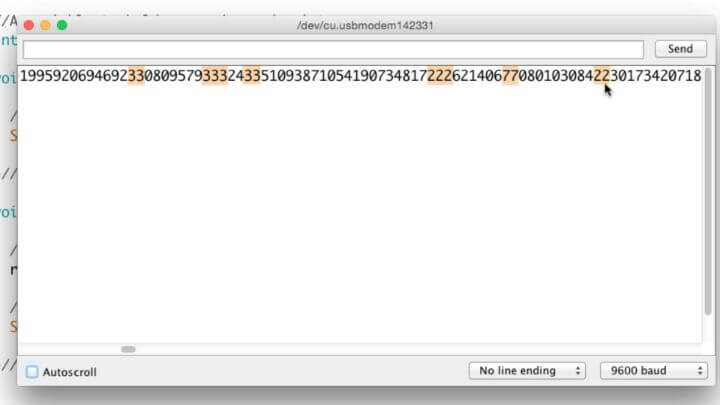
If you upload this code and open the serial monitor you will see in some cases where the same number shows up two times in a row.

This is the problem. The viewer doesn't ever want the same number two times in a row.

Discuss how we might solve the problem.

So let's talk about how we might solve this problem. We know we need to generate a random number.

What if we create a variable to track the previous random number?

Then we could use a condition that says something like "If the previous random number is equal to the random number that was just generated, toss that number out the window, and create a different one."

The final thing we would need to do is set the previous random number equal to the new random number, that way we keep updating our previous random number every time through the loop().

Let's Implement our solution in an Arduino Sketch.

Copy and paste this code into your Arduino IDE. All you need is an Arduino board attached to your computer to make it work.

//This sketch outputs pseudo random non-consecutive integers. //A variable to hold pseudo random non-consecutive integers. int randomInt = 0; //A variable to hold the previously assigned pseudo random non-consecutive integers. int previousRandomInt = 0; void setup() { //Initiate serial communication. Serial.begin(9600); }//Close setup function void loop() { //Create a random number and assign it to the randomInt variable. randomInt = random(0, 10); /*Check if the random number is the same as the previous random number. If it is, then reassign a new random number until it is different from the previously set one.*/ while (randomInt == previousRandomInt) { //Create a random number and assign it to the randomInt variable. randomInt = random(0, 10); //When a consecutive random number has been identified, indicate it. Serial.println(); }//close while statement //Set previousRandomInt equal to the current randomInt. previousRandomInt = randomInt; //Send randomInt to the serial port for displaying on the serial monitor window. Serial.print(randomInt); }//Close loop function.

If you upload this code to your Arduino and open the serial monitor window you will see the numbers scrolling across the serial monitor window, but now you will not witness any duplicates side-by-side. You may notice some X's intermittently between the numbers, this is where the Arduino sketch identified a duplicate random number and generated a replacement.

If you look through the code, you will see this is accomplished with a While Statement.

I hope you can find some application for this simple process of creating a pseudo random non-consecutive number with Arduino. Let me know what you think the comments!

Jaksot(61)

How to read voltages with analogRead()

How to read voltages with analogRead()

In the last lesson you learned about using the analogRead() function to collect data from a sensor connected to one of the Arduino analog pins. The range of data we received from the analogRead() func...

12 Maalis 201714min

analogRead() and the Serial Port

analogRead() and the Serial Port

Knowing if something is on or off can be extremely useful, but often you will want to know more. How bright is the light? How fast is the satellite moving? These types of answers are often analog – th...

11 Maalis 201712min

digitalRead() and the Serial Port

digitalRead() and the Serial Port

As simple as it may seem, knowing when something is either on or off can be a great tool for designing something useful. This lesson will answer the following questions: Is a button being pressed? Has...

10 Maalis 201721min

How to Blink an LED with Arduino

How to Blink an LED with Arduino

The first program you usually write when learning a new programming language is called, "Hello World". Its only function is to display the words "Hello World" on the computer monitor. When learning to...

9 Maalis 201714min

Understanding Variables

Understanding Variables

Let's have a discussion about a powerful and semi-confusing programming topic – variables. Arduino code variables are like buckets. You choose what types of stuff you want in the bucket and can change...

8 Maalis 201711min

Understanding Arduino Syntax

Understanding Arduino Syntax

Arduino Code & Syntax Overview As you learned in Module 01, IDE stands for Integrated Development Environment. Pretty fancy sounding, and should make you feel smart any time you use it. The IDE is a t...

7 Maalis 201710min

Arduino IDE and Sketch Overview

Arduino IDE and Sketch Overview

IDE stands for Integrated Development Environment. Pretty fancy sounding, and should make you feel smart anytime you use it. The IDE is a text editor like program that allows you to write computer cod...

6 Maalis 20178min

Download & Install the Arduino IDE

Download & Install the Arduino IDE

One of the absolute best things about the Arduino IDE and platform is how easy it is to get started. The software that is installed on your computer is completely free and designed specifically for ea...

5 Maalis 20175min

Suosittua kategoriassa Koulutus

rss-murhan-anatomia
voi-hyvin-meditaatiot-2
psykopodiaa-podcast
rss-narsisti
adhd-podi
rss-liian-kuuma-peruna
aamukahvilla
rss-rahamania
rss-eron-alkemiaa
kesken
rss-duodecim-lehti
rss-koira-haudattuna
rahapuhetta
rss-tietoinen-yhteys-podcast-2
rss-niinku-asia-on
rss-uskonto-on-tylsaa
rss-onks-ok
rss-turun-yliopisto
rss-vapaudu-voimaasi
rss-finnish-daily-dialogues