
Talent Tip #13: Find the Sweet Spot

Talent Tip #13: Find the Sweet Spot

Talent Tip #13: Find the Sweet Spot


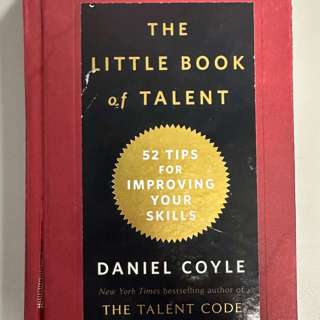
Talent tip number 13. Find the sweet spot. There is a place right on the edge of your ability where you learn best and fastest. It's called the sweet spot. Here's how to find it. The comfort zone feels like ease, effortlessness, you're working, but you're not reaching or struggling, and your percentage of successful attempts is 80 percent and above.


So that might be an easy math worksheet, or A drill and practice that at least four, four times out of five, you get right. That's called the comfort zone. Here's the sweet spot. It feels like frustration, difficulty, alertness to errors. You are fully engaged in an intense struggle as if you're stretching with all your might for a nearly unreachable goal, brushing it with your fingertips and then reaching again.


Your percentage of successful attempts in the sweet spot. is 50 to 80 percent, but there's a place beyond the sweet spot and beyond the sweet, uh, the comfort zone. It's called the survival zone. Sensations in the survival zone are confusion, desperation. You are overmatched, scrambling, thrashing, and guessing.


That's a math test you didn't study for and skipped class all week. You guess right sometimes, but it's mostly luck. And your percentage of successful attempts is below 50%. That's the survival zone. So think of it like a gauge. Comfort zone. Easy. Sweet spot. Frustrating. 50 to 80 percent correct. Challenging.


But past that's like the red zone. I'm just trying to survive. To understand the importance of the sweet spot, consider Clarissa, a freckle faced 13 year old clarinet player, who was part of a study by two Australian music psychologists. Yes. There's an interesting job for you. Music psychologist. You study how people learn music.


Clarissa was an average musician in every sense of the word. She had average ability, average practice habits, average motivation. But one morning, a remarkable thing happened. Clarissa accomplished a month's worth of practice in five minutes. Your brain has to be going, how is it possible to get a month's worth of practice done in five minutes?


Here's what it looked like. Clarissa played a few notes. Then she made a mistake and immediately froze, as if the clarinet became electrified. She peered closely at the sheet music, reading the notes. She hummed the notes to herself. She fingered the keys in a fast, silent rehearsal. Then she started again, got a bit further, made another mistake, stopped, went back to the start.


In this fashion, working instinctively, she learned the song. The music psychologist calculated that Clarissa learned more in a span of five minutes than she would have learned in an entire month practicing her normal way, in which she played songs straight through, ignoring any mistakes. Why? Picture the wires of Clarissa's brain during those five minutes.


Each time she made a mistake, she was, one, sensing it. She knew she messed up. Two, she was fixing it right away, welding the right connections in her brain. Each time she repeated the passage, she was strengthening those connections and linking them together. She was not just practicing, she was building her brain.


She was in the sweet spot. Locating your sweet spot requires some creativity. For instance, some golfers work on their swings like this. This slows them down so they can sense and fix the mistakes in their swing. Some musicians play songs backwards, which helps them better sense the relationship between notes.


If you think you know the alphabet, try saying it backwards. You only know it one way. These are different methods, but the underlying pattern is the same. Seek out ways to stretch yourself. Play on the edges of your competence. As Albert Einstein said, One must develop an instinct for what one can just barely achieve through one's greatest efforts.


The word that's important there is barely. Ask yourself, if you tried your absolute hardest, what could you almost do? Mark the boundary of your current ability and aim a little bit beyond that. That is your sweet spot. Talent tip number 13, find the sweet spot. Now, how does this apply to you as a student?


I want you to think of how much time you've spent in school from kindergarten until wherever you are right now. You've done a lot of math worksheets, written a lot of essays, listened to teachers talk. What percent of your time in school have you spent in the sweet spot? 50 to 80 percent of the time you got the problem right, you were frustrated, you were challenged, you were keenly attuned to errors.


If you are like most students, you have spent very little time in the sweet spot. You are mostly in one of the other two zones, and a lot of you, it's the comfort zone. This is easy. Here's a worksheet. First one done. Boom. Are you actually learning? No. You're just filling time. You could do 2 plus 2 all day.


You didn't get better at math. But look at all the math worksheets that I did. That's not your sweet spot. If you get every question right, that was a waste of your time. You shouldn't get more than 4 out of 5 right. Or, it's too easy, you're in the comfort zone. The other side of that is I skip math class all week, I show up and have a test.


You're in the danger zone. You have no idea what you're doing. You don't even know how to start to solve the problem. That is just system overload and I shut down. So, try to spend more time in the sweet spot and less time in the comfort zone and the danger zone and you'll get more out of school.


We’re thrilled to be sponsored by IXL.

IXL’s comprehensive teaching and learning platform for math, language arts, science, and social studies is accelerating achievement in 95 of the top 100 U.S. school districts. Loved by teachers and backed by independent research from Johns Hopkins University, IXL can help you do the following and more:
Simplify and streamline technology
Save teachers’ time
Reliably meet Tier 1 standards
Improve student performance on state assessments
🚀 Ready to see why leading districts trust IXL for their educational needs? Visit IXL.com/BE today to learn more about how IXL can elevate your school or district.

Tämä jakso on lisätty Podme-palveluun avoimen RSS-syötteen kautta eikä se ole Podmen omaa tuotantoa. Siksi jakso saattaa sisältää mainontaa.

Jaksot(25)

3 AI Apps for Teachers in 2025 (and 2 you can skip)

3 AI Apps for Teachers in 2025 (and 2 you can skip)

To get my free resources for teachers wanting to learn how to use AI in your classroom here:👉 https://www.aaronmakelky.com/student-facing-ai 👈If you know a student who wants to learn how to use AI f...

3 Maalis 202513min

3 AI Skills Everyone Needs in 2025 (teacher edition)

3 AI Skills Everyone Needs in 2025 (teacher edition)

This is a episode #3 in the AI Toolkit for Teachers series where we learn to use AI in our classrooms.To get my free resources for teachers wanting to learn how to use AI in your classroom here:👉 htt...

22 Helmi 202514min

Talent Tip 5: Be Willing To Be Stupid

Talent Tip 5: Be Willing To Be Stupid

Embracing Mistakes: The Power of Being Willing to Be StupidThis episode gets into Talent Tip #5: Be Willing to Be Stupid. The discussion highlights the importance of allowing oneself to make mistakes ...

11 Helmi 20256min

AI Policy for Schools: A Practical Guide for Teachers

AI Policy for Schools: A Practical Guide for Teachers

AI Policy for Schools: A Practical Guide for TeachersCreating Effective AI Policies in Schools: Part 2 of the AI Teacher ToolkitTo get my free resources and the student AI survey mentioned, click here...

10 Helmi 202513min

Talent Tip 4: Buy a Notebook

Talent Tip 4: Buy a Notebook

Talent Tip #4: The Power of Keeping a Notebook- Importance of keeping a daily performance journal, used by top performers like Serena Williams and Kurt Schilling.- Notebooks: can be physical notebooks...

4 Helmi 20253min

5 Mistakes Teachers Make with AI (and how to fix them)

5 Mistakes Teachers Make with AI (and how to fix them)

This is episode 1 in the AI Toolkit for Teachers series where we learn to use AI in our classrooms.To get my free resources and the student AI survey mentioned, click here:👉 https://www.aaronmakelky....

2 Helmi 202514min

Understanding Napoleon Bonaparte: Key Battles Explained

Understanding Napoleon Bonaparte: Key Battles Explained

Understanding Napoleon: Key Battles ExplainedIn this episode of 'That's Not Crazy, That's History,' students from second block advanced world history class present detailed accounts of significant Nap...

12 Marras 202437min

Child Labor Interview (Google NotebookLM)

Child Labor Interview (Google NotebookLM)

Child Labor During the English Industrial RevolutionThis episode is dedicated to Aravind Srinivas, CEO of Perplexity courtesy of my 2nd Block Advanced World History Class. Please add features like Not...

4 Marras 202415min

Suosittua kategoriassa Koulutus

rss-murhan-anatomia
psykopodiaa-podcast
voi-hyvin-meditaatiot-2
adhd-podi
rss-liian-kuuma-peruna
psykologia
rss-vapaudu-voimaasi
rss-niinku-asia-on
kesken
rss-narsisti
leikitaanko-laakaria
koulu-podcast-2
ihminen-tavattavissa-tommy-hellsten-instituutti
rss-hereilla
rss-luonnollinen-synnytys-podcast
rss-koira-haudattuna
rss-arkea-ja-aurinkoa-podcast-espanjasta
rahapuhetta
rss-psykalab
rss-valo-minussa-2