

Carissa Carter & Scott Doorley on Assembling Tomorrow

Carissa Carter & Scott Doorley on Assembling Tomorrow

What role does creativity play in navigating an unpredictable world?

On this episode, I sit down with Carissa Carter and Scott Doorley, both members of the Stanford d.school faculty. Together, they’ve co-authored Assembling Tomorrow, a fascinating exploration of how design influences the future, especially amidst the rapid rise of emerging technologies like AI and synthetic biology. We discuss how design shapes the environments we live and work in and why getting it right can help people make better, safer, and more ethical choices.

Our conversation dives into some intriguing concepts like “mischievous materials” and the role that design fiction plays in imagining the future. Carissa and Scott share their insights into the power of speculative fiction, demonstrating how it can help us predict and adapt to the future consequences of today’s decisions. We also discuss how design often starts as fiction and evolves into real-world innovations and how emotions and make-believe play crucial roles in the creative process.

Lastly, we discuss the ethical implications of design and the importance of considering all possible outcomes—positive and negative—when creating new tools or systems. The discussion is both a hopeful and realistic look at how designers, and indeed all of us, can better navigate an increasingly unpredictable world.


Biography of the Guests:
Carissa Carter
is a designer, geoscientist, and the academic director at the Stanford d.school. She teaches design courses focused on emerging technologies, climate change, and data visualization, helping students apply design thinking to complex, real-world challenges. Carissa is passionate about exploring how design can foster creativity, ethical decision-making, and positive societal impact.

Scott Doorley
is the creative director at the Stanford d.school, where he oversees a wide array of projects, including books, workspaces, digital products, and initiatives aimed at shaping the future of learning and design. A designer and writer, Scott has a deep interest in how design can be used as a tool for understanding and influencing human behaviour, particularly in times of rapid technological and societal change.

Together, Carissa and Scott have co-authored Assembling Tomorrow, a book that delves into how emerging technologies influence human behaviour, decision-making, and ethics. They use the power of storytelling and speculative fiction to imagine future scenarios and provoke thought on how design can guide us through an increasingly complex world.

Links
Carissa's profile - https://dschool.stanford.edu/team-directory/carissa-l-carter

Scott's profile - https://dschool.stanford.edu/team-directory/scott-doorley

The Stanford d School - https://dschool.stanford.edu/

Assembling Tomorrow and other d School books - https://dschool.stanford.edu/books

AI-Generated Timestamp Summary
[00:00:00] Introduction and welcome

[00:00:33] How design shapes our environments and influences decision-making

[00:01:00] Introduction to Stanford d.school and the work of Carissa and Scott

[00:01:41] Overview of Assembling Tomorrow and its exploration of emerging tech

[00:02:20] Ethical implications of design and the influence of emerging technologies

[00:03:16] Carissa and Scott introduce themselves and their work

[00:04:36] The role of ambiguity in design and navigating uncertainty

[00:06:24] Emotions and make-believe in the design process

[00:08:19] Importance of seeing the full impact of design decisions

[00:10:07] The dynamic of young versus experienced creators in technology

[00:15:35] Speculative fiction as a tool for imagining future design consequences

[00:17:23] The process behind creating Assembling Tomorrow

[00:22:04] Strategies for solving complex problems in an unpredictable world

[00:23:14] Embracing awkwardness and aiming for imperfection in design

[00:26:35] Need to adapt to more organic, unpredictable processes in design

[00:33:04] Developing an ethical mindset within design education

[00:36:00] Generational shift in attitudes towards ethical design

[00:45:11] Visuals and illustrations as tools for engaging readers in design concepts

Tämä jakso on lisätty Podme-palveluun avoimen RSS-syötteen kautta eikä se ole Podmen omaa tuotantoa. Siksi jakso saattaa sisältää mainontaa.

Jaksot(368)

Dr Michael Hallsworth on The Hypocrisy Trap

Dr Michael Hallsworth on The Hypocrisy Trap

We all intuitively know that hypocrisy is a bad thing. But what if it isn’t a flaw, but a feature? But maybe the real problem isn’t hypocrisy, it’s how we think about it.Episode SummaryOn this episode...

16 Marras 202558min
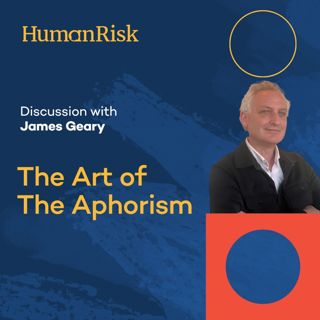
James Geary on The Art of The Aphorism

James Geary on The Art of The Aphorism

Can a single sentence change the way you see the world? My guest on this episode, James Geary thinks so.Episode SummaryOn this episode, I speak with writer and journalist James, whose lifelong fascina...

9 Marras 20251h 4min

Dr Nicholas Wright on How the Brain Shapes War and War Shapes The Brain

Dr Nicholas Wright on How the Brain Shapes War and War Shapes The Brain

What can war teach us about how the human brain really works? And why is human decision-making a more significant factor than military strength in wars?Episode SummaryOn this episode, I'm exploring ho...

1 Marras 20251h 2min

Dr Nikolay Kukushkin on Memory

Dr Nikolay Kukushkin on Memory

What if your body is learning things your mind doesn’t know? What if memory wasn't just something that our brain has?Episode Summary On this episode, I'm exploring a bold idea with neuroscientist Dr N...

25 Loka 20251h 6min

Richard Chataway on Designing AI for Humans

Richard Chataway on Designing AI for Humans

What if the biggest AI risk isn’t bias or data, but human behaviour itself? How might AI impact the people using it and what does that mean for how we design solutions and deploy the technology?Episod...

18 Loka 20251h 8min

Tom Hardin On Turning A Crime Into A Calling

Tom Hardin On Turning A Crime Into A Calling

What happens when the worst thing you’ve ever done becomes the foundation for your life’s work?Episode SummaryMy guest on this episode is Tom Hardin, otherwise known as Tipper X.  He's been on the sho...

5 Loka 202555min

James Healy on BS at Work (Bullshit & Behavioural Science)

James Healy on BS at Work (Bullshit & Behavioural Science)

Why do so many workplaces run on bullshit processes and procedures?  And how might Behavioural Science help resolve them?Episode SummaryIn this episode, I sit down with author, speaker and advisor Jam...

27 Syys 20251h 4min

Pep Rosenfeld on Work Laugh Balance

Pep Rosenfeld on Work Laugh Balance

What if the most powerful tool at work isn’t logic, but laughter? On this episode I'm speaking to a comedian who far from thinking humour is a workplace distraction, thinks it might be one of our most...

6 Syys 20251h 3min

Suosittua kategoriassa Tiede

rss-poliisin-mieli
tiedekulma-podcast
rss-mita-tulisi-tietaa
docemilia
filocast-filosofian-perusteet
menologeja-tutkimusmatka-vaihdevuosiin
rss-duodecim-lehti
rss-tiedetta-vai-tarinaa
sotataidon-ytimessa
rss-lapsuuden-rakentajat-podcast
rss-lihavuudesta-podcast
utelias-mieli
radio-antro
rss-bios-podcast
rss-metsantuntijat-podcast
rss-luontopodi-samuel-glassar-tutkii-luonnon-ihmeita
rss-sosiopodi