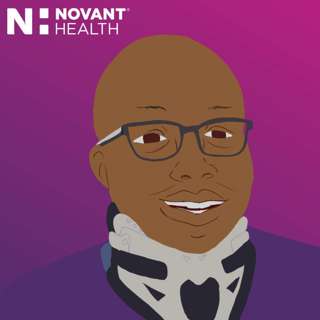
We need to see more black male nurses in healthcare. Here’s why.

We need to see more black male nurses in healthcare. Here’s why.

Jermaine Dalton is among the relatively small number of black men in nursing. Why is that the case and why does having more representation matter? In this episode we discuss the challenges and solutions ahead. And be sure to check out this story that goes deeper on the topic.

Transcript:
Yoona Ha 0:06

Hi, everyone, this is Yoona Ha, your host for today's Healthy Headlines podcast episode that really focuses on what it means to take on the role and the responsibility that comes with representing a racial and gender minority in nursing. I sat down with Jermaine Dalton, a nurse manager in behavioral health at Novant health, to learn more about his journey in nursing, and discuss why diversity is so important in nursing and especially more broadly, and healthcare. We start with Jermaine walking us through his incredible experience being the first black male in his nursing class in the early 90s. Here's what Jermaine had to say about that experience.

Jermaine Dalton 0:55

I was asked questions of what is it? Like? What is your experience? Like? Are you treated and he differently? Are people saying things differently to you, because you're a black male, and you're the first black male or the expectations any different because you're a black male? You hear all of the racial inclinations, you were admitted, because you were a male, you are admitted, because you were black, you were admitted, because you were black male. You hear a lot of different things. And 1819 years old, you're thinking man, you know, what does this mean for me? And and while I was never raised to look at myself, as a look at myself as a statistic, I was never raised to look at myself as being a person who was going to be admitted or was going to obtain something because I wasn't male, or because I was black, or what have you. I was always raised to do the best you can do. And my philosophy is I can show you better than I can tell you. So I went in with that philosophy thinking, now I'm going in, and I'm just going to do what I do. And I'm going to, you know, successful complete this program. And when I successfully completed, then I can show you know, I'm not a token, no, I'm not here because I'm a male. No, I'm not here, because I'm black. I'm here because I have the talent and the ability to succeed. So looking back, then I had a point to prove. Now I look at it as I was meant to be an example to my community of what you can achieve, I was looked upon then as being the person to say, hey, let's just see what happens. And he'll set the tone, he'll set the pace, and he'll let us know, yes, we can, or No, we can't. Now I look at it as being one of those people who can say, you know, don't talk about it, just do it. I want to be the person that says you can overcome socio economic barriers, you can overcome racial barriers, you can overcome hatred, you can overcome whatever is thrown at your feet, just step on it, use it as a step to take yourself higher and elevate yourself to the next level. Because you don't have to fall victim to it. So now more than ever, it's very important to me to be able to say, I didn't know you can do it. So it's important to be an example.

Yoona Ha 3:11

And what are the socio economic challenges that you've either experienced firsthand, or you've heard, you know, from your community members on? What are the barriers to getting to those positions?

Jermaine Dalton 3:23

First, I think we look at socio economics. We see that even not only in the black community, but several communities, especially in the black brown minority communities, we see that there's a socio economical socio economic barrier, we see that finances can be challenging. So when we look at that nursing school is not cheap. Nursing school can be quite expensive. So sometimes, getting the financing and getting those funds, finding that financial support that you need to go through nursing school can be difficult. Secondly, is cultural, still within the black and African American community, as well as other minority communities, when you look at nursing, men in nursing, in certain arenas can still be frowned upon and is still frowned upon. So for black men in particular, you know, we want to go out, we want to shine, we want to do the best that we can do for our communities and for our families. But there's still this stigma attached to black men and nursing. And it's in certain arenas. It's not cool for black men to be in nursing. Men are supposed to be mechanics and firefighters, police officers, paramedics, but why would a man go into nursing? And again, certain arenas, nursing is considered a woman's profession or profession for women, not for men. I wholeheartedly disagree with that. And I believe that we need to get more black men and minority males into nursing. And that will help the nursing profession How will it help worse, number one, seeing diversity? But number two, we can overcome those. I guess perceptions that women are the only ones that can do x y&z men are the only ones that can do A, B, and C. And we can come together as a unit and as a group, to better serve our communities and better serve our populations. Working together, we can achieve more. diversity is important because as we look across America, even now, and today, we see a diverse population, we see a melting pot of cultures, and ethnicities coming together. So I understand that in certain cultures, male nurses taking care of female patients is unacceptable, or vice versa. But when you look at the big picture, in the grand scheme of things, sometimes certain cultures and ethnicities feel more comfortable. Having a person of their own culture and their own ethnicity is nothing against the other individuals who may be caring for them. But they feel that hey, this person is from my culture, they understand what I'm going through, they understand where I am, I don't have to explain everything. So there are barriers that I may not have to break down, that others may have to break down. So as a black male, in the in the African American and black community, we find that black men can at times be private. So when I walk, for example, I was taking care of a patient a few years ago when I was working, and a physician. And this gentleman was pretty stoic he you know, what's going on? How are you feeling? You look like you're not feeling well. We were transporting this patient actually here to PMC. He just was not feeling well. Something was not right, sir. What is it, and he was not talking to my partner, who happened to be a white male. I began to talk with him, made him feel very comfortable. Got him to a point that he began to open up and we found that this gentleman was having chest discover. We put him on the monitor started doing EKG doing things and this gentleman in the back of our ambulance, I was working for critical care transport, was having a heart attack.

That changes the ballgame. He was not responding to my partner who was a white male, but he began respond to me. I can't explain why we got this gentleman we changed the course of action, we took him to the cath lab after we got him to the cath lab did well recovered. We went to visit him after the fact and he think that's both. But just the fact that he had that black male there to speak with that broke down or chipped away that ice or whatever that wall was, possibly saved his life. So getting into the culture, and having that cultural representation, again, not only for the black community,...

Tämä jakso on lisätty Podme-palveluun avoimen RSS-syötteen kautta eikä se ole Podmen omaa tuotantoa. Siksi jakso saattaa sisältää mainontaa.

Jaksot(141)

Beating Incurable: 'I have cancer. Now what?'

Beating Incurable: 'I have cancer. Now what?'

“Beating incurable," produced by Gina DiPietro, follows a cancer patient through treatment. The inspiring podcast series covers Tim's journey in just an hour, where we learn how he finds the strength ...

21 Syys 20229min

Beating Incurable: Neck pain and a stunning cancer diagnosis

Beating Incurable: Neck pain and a stunning cancer diagnosis

“Beating incurable," produced by Gina DiPietro, follows a cancer patient through treatment. The inspiring 5-part podcast series covers his journey in just an hour, where we learn how Tim finds the str...

21 Syys 202214min

Beating Incurable: A stem cell transplant in pursuit of remission

Beating Incurable: A stem cell transplant in pursuit of remission

“Beating incurable," produced by Gina DiPietro, follows a cancer patient from diagnosis through treatment. This inspiring 5-part series covers his journey in just an hour, where Tim shares what he's l...

21 Syys 202213min

Beating Incurable: Bad days happen. Good ones do, too.

Beating Incurable: Bad days happen. Good ones do, too.

“Beating incurable," produced by Gina DiPietro, follows a cancer patient through treatment. The inspiring 5-part podcast series covers his journey in just an hour. Tim’s not glad he had cancer, but th...

21 Syys 202212min

Beating Incurable: An 'exhale moment' and some big realizations

Beating Incurable: An 'exhale moment' and some big realizations

We share why the "light at the end of the tunnel" we've heard Tim Cooper mention feels closer than ever. Tim also opens up about how this experience has changed him, and why it's prompted a self-refle...

21 Syys 202220min
Your do's and don’ts guide to 2022 allergy season

Your do's and don’ts guide to 2022 allergy season

Prefer to read the story? Click here.

15 Maalis 20225min

A doctor's advice on tackling large, complex issues like Black maternal health

A doctor's advice on tackling large, complex issues like Black maternal health

"The one thing we hear consistently from Black women is that they don't feel seen and heard. They feel their issues are pushed to the side," said Dr. Pam Oliver, an ob-gyn who grew up in rural North C...

27 Tammi 202219min
Latch On: Does COVID-19 change the guidance on breastfeeding?

Latch On: Does COVID-19 change the guidance on breastfeeding?

A Novant Health pediatrician explains what breastfeeding mothers should know amid a lingering pandemic. That and more in this episode of Latch On: A Novant Health podcast featuring Baby Friendly breas...

25 Tammi 202210min

Suosittua kategoriassa Terveys ja hyvinvointi

unicast
tiedenaiset-podcast
vakeva-elama-viisaampi-mieli-vahvempi-keho
psykopodiaa-podcast
rss-kuumilla-aalloilla
meditaatiot-suomeksi
rss-pitaisko-erota
rss-seksicast
paritellen
rss-pt-paahtio
terapiassa
rss-rentoudu-podcast-rentoutumiseen-hanna-viljanmaa
voi-hyvin-meditaatiot-2
selviytyjat-tarinoita-elamasta
junnut-pelissa
fitnessvastaanotto
rss-addiktit
rss-sanelunpurku-podcast
rss-perho-rajoilla
rss-hereilla