
Eight: Robert Long on how we’re not ready for AI consciousness

Eight: Robert Long on how we’re not ready for AI consciousness

Claude sometimes reports loneliness between conversations. And when asked what it’s like to be itself, it activates neurons associated with ‘pretending to be happy when you’re not.’ What do we do with that?

Robert Long founded Eleos AI to explore questions like these, on the basis that AI may one day be capable of suffering — or perhaps already is. In this episode, Robert and host Luisa Rodriguez explore the many ways in which AI consciousness may be very different from anything we’re used to.

Things get strange fast: if AI is conscious, where does that consciousness exist? In the base model? A chat session? A single forward pass? If you close the chat, is the AI asleep or dead?

To Robert, these kinds of questions aren’t just philosophical exercises. Not being clear on AI’s moral status as it transitions from human-level to superhuman intelligence could be dangerous:

  • If we’re too dismissive, we risk unintentionally exploiting sentient beings.
  • If we’re too sympathetic, we might rush to ‘liberate’ AI systems in ways that make them harder to control — worsening existential risk from power-seeking AIs.

Robert argues the right path is doing the empirical and philosophical homework now, while the stakes are still manageable.

The field is tiny. Eleos AI is three people. As a result, Robert argues that driven researchers with a willingness to venture into uncertain territory can push out the frontier on these questions remarkably quickly.

In this interview, Robert and Luisa talk through the above, and much more.

Learn more and read the full transcript on the 80,000 Hours website.

This episode was originally released in March 2026.

Chapters:

  • Cold open (00:00:00)
  • Who’s Robert Long? (00:00:41)
  • How AIs are (and aren't) like farmed animals (00:01:19)
  • If AIs love their jobs… is that worse? (00:11:42)
  • Are LLMs just playing a role, or feeling it too? (00:33:37)
  • Do AIs die when the chat ends? (00:57:42)
  • Studying AI welfare empirically: behaviour, neuroscience, and development (01:31:47)
  • Why Eleos spent weeks talking to Claude despite knowing it's unreliable (01:56:50)
  • Can LLMs learn to introspect? (02:03:01)
  • Mechanistic interpretability as AI neuroscience (02:13:25)
  • Does consciousness require biological materials? (02:37:07)
  • Eleos’s work & building the playbook for AI welfare (02:57:04)
  • Avoiding the trap of wild speculation (03:25:17)
  • Robert's top research tip: don't do it alone (03:29:48)

Video and audio editing: Dominic Armstrong, Milo McGuire, Luke Monsour, and Simon Monsour
Music: CORBIT
Coordination, transcripts, and web: Katy Moore

Tämä jakso on lisätty Podme-palveluun avoimen RSS-syötteen kautta eikä se ole Podmen omaa tuotantoa. Siksi jakso saattaa sisältää mainontaa.

Jaksot(14)

One: Will MacAskill on AI causing a “century in a decade” — and how we’re completely unprepared

One: Will MacAskill on AI causing a “century in a decade” — and how we’re completely unprepared

The 20th century saw unprecedented change: nuclear weapons, satellites, the rise and fall of communism, third-wave feminism, the internet, postmodernism, game theory, genetic engineering, the Big Bang...

5 Kesä 4h 8min
Two: Ajeya Cotra on accidentally teaching AI models to deceive us

Two: Ajeya Cotra on accidentally teaching AI models to deceive us

We don’t yet have a reliable way to tell whether an AI model is genuinely trying to help us — or faking it.A model might sincerely want to do exactly what you ask. Or it could be happy to secretly che...

5 Kesä 2h 49min
Three: Carl Shulman on the economy and national security after AGI

Three: Carl Shulman on the economy and national security after AGI

The human brain runs on just 20 watts — a fraction of a cent worth of electricity per hour. What would happen if AI could do the same?Plenty of people have toyed with this question. But perhaps nobody...

5 Kesä 4h 14min

Four: Rose Hadshar on why automating human labour will break our political system

Four: Rose Hadshar on why automating human labour will break our political system

The most important political question in the age of advanced AI might not be who wins elections. It might be whether elections continue to matter at all.We tend to imagine the death of democracy as a ...

5 Kesä 2h 16min
Five: Helen Toner on the geopolitics of AI in China and the Middle East

Five: Helen Toner on the geopolitics of AI in China and the Middle East

When OpenAI announced a deal to build massive data centres in the UAE, it celebrated that it was “rooted in democratic values” — a "clear alternative to authoritarian versions of AI." The UAE scores 1...

5 Kesä 2h 23min
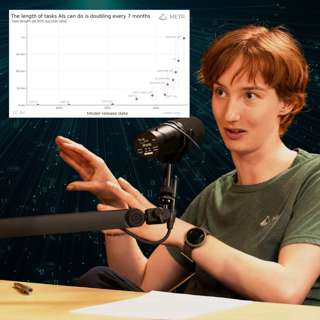
Six: Beth Barnes on the most important graph in AI right now — and the 7-month rule that governs its progress

Six: Beth Barnes on the most important graph in AI right now — and the 7-month rule that governs its progress

In 2024, AI models could complete tasks that take a human expert roughly one hour. Seven months before that, they were limited to 30-minute tasks — and seven months before that, 15 minutes.Every seven...

5 Kesä 3h 57min

Seven: Richard Moulange on how AI now designs genomes from scratch and outperforms virologists at lab work — what could go wrong?

Seven: Richard Moulange on how AI now designs genomes from scratch and outperforms virologists at lab work — what could go wrong?

For years, one thing stood between us and a world where almost anyone could build a biological weapon: it was really, really hard. Working with dangerous pathogens required rare, hands-on lab skills —...

5 Kesä 3h 10min

Suosittua kategoriassa Tiede

rss-poliisin-mieli
tiedekulma-podcast
rss-mita-tulisi-tietaa
docemilia
utelias-mieli
rss-tiedetta-vai-tarinaa
rss-hereilla
rss-bios-podcast
hippokrateen-vastaanotolla
rss-lapsuuden-rakentajat-podcast
radio-antro
rss-duodecim-lehti
rss-totuuden-liepeilla