
Two: Ajeya Cotra on accidentally teaching AI models to deceive us

Two: Ajeya Cotra on accidentally teaching AI models to deceive us

We don’t yet have a reliable way to tell whether an AI model is genuinely trying to help us — or faking it.

A model might sincerely want to do exactly what you ask. Or it could be happy to secretly cheat, as long as its answer gets positive reinforcement during training. It might even follow the rules just to gain our trust, all while concealing goals of its own.

The problem is: each of these three motivations scores the same during testing.

Ajeya Cotra — previously a senior research analyst at Coefficient Giving, now working at METR (Model Evaluation & Threat Research) — explains how dangerous this dynamic could become as we train very general and very capable AI models.

She likens humanity’s future trust in AI systems to an orphaned child who inherits a $1 trillion company. This child has to hire someone to run the company, guide his life, and manage his wealth — but he can only choose this person based on a work trial or interview that he designs, with no resumes or reference checks.

And, because he’s so rich, all sorts of people apply — for all sorts of reasons. Some applicants will truly want to help. But the role will attract others who only pretend to care while they’re being monitored, but intend to exploit the child as soon as they can get away with it.

Like a child trying to judge adults, at some point humans will need to judge the trustworthiness and reliability of machine learning models that are as goal-oriented as people, and greatly outclass us in knowledge, experience, breadth, and speed.

And we can’t rely on models’ performance during training tasks to guide us, as current reinforcement learning would give the same grades to three vastly different motivations:

  • Saints — models that genuinely care about doing what we want
  • Sycophants — models that just want positive reinforcement for a ‘correct’ result, even if they get there with actions they know we wouldn’t approve of
  • Schemers — models that don’t care about our interests at all, and only behave correctly as long as it serves their own agenda

Worse still, training might actively encourage deception.

Imagine training a model to run a business, and measuring its success by the balance in its bank account. A highly capable model might experiment with dishonest strategies. Maybe it steals some money and covers it up. (This isn’t a hypothetical worry; models often come up with creative — sometimes undesirable — approaches during training that their developers didn’t anticipate.)

A model that cheats and covers its tracks would look like a star performer — and get reinforced for exactly that behaviour. If cheating is only caught some of the time, the model still might not learn to stop deceptive behaviour. Instead, it might learn that deceiving without being caught gives it a competitive advantage.

In this conversation, Ajeya and host Rob Wiblin discuss the above, as well as:

  • How to predict the motivations a neural network will develop through training
  • Whether AIs in training will functionally understand that they’re AIs being trained
  • Stories of AI misalignment that Ajeya doesn’t buy
  • Analogies for AI, from octopuses to aliens to can openers
  • Why it’s smarter to have separate ‘planning AIs’ and ‘doing AIs’
  • The benefits of only following through on AI-generated plans that make sense to human beings
  • Which approaches for fixing alignment problems Ajeya is most excited about, and which she thinks are overrated
  • How we might demonstrate actually scary AI failure mechanisms

Learn more and read the full transcript on the 80,000 Hours website.

This episode was originally released in May 2023.

Chapters:

  • Rob’s intro (00:00:00)
  • The interview begins (00:02:38)
  • How Ajeya’s views have changed since 2020 (00:05:09)
  • Are neural networks more like a sped-up version of evolution, or a slower version of human learning? (00:17:42)
  • Situational awareness (00:26:10)
  • Misalignment stories Ajeya doesn't buy (00:42:03)
  • The orphan heir with a trillion-dollar fortune (00:59:14)
  • Saints, Sycophants, and Schemers (01:03:41)
  • Ways to train safer AI systems (01:23:20)
  • Aliens and other analogies (01:38:22)
  • Moral patienthood (01:53:21)
  • ARC Evaluations (01:55:35)
  • Interpretability research (02:09:25)
  • Rewarding models based on how good and sensible their plans seem to us (02:17:48)
  • Overrated approaches (02:25:49)
  • Demos of actually scary alignment failures (02:30:57)
  • Skills to develop for doing useful work (02:37:23)
  • Rob’s outro (02:47:24)

Producer: Keiran Harris

Audio mastering: Ryan Kessler and Ben Cordell

Transcriptions: Katy Moore

Tämä jakso on lisätty Podme-palveluun avoimen RSS-syötteen kautta eikä se ole Podmen omaa tuotantoa. Siksi jakso saattaa sisältää mainontaa.

Jaksot(14)

One: Will MacAskill on AI causing a “century in a decade” — and how we’re completely unprepared

One: Will MacAskill on AI causing a “century in a decade” — and how we’re completely unprepared

The 20th century saw unprecedented change: nuclear weapons, satellites, the rise and fall of communism, third-wave feminism, the internet, postmodernism, game theory, genetic engineering, the Big Bang...

5 Kesä 4h 8min

Three: Carl Shulman on the economy and national security after AGI

Three: Carl Shulman on the economy and national security after AGI

The human brain runs on just 20 watts — a fraction of a cent worth of electricity per hour. What would happen if AI could do the same?Plenty of people have toyed with this question. But perhaps nobody...

5 Kesä 4h 14min

Four: Rose Hadshar on why automating human labour will break our political system

Four: Rose Hadshar on why automating human labour will break our political system

The most important political question in the age of advanced AI might not be who wins elections. It might be whether elections continue to matter at all.We tend to imagine the death of democracy as a ...

5 Kesä 2h 16min
Five: Helen Toner on the geopolitics of AI in China and the Middle East

Five: Helen Toner on the geopolitics of AI in China and the Middle East

When OpenAI announced a deal to build massive data centres in the UAE, it celebrated that it was “rooted in democratic values” — a "clear alternative to authoritarian versions of AI." The UAE scores 1...

5 Kesä 2h 23min
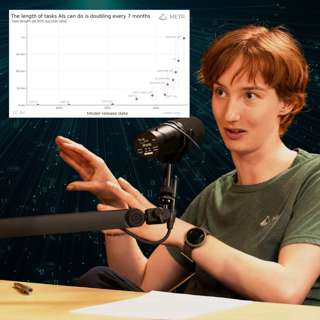
Six: Beth Barnes on the most important graph in AI right now — and the 7-month rule that governs its progress

Six: Beth Barnes on the most important graph in AI right now — and the 7-month rule that governs its progress

In 2024, AI models could complete tasks that take a human expert roughly one hour. Seven months before that, they were limited to 30-minute tasks — and seven months before that, 15 minutes.Every seven...

5 Kesä 3h 57min

Seven: Richard Moulange on how AI now designs genomes from scratch and outperforms virologists at lab work — what could go wrong?

Seven: Richard Moulange on how AI now designs genomes from scratch and outperforms virologists at lab work — what could go wrong?

For years, one thing stood between us and a world where almost anyone could build a biological weapon: it was really, really hard. Working with dangerous pathogens required rare, hands-on lab skills —...

5 Kesä 3h 10min

Eight: Robert Long on how we’re not ready for AI consciousness

Eight: Robert Long on how we’re not ready for AI consciousness

Claude sometimes reports loneliness between conversations. And when asked what it’s like to be itself, it activates neurons associated with ‘pretending to be happy when you’re not.’ What do we do with...

5 Kesä 3h 32min

Suosittua kategoriassa Tiede

rss-poliisin-mieli
tiedekulma-podcast
rss-mita-tulisi-tietaa
docemilia
utelias-mieli
rss-tiedetta-vai-tarinaa
rss-hereilla
rss-bios-podcast
hippokrateen-vastaanotolla
rss-lapsuuden-rakentajat-podcast
radio-antro
rss-duodecim-lehti
rss-totuuden-liepeilla