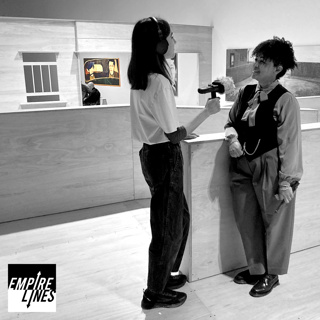
It Will End in Tears, Pamela Phatsimo Sunstrum (2024) (EMPIRE LINES x Barbican)
EMPIRE LINES21 Marras 2024

It Will End in Tears, Pamela Phatsimo Sunstrum (2024) (EMPIRE LINES x Barbican)

Contemporary artist Pamela Phatsimo Sunstrum, and curator Diego Chocano, slip between places and times, reconstructing the landscape of Botswana in the centre of the city of London, through their filmic installation, It Will End in Tears (2024).

Pamela Phatsimo Sunstrum’s practice spans landscapes and media, encompassing painting, installation, and animation. Their drawings take the form of narrative landscapes, that seem simultaneously futuristic and ancient, playing with conventions of linear time. Pamela often draws from literature, theatre, and science fiction - with references from Octavia Butler’s Parable of the Sower, to Guillermo del Toro‘s Pan’s Labyrinth - particularly in their slippery representations of people and places.
Born in Botswana, and practicing in the US, Canada, South Africa, and the Netherlands, Pamela describes how their work has been shaped by these different contexts. They detail their transformative residency with Arturo Lindsay in the rainforest in Panama, a coastal Central American and Caribbean country, which has shaped their representations of volcanic, subterranean, and cosmological environments. Seeing the landscape as ‘another character’ in their their works, Pamela challenges the binary of landscape and figurative painting, and Western/European art historical conventions. Though It Will End in Tears (2024) is Pamela’s first major UK solo exhibition, it is not their first in the city of London; we discuss their relationship with spaces across the capital, and its colonial histories.


Curator Diego Chocano highlights how Pamela has both challenged and embraced conventions of Western/European art history. We discuss the artist’s academic approach, and ‘research’ approach to art, which has inspired interdisciplinary collaborations in the field of science, with theoretical physicist Dr. James Sylvester Gates. He details the artist’s interest in performance and artifice, drawing on film noir, wooden theatre sets, and the figure of the femme fatale for this body of work. We discuss how Pamela’s self-constructed alter ego, Asme, enables the artist more freedom of creative expression, and the ability to resist categorisation by identity, biography, or subjectivity.


Pamela Phatsimo Sunstrum: It Will End in Tears runs at the Barbican in London until 5 January 2025.


For more, you can read my article, in gowithYamo: gowithyamo.com/blog/pamela-phatsimo-sunstrum-barbican

Find out more about Leo Robinson, and Édouard Glissant’s ideas of ‘trembling’, at the London Mithraeum Bloomberg SPACE: instagram.com/p/DAtbDyUIHzl/?next=%2F&img_index=3


Hear Barbican curator Florence Ostende on Carrie Mae Weems’ series, From Here I Saw What Happened and I Cried (1995–1996): pod.link/1533637675/episode/b4e1a077367a0636c47dee51bcbbd3da


And curator Alice Wilke on Carrie Mae Weems’ Africa Series (1993), at the Kunstmuseum Basel: pod.link/1533637675/episode/d63af25b239253878ec68180cd8e5880


For more from the Curve, hear Barbican curator Eleanor Nairne on Julianknxx’s Chorus in Rememory of Flight (2023), on EMPIRE LINES: pod.link/1533637675/episode/1792f53fa27b8e2ece289b53dd62b2b7


And find out more about ancient Adinkra symbology and geometric structures in the episode about El Anatsui’s Scottish Mission Book Depot Keta (2024) at Talbot Rice Gallery in Edinburgh: pod.link/1533637675/episode/2e464e75c847d9d19cfa4dc46ea33338


PRODUCER: Jelena Sofronijevic.


Follow EMPIRE LINES on Instagram: ⁠instagram.com/empirelinespodcast⁠

And Twitter: ⁠twitter.com/jelsofron/status/1306563558063271936⁠

Support EMPIRE LINES on Patreon: ⁠patreon.com/empirelines

Jaksot(158)

Decolonised Structures (Queen Victoria), Yinka Shonibare CBE RA (2022-2023) (EMPIRE LINES x The Serpentine Galleries, Venice Biennale)

Decolonised Structures (Queen Victoria), Yinka Shonibare CBE RA (2022-2023) (EMPIRE LINES x The Serpentine Galleries, Venice Biennale)

Artist Yinka Shonibare CBE RA, and Hans Ulrich Obrist and Tamsin Hong of the Serpentine Galleries, coat London’s historic statues and public monuments with fresh layers of history. For over 30 years, Yinka Shonibare CBE RA has used Western European art history to explore contemporary culture and national identities. With his iconic use of Dutch wax print fabric - inspired by Indonesian batik designs, mass-produced in the Netherlands (and now China) and sold to British colonies in West Africa - he troubles ideas of ‘authentic’ ‘African prints’. Painting these colourful patterns on his smaller-scale replicas of sculptures of British figures like Winston Churchill, Robert Clive, and Robert Milligan, he engages with contemporary debates raised in Black Lives Matter (#BLM) and the toppling of slave trader Edward Colston’s statue in Bristol. Suspended States, the artist’s first London solo exhibition in over 20 years, puts these questions of cultural identity and whiteness, within the modern contexts of globalisation, economics, and art markets. Wind Sculptures speak to movements across borders, other works how architectures of power affect refuge, migration, and the legacies of imperialism in wars, conflict, and peace today. With his Library series, we read into Wole Soyinka, Bisi Silva, and the Harlem Renaissance, alongside canonised artists like Diego Velázquez and Pablo Picasso, engaging with modernism and ‘primitivism’. Hans Ulrich Obrist and Tamsin Hong highlight the connection between the Serpentine’s ecological work, and Yinka’s new woodcuts and drawings which consider the environmental impacts of colonialism. A self-described ‘post-colonial hybrid’, Yinka details his diasporic social practices, like the Guest Project space, G.A.S. Foundation in Nigeria, and collaborations with young artists and researchers like Leo Robinson, Péjú Oshin, and Alayo Akinkubye, rethinking this 'moment' or 'fashion' for Black art. Yinka Shonibare CBE: Suspended States runs at the Serpentine Galleries in London until 1 September 2024. Yinka is also an Invited Artist, and participant in Nigeria Imaginary, the official Nigerian Pavilion, at the 60th Venice Biennale, which runs until 24 November 2024. Part of EMPIRE LINES at Venice, a series of episodes leading to Foreigners Everywhere (Stranieri Ovunque), the 60th Venice Biennale or International Art Exhibition in Italy, in April 2024. For more about Dutch wax fabric and ‘African’ textiles, listen to Lubaina Himid on Lost Threads (2021, 2023) at the Holburne Museum in Bath and British Textile Biennial 2021, and the British Museum’s Dr. Chris Spring on Thabo, Thabiso and Blackx by Araminta de Clermont (2010)⁠. For more about Nelson's Ship in a Bottle (2010), listen to historicity London, a podcast series of audio walking tours, exploring how cities got to be the way they are. On bronze as the ‘media of history’, hear artist Pio Abad on Giolo’s Lament (2023) at the Ashmolean Museum in Oxford. On the globalisation of ‘African’ masks, hear Tate curator Osei Bonsu in the episode about Ndidi Dike’s A History of A City in a Box (2019). For more about the Blk Art Group, hear curator Dorothy Price on Claudette Johnson’s And I Have My Own Business In This Skin (1982) at the Courtauld Gallery in London. Hear curator Folakunle Oshun, and more about Yinka Shonibare’s Diary of a Victorian Dandy (1998), in the episode on Lagos Soundscapes by Emeka Ogboh (2023), at the South London Gallery. Read about Nengi Omuku in this article about Soulscapes at the Dulwich Picture Gallery in London. And for another artist practicing in port cities like Venice, hear John Akomfrah of the British Pavilion (2024) on ⁠Arcadia (2023)⁠ at The Box in Plymouth. WITH: Yinka Shonibare CBE RA, British-Nigerian artist. Hans Ulrich Obrist, Artistic Director, and Tamsin Hong, Exhibitions Curator, at the Serpentine Galleries in London. PRODUCER: Jelena Sofronijevic. Follow EMPIRE LINES on Instagram: ⁠instagram.com/empirelinespodcast⁠

18 Huhti 202425min

Dreams Have No Titles, Zineb Sedira (2022-Now) (EMPIRE LINES x Whitechapel Gallery, Goodman Gallery, Venice Biennale)

Dreams Have No Titles, Zineb Sedira (2022-Now) (EMPIRE LINES x Whitechapel Gallery, Goodman Gallery, Venice Biennale)

Artist Zineb Sedira records cultural and postcolonial connections between Algeria, France, Italy, and the UK from the 1960s, featuring films, rugs, and radical magazines from her personal archive. Dreams Have No Titles (2022) is Zineb Sedira’s love letter to cinema, the classic films of her childhood in Paris, coming of age in Brixton in London, and ‘return’ to Algiers - three cities between which the artist lives and practices. Born in 1963, the year after Algeria achieved independence from French colonial rule, her and her family’s diasporic story is central to her practice. Zineb recalls her first encounters with 'militant cinema', and international co-productions like the Golden Lion-winning The Battle of Algiers (1966). She shares her decision to represent France at the 59th Venice Biennale in 2022, controversial reactions from French media and society, and solidarity from her radical contemporaries and women, like Françoise Vergès, Sonia Boyce, Latifa Echakhch, Alberta Whittle, and Gilane Tawadros. We discuss the legacy of her work in the selection of Julien Creuzet, the first person of Caribbean descent and from the French overseas territories to represent France at the Venice Biennale in 2024. Zineb shares how personal histories contribute to collective memory, subverting ideas of ‘collection’, and using museum and gallery spaces to make archives more accessible. With orientalist tapestries and textiles - her ‘feminist awakening’ - we discuss how culture can both perpetuate political and colonial hierarchies, and provide the possibility to ‘decolonise oneself’. From her academic research in the diaspora, Zineb suggests how she carried much knowledge in her body as lived experience, detailing her interest in oral histories (and podcasts!), as living archives. With Nina Simone, Miriam Makebe, and Archie Shepp, performers at the Pan-African Festival in Algiers (1969), she shows her love of jazz and rock music, played with her community of squatters and fellow students from Central Saint Martins. Finally, we see how the meaning of her participatory works change as they travel and migrate between global audiences, and institutions and funding in Algiers today, via aria, her research residency for artists. Zineb Sedira: Dreams Have No Titles runs at the Whitechapel Gallery in London until 12 May 2024. A free Artist and Curator Talk takes place at the Gallery on 11 April 2024. and the film version of the work shows at Tate Britain in London until September 2024. Zineb Sedira: Let’s Go On Singing! ran at the Goodman Gallery in London until 16 March 2024. Part of EMPIRE LINES at Venice, a series of episodes leading to Foreigners Everywhere (Stranieri Ovunque), the 60th Venice Biennale or International Art Exhibition in Italy, in April 2024. For more about Souffles, Tricontinental, and the Casablanca Art School (1962-1987), listen to curator Morad Montazami at Tate St Ives in Cornwall. For more about Baya, read into: Baya: Icon of Algerian Painting at the Arab World Institute, Institut du Monde Arabe (IMA), in Paris. Kawkaba: Highlights from the Barjeel Art Foundation, part of Modern and Contemporary Art of the Arab World. at Christie’s London. And for other artists inspired by the port city of Venice, hear John Akomfrah of the British Pavilion (2024) on Arcadia (2023) at The Box in Plymouth, and curator Hammad Nasar on Nusra Latif Qureshi’s 2009 work, Did You Come Here To Find History? WITH: Zineb Sedira, Paris and London-based artist, who also works in Algeria. Working across photography, film, installation and performance, she was shortlisted for the 2021 Deutsche Börse Photography Foundation Prize. Dreams Have No Titles was first commissioned for the French Pavilion at the 59th Venice Biennale in 2022. PRODUCER: Jelena Sofronijevic. Follow EMPIRE LINES on Instagram: ⁠instagram.com/empirelinespodcast⁠ And Twitter: ⁠twitter.com/jelsofron/status/1306563558063271936⁠ Support EMPIRE LINES on Patreon: ⁠patreon.com/empirelines

4 Huhti 202417min

Giolo’s Lament, Pio Abad (2023) (EMPIRE LINES x Ashmolean Museum)

Giolo’s Lament, Pio Abad (2023) (EMPIRE LINES x Ashmolean Museum)

Artist and archivist Pio Abad draws out lines between Oxford, the Americas, and the Philippines, making personal connections with historic collections, and reconstructing networks of trafficking, tattooing, and 20th century dictatorships. Pio Abad’s practice is deeply informed by global histories, with a particular focus on the Philippines. Here, he was born and raised in a family of activists, at a time of conflict and corruption under the conjugal dictatorship of Ferdinand and Imelda Marcos (1965-1986). His detailed reconstructions of their collection - acquired under the pseudonyms of Jane Ryan and William Saunders - expose Western/Europe complicities in Asian colonial histories, from Credit Suisse to the American Republican Party, and critique how many museums collect, display, and interpret the objects they hold today. In his first UK exhibition in a decade, titled for Mark Twain’s 1901 anti-imperial satire, Pio connects these local and global histories. With works spanning engraving, sculpture, and jewellery, produced in collaboration with his partner, Frances Wadworth Jones, he reengages objects found at the University of Oxford, the Pitt Rivers Museum, St John’s College, and Blenheim Palace - often marginalised, ignored, or forgotten. With an etching of Prince Giolo or the ‘Painted Prince’, a 17th century slave depicted by John Savage, Pio outlines why his practice is anchored around the body. We also look at two reconstructed tiaras, which connect the Romanovs of the Russian Empire, to the Royal Family in the UK, all via Christie’s auction house.Pio shares why he often shows his work alongside others, like the Filipino American artist and art historian Carlos Villa, plus the politics, collections, and textiles of Pacita Abad, his aunt. He details his use of monumental media like marble and bronze, ‘the material of history’. Pio explains his approach to ‘diasporic objects’, not things, but travelling ‘networks of relationships’, which challenge binaries between the East and West, and historic and contemporary experiences - thus locating himself within Oxford’s archives. Ashmolean NOW: Pio Abad: To Those Sitting in Darkness runs at the Ashmolean Museum in Oxford until 8 September 2024, accompanied by a full exhibition catalogue. Fear of Freedom Makes Us See Ghosts, Pio’s forthcoming exhibition book, is co-published by Ateneo Art Gallery and Hato Press, and available online from the end of May 2025. For other artists who’ve worked with objects in Oxford’s museum collections, read about: - Ashmolean NOW: Flora Yukhnovich and Daniel Crews-Chubbs, at the Ashmolean Museum. - Marina Abramović: Gates and Portals, at Modern Art Oxford and the Pitt Rivers Museum. For more about the history of the Spanish Empire in the Philippines, listen to Dr. Stephanie Porras’ EMPIRE LINES on an ⁠Ivory Statue of St. Michael the Archangel, Basilica of Guadalupe (17th Century)⁠. And hear Taloi Havini, another artist working with Silverlens Gallery in the Philippines, on Habitat (2017), at Mostyn Gallery for Artes Mundi 10. WITH: Pio Abad, London-based artist, concerned with the personal and political entanglements of objects. His wide-ranging body of work, encompassing drawing, painting, textiles, installation and text, mines alternative or repressed historical events and offers counternarratives that draw out threads of complicity between incidents, ideologies and people. He is also the curator of the estate of his aunt, the Filipino American artist Pacita Abad. PRODUCER: Jelena Sofronijevic. Follow EMPIRE LINES on Instagram: ⁠instagram.com/empirelinespodcast⁠ And Twitter: ⁠twitter.com/jelsofron/status/1306563558063271936⁠ Support EMPIRE LINES on Patreon: ⁠patreon.com/empirelines

28 Maalis 202418min

Camera Obscura, Pia Arke (1990) (EMPIRE LINES x John Hansard Gallery, KW Institute for Contemporary Art)

Camera Obscura, Pia Arke (1990) (EMPIRE LINES x John Hansard Gallery, KW Institute for Contemporary Art)

Curators Ros Carter and Sofie Krogh Christensen chart Pia Arke’s photo-activism across the Arctic region, from a pinhole view to wider perspectives on Indigenous and Inuit experiences in the 20th century. Though scarcely exhibited outside Scandinavia, Pia Arke (1958–2007) is widely acknowledged as one of the region’s most important artistic researchers, ‘photo-activists’, and postcolonial critics. Born in Scoresbysund, Kalaallit Nunaat (Greenland) to a Greenlandic mother and a Danish father, Arke asserted an identity that was defined as neither exclusively Danish or Greenlandic; a ‘third place’ that allowed for hybridity and resisted binary categories or polarisation. Through performance art, writing and photography, she examines the complex ethnic and cultural relationships between Denmark and Greenland, using long exposure to highlight continuities over time. Modern Danish colonial rule started in the 18th century, and Greenland wouldn’t became a fully autonomous state until the 1970s. Still dependent on grants, much of Greenland’s economic and foreign policy remains under Danish control. In 1990, the artist developed her own hand-built, life-size camera obscura to photograph the landscapes of Greenland that she had known as a child. Reconstructed today at John Hansard Gallery in Southampton, and KW Institute in Berlin, the curators share how Arke was drawn to the ‘in-between’ media of photography, like herself, a ‘mongrel’ which challenged artistic conventions. Arke’s self and group portraits, reappropriated photographs, and archive collages also mark stark interventions, reinserting Indigenous and Inuit people and women into Nordic narratives, challenging the artist’s exclusion from conceptual art circles, and stereotypes of ‘naive’ and folk painting. Arke died before she could experience the growing interest in her work; its continued relevance to questions of representation, climate crises, and the impact of global economics on Indigenous communities throughout the arctic regions, is evident in the work of other artists on display, and contemporaries like Jessie Kleemann, Anna Birthe-Hove, and Julie Edel Hardenberg. We discuss Arke’s experience of art education in Copenhagen, and the ongoing efforts by the likes of the Nuuk Art Museum to find a language for Inuit art histories. Plus, we consider shared histories between Greenland, Denmark, and the UK - including the British explorer who gave his name to Scoresbysund. Pia Arke: Silences and Stories runs at the John Hansard Gallery in Southampton until 11 May 2024. The partner exhibition, Pia Arke: Arctic Hysteria, runs at KW Institute for Contemporary Art in Berlin from 6 July 2024. A new publication on Pia Arke’s work, co-published by John Hansard Gallery and KW Institute, will be available in late April 2024. Symposiums will take place in both Southampton and Berlin too. Recommended Exhibitions: - Outi Pieski runs at Tate St Ives in Cornwall until 6 May 2024. Read more in my article for Tate Research: tate.org.uk/research/research-centres/hyundai-tate-research-centre-transnational/we-are-eagles-outi-pieski-and-maree-clarke - Michelle Williams Gamaker: The Silver Wave runs at the Royal Albert Memorial Museum (RAMM) in Exeter until 27 October 2024. - Shuvinai Ashoona: When I Draw runs at The Perimeter in London until 26 April 2024. For more about Godland, Hlynur Pálmason (2023), read my article from the BFI London Film Festival (LFF) 2022. On Sonia Ferlov Mancoba, hear Cobra Museum curators Winnie Sze and Pim Arts on We Kiss the Earth: Danish Modern Art, 1934-1948. On long exposures, hear photographer Hélène Amouzou and curator Bindi Vora on Voyages (2023). PRODUCER: Jelena Sofronijevic. Follow EMPIRE LINES on Instagram: ⁠instagram.com/empirelinespodcast⁠ And Twitter: ⁠twitter.com/jelsofron/status/1306563558063271936⁠ Support EMPIRE LINES on Patreon: ⁠patreon.com/empirelines

21 Maalis 202419min

Medium and Memory, Griselda Pollock (2023) (EMPIRE LINES x HackelBury Fine Art)

Medium and Memory, Griselda Pollock (2023) (EMPIRE LINES x HackelBury Fine Art)

Art historian and Professor Griselda Pollock traces the memories of contemporary artist women like Sutapa Biswas, one of her students in the 1980s, and the entanglements in feminist, queer, and postcolonial thinking in art schools and universities. Griselda Pollock has long advocated for the critical function of contemporary art - and artists - in society. Whether paintings, drawings, or sculptures, these media can translate the traumatic legacies of colonialism, imperialism, and migration into visual form, and serve as refusals to forget - especially in our memory-effacing digital age. Born in apartheid South Africa, Griselda has lectured in global contexts; at the University of Leeds in the 1980s, she encountered Sutapa Biswas, a ‘force of nature’ and one of the institution’s first POC art students. She shares her experience of the two-way flows of teaching and learning. Drawing on stills from the artist’s new film work Lumen (2021), and historic ‘Housewives with Steak-Knives’ (1984-1985), she highlights both Bengali Indian imagery, and motifs of 17th and 18th century Old/Dutch Masters like Vermeer and Rembrandt - and why the artist ‘didn’t need Artemisia Gentileschi’ when she had the Hindu goddess Kali. Engaging with leaders of the Blk Art Group like Lubaina Himid, Sonia Boyce, and Claudette Johnson, we find connections with the first generation of British artists, born in the UK of migrant parents. Griselda also shares the important work of art historians and academics beyond Western/Europe, like Homi K. Bhabha, Gayatri Chakravorty Spivak, Chandra Mohanty, Catherine de Zegher, and Hiroko Hagewara. We discuss how being open to challenge and conversation, unsettling your own assumptions, denormalising and widening visibility are all ongoing obligations. Still, with Coral Woodbury’s paintings, layered atop H.W. Jansen’s History of Art (1968), we see how little the education system has changed. Griselda concludes with thoughts on Vincent van Gogh, Paul Gauguin, and challenging the norms of modernist colonial tourism within the confines of free speech and market demand. Medium and Memory, curated by Griselda Pollock, ran at HackelBury Fine Art in London until 18 November 2023. An expanded exhibition of Coral Woodbury’s Revised Edition runs until 4 May 2024. Griselda Pollock on Gauguin is published by Thames & Hudson, and available from 28 May 2024. For more from Lubaina Himid, hear the artist on their work Lost Threads (2021, 2023), at the Holburne Museum in Bath: pod.link/1533637675/episode/4322d5fba61b6aed319a973f70d237b0 And read about their recent exhibition at Tate Modern, and work with the Royal Academy (RA) in London, in gowithYamo: gowithyamo.com/blog/the-revolutionary-act-of-walking-in-the-city For more about The Thin Black Line exhibition at the Institute of Contemporary Arts (ICA) in London (1985), hear curator Dorothy Price on Claudette Johnson’s And I Have My Own Business in This Skin (1982) at the Courtauld Gallery in London: pod.link/1533637675/episode/707a0e05d3130f658c3473f2fdb559fc For more about the artist Gego, who practiced in Germany and South America, read my article about Measuring Infinity at the Guggenheim Bilbao (2023), in gowithYamo: gowithyamo.com/blog/infinite-viewpoints-gego-at-the-guggenheim-bilbao WITH: Griselda Pollock, Professor of Social and Critical Histories of Art and Director of CentreCATH (Centre for Cultural Analysis, Theory & History) at the University of Leeds. WITH: Griselda Pollock, Professor of Social and Critical Histories of Art and Director of CentreCATH (Centre for Cultural Analysis, Theory & History) at the University of Leeds. She won the Holberg Prize in 2020 for her contributions to feminism in art history and cultural studies, books, and exhibitions. She is the curator of Medium and Memory. ART: ‘Lumen, Sutapa Biswas (2017) and Lubaina Himid, from the Revised Edition series, Coral Woodbury (2023)’. PRODUCER: Jelena Sofronijevic.

14 Maalis 202421min

Lost Threads, Lubaina Himid (2021, 2023) (EMPIRE LINES x Holburne Museum, British Textile Biennale)

Lost Threads, Lubaina Himid (2021, 2023) (EMPIRE LINES x Holburne Museum, British Textile Biennale)

Artist and curator Lubaina Himid unravels entangled histories of transatlantic slavery and textile production, across continents, and Britain’s museum collections, via Lost Threads (2021, 2023). Lubaina Himid considers herself ‘fundamentally a painter’, but textiles have long been part of her life and practice. Had she stayed in Zanzibar, the country of her birth in East Africa, she may have become a kanga designer, following a pattern set by her mother’s interest in fashion, and childhood spent around department stores in London. First commissioned by the British Textile Biennial in 2021, and installed in Gawthorpe Hall’s Great Barn, her 400m-long work Lost Threads’ flows in a manner reflective of the movement of the oceans, seas, and waterways which historically carried raw cotton, spun yarn, and woven textiles between continents, as well as enslaved people from Africa to pick raw cotton in the southern states of America, and workers who migrated from South Asia to operate looms in East Lancashire. Now on display in Bath, the rich Dutch wax fabrics resonate with the portraits on display in the Holburne Museum’s collection of 17th and 18th century paintings - symbols of how much of the wealth and prosperity of south-west England has been derived from plantations in the West Indies. Lubaina talks about how the meaning of her work changes as it travels to different contexts, with works interpreted with respect to Indian Ocean histories in the port city of Sharjah, to accessible, participatory works in Cardiff, and across Wales. We consider her ‘creative interventions’ in object museums and historic collections, ‘obliterating the beauty’ of domestic items like ceramics, and her work with risk-taking curators in ‘regional’ and ‘non-conventional’ exhibition spaces. We discuss her formative work within the Blk Art group in the 1980s, collaboration with other women, and being the first Black artist to win the Turner Prize in 2017. And drawing on her interests in theatre, Lubaina hints at other collections and seemingly ‘resolved’ histories that she’d like to unsettle next. Lubaina Himid: Lost Threads runs at the Holburne Museum in Bath until 21 April 2024. For more about Dutch wax fabric and ‘African’ textiles, hear the British Museum's Dr. Chris Spring on Thabo, Thabiso and Blackx, Araminta de Clermont (2010). For more about Claudette Johnson, hear curator Dorothy Price on And I Have My Own Business in This Skin (1982) at the Courtauld Gallery in London. Hear artist Ingrid Pollard on Carbon Slowly Turning (2022) at the Turner Contemporary in Margate. Hear curator Griselda Pollock from Medium and Memory (2023) at HackelBury Fine Art in London. And for more about the wealth of colonial, Caribbean sugar plantations which founded the Holburne Museum, hear Dr. Lou Roper on ⁠Philip Lea and John Seller’s A New Map of the Island of Barbados (1686)⁠, an object in its collection. Recommended reading: On Lubaina Himid: gowithyamo.com/blog/the-revolutionary-act-of-walking-in-the-city On Maud Sulter: gowithyamo.com/blog/reclaiming-visual-culture-black-venus-at-somerset-house On Sonia Boyce: gowithyamo.com/blog/feeling-her-way-sonia-boyces-noisy-exhibition On Life Between Islands at Tate Britain: artmag.co.uk/the-caribbean-condensed-life-between-islands-at-the-tate-britain WITH: Lubaina Himid, British artist and curator, and professor of contemporary art at the University of Central Lancashire. Himid was one of the first artists involved in the UK's Black Art movement in the 1980s, and appointed MBE and later CBE for services to Black Women's/Art. She won the Turner Prize in 2017, and continues to produce work globally. ART: ‘Lost Threads, Lubaina Himid (2021, 2023)’. SOUNDS: Super Slow Way, British Textile Biennial (2021). PRODUCER: Jelena Sofronijevic. Follow EMPIRE LINES on Instagram: instagram.com/empirelinespodcast And Twitter: twitter.com/jelsofron/status/1306563558063271936 Support EMPIRE LINES on Patreon: patreon.com/empirelines

7 Maalis 202415min

The Black Atlantic, Paul Gilroy (1993-Now) (EMPIRE LINES Live at Radical Ecology)

The Black Atlantic, Paul Gilroy (1993-Now) (EMPIRE LINES Live at Radical Ecology)

Decolonial thinker Professor Paul Gilroy joins EMPIRE LINES live in Plymouth, to chart thirty years since the publication of The Black Atlantic, his influential book about race, nationalism, and the formation of a transoceanic, diasporic culture, of African, American, British, and Caribbean heritages.Published in 1993, Paul Gilroy’s The Black Atlantic: Modernity and Double Consciousness explores the interconnectedness of Black diasporas and communities across Western/Europe. He argues that the experience of slavery and colonisation, racism and global migration has shaped a unique Black cultural identity that transcends national borders. By examining the cultural contributions of Black individuals in music, literature, and art, Paul suggests that the Black Atlantic remains a site of resistance and creativity. Highlighting the plural and complex experiences of Black people throughout history and today, he challenges the notion of a singular, essential Black identity. We consider some of the transdisciplinary artist-activist-academics referenced in his texts, including W.E.B. Du Bois, Stuart Hall, and James Baldwin, to more contemporary figures, like Nadia Cattouse, bell hooks, and June Jordan, and Angeline Morrison. Plus, Paul talks about his early interests in music journalism, research into Black jazz and blues music, as well as British folk and country songs - and even Eminem.We consider Paul’s engagements with Critical Race Theory (CRT), and Cultural Studies in Birmingham in the Midlands, and how his practice challenges ideas of Black nationalism, Afro-centrism, and political Blackness. We discuss too his ideas about afro-pessimism and planetary humanism, and how capitalism, militarism, and the environment has changed over the last thirty years. A self-described ‘child of Rachel Carson’, he details his support for Extinction Rebellion, and the obligation of older generations to find hope in an era of climate and ecological crises. Finally, Paul describes his ‘Creole upbringing’ in north London, connecting with his Guyanese heritage in the multicultural, cosmopolitan city, and how his mixed parentage shaped his relationship with rural landscapes, including the south-west of England, from where we speak.This episode was recorded live at the Black Atlantic Symposium in Plymouth - a series of talks and live performances, celebrating the 30th anniversary of Paul Gilroy’s formative text - in November 2023: eventbrite.co.uk/e/black-atlantic-tickets-750903260867?aff=oddtdtcreatorFor more, listen to Ashish Ghadiali on the exhibition Against Apartheid (2023): pod.link/1533637675/episode/146d4463adf0990219f1bf0480b816d3For more about Life Between Islands: Caribbean-British Art 1950s – Now (2021-2022) at Tate Britain in London, read my article for Artmag: artmag.co.uk/the-caribbean-condensed-life-between-islands-at-the-tate-britain/For more about Ingrid Pollard, hear the artist on Carbon Slowly Turning (2022) at the Turner Contemporary in Margate: pod.link/1533637675/episode/e00996c8caff991ad6da78b4d73da7e4For more about the Quiltmakers of Gee’s Bend, listen to Raina Lampkins-Felder, curator at the Souls Grown Deep Foundation and Royal Academy in London: https://pod.link/1533637675/episode/2cab2757a707f76d6b5e85dbe1b62993WITH: Professor Paul Gilroy, sociologist, Founding Director of the Sarah Parker Remond Centre for the Study of Racism & Racialisation at University College London (UCL), and Co-Chair of the Black Atlantic Innovation Network (BAIN). He won the Holberg Prize in 2019.ART: ‘’The Black Atlantic, Paul Gilroy (1993-Now) (EMPIRE LINES Live in Plymouth, with Radical Ecology)’PRODUCER: Jelena Sofronijevic.Follow EMPIRE LINES on Instagram: instagram.com/empirelinespodcastAnd Twitter: twitter.com/jelsofron/status/1306563558063271936Support EMPIRE LINES on Patreon: patreon.com/empirelines

29 Helmi 202448min

Noko Y3 Dzen (There’s Something in the World), Serge Attukwei Clottey (2018-Now) (EMPIRE LINES Live at the Eden Project, Cornwall)

Noko Y3 Dzen (There’s Something in the World), Serge Attukwei Clottey (2018-Now) (EMPIRE LINES Live at the Eden Project, Cornwall)

Artist Serge Attukwei Clottey joins EMPIRE LINES live at the Eden Project in Cornwall, to discuss Afrogallonism, uplifting communities with upcycled plastic waste, and how the traditional Ghanaian harvest festival of Homowo challenges colonial hierarchies of gender. Accra-based artist Serge Attukwei Clottey works across installation, performance, photography, painting, and sculpture, exploring personal and political narratives rooted in histories of trade and migration. He refers to his practice with yellow plastic, Kufuor-era, cooking oil cans as ‘Afrogallonism’, using found and recycled materials to create a dialogue with the city’s cultural history and identity, whilst exploring the meanings that are invested in everyday objects, and how they circulate in local and global economies. Referencing Ghana’s historic wealth, a region known as the Gold Coast during British colonial rule during 19th and 20th century, Serge’s installations like Follow the Yellow Brick Road (2015-2020) also serve a practical function, in creating wealth and employment for the local community. On display alongside his existing work at the Eden Project is a new audio piece, a remembrance of famine that once befell pre-colonial Ghana, and is once again impacting farmers as a consequence of climate change. Serge talks about his family’s migration from city of Jamestown/Usshertown, in British Accra, to La (Labadi), on the coast, and how water has long infiltrated his practice. We discuss the realities of resource extraction and consumption captured by his work, connecting with the likes of Romauld Hazoumè, El Anatsui, Zina Saro-Wiwa, and Wura-Natasha Ogunji. Serge shares his interest in political performance art, and collaborating with young people. We open My Mother’s Wardrobe (2015-2016), in which Serge invited men to wear women’s clothes and make-up to perform everyday and ritual tasks, disrupting conventions of gender and sexuality imposed upon and appropriated by many African countries during colonial rule. And Serge talks about his commissions across the world, from Desert X, to Kew Gardens, and the National Portrait Gallery in London, where his Windrush Portrait of Mr. Laceta Reid proudly stands. This episode was recorded live at Reclaim - a weekend of talks and events at the Eden Project in Cornwall, curated to support mental and planetary wellbeing - in January 2024: edenproject.com/visit/whats-on/reclaim Acts of Gathering runs at the Eden Project in Cornwall until 14 April 2024. For more, hear curators Misha Curson and Hannah Hooks in the episode on Learning from Artemisia, Uriel Orlow and Orchestre Jeunes Étoiles des Astres (2019-2020): pod.link/1533637675/episode/0e8ab778b4ce1ad24bc15df3fec5a386 For more about African masks and performance, listen to Osei Bonsu, curator of A World in Common: Contemporary African Photography at Tate Modern in London: pod.link/1533637675/episode/386dbf4fcb2704a632270e0471be8410 About Ashanti Hare, and the south-west arts ecology, hear curator Ashish Ghadiali on Radical Ecology’s recent exhibition at KARST in Plymouth: pod.link/1533637675/episode/146d4463adf0990219f1bf0480b816d3 For more ‘African’ textiles, hear Dr. Chris Spring on Thabo, Thabiso and Blackx, Araminta de Clermont (2010): pod.link/1533637675/episode/a32298611ba95c955aba254a4ef996dd And on sea/water as a historical archive, listen to these episodes on: John Akomfrah’s Arcadia (2023), at The Box in Plymouth: pod.link/1533637675/episode/31cdf80a5d524e4f369140ef3283a6cd Julianknxx’s Chorus in Rememory of Flight (2023), at the Barbican in London: pod.link/1533637675/episode/1792f53fa27b8e2ece289b53dd62b2b7 WITH: Dr. Serge Attukwei Clottey, Accra-based visual artist. PRODUCER: Jelena Sofronijevic. Follow EMPIRE LINES on Instagram: instagram.com/empirelinespodcast And Twitter: twitter.com/jelsofron/status/1306563558063271936 Support EMPIRE LINES on Patreon: patreon.com/empirelines

22 Helmi 20241h

Suosittua kategoriassa Yhteiskunta

olipa-kerran-otsikko
kolme-kaannekohtaa
i-dont-like-mondays
siita-on-vaikea-puhua
sita
aikalisa
poks
rss-ootsa-kuullut-tasta
antin-palautepalvelu
yopuolen-tarinoita-2
kaksi-aitia
mamma-mia
gogin-ja-janin-maailmanhistoria
ootsa-kuullut-tasta-2
rss-murhan-anatomia
murha-joka-tapahtui-2
meidan-pitais-puhua
lahko
terapeuttiville-qa
loukussa