Exploring Ant Financial’s Cloud-Native Journey with Haojie Hang

Exploring Ant Financial’s Cloud-Native Journey with Haojie Hang

Some highlights of the show include

  • The challenges of operating digital commerce at scale, including the need for resource pooling and resiliency — and how this caused Ant Financial to re-think their infrastructure.
  • Ant Financial’s former approach to scaling, which was mostly manual, and highly resource-intensive.
  • How Kubernetes is expediting cloud development for Ant Financial.
  • Haojie’s thoughts on the global engineering skills gap, and China’s growing cloud computing market including driving factors and barriers.
  • Why Ant Financial’s migration has largely been a success — and why achieving operational security is now a top priority for the company.
  • How Ant Financial is managing disconnect between its engineers and business leaders.
  • The company’s ongoing mission to migrate its systems and applications away from legacy architectures.


Links


Transcript


Announcer: Welcome to The Business of Cloud Native podcast where we explore how end users talk and think about the transition to Kubernetes and cloud-native architectures.


Emily: So, I always start the same way. Can you introduce yourself?


Haojie: Hey, my name is Haojie Hang. I'm a product manager in the CTO office at Ant Financial. I work on the product and strategy side for, basically, the CTO and the other executive leaders, as well as leading a small product teams within the org to look at the frontier technology in the cloud and other infrastructure businesses.


Emily: And can you tell me a little bit more about what Ant Financial does? And then, also, what do you do on a day to day basis? What do you do when you get into the office?


Haojie: Yeah, I'll do a quick introduction about the Ant Financial business. It's not just one business or two business, it's a group of businesses that we innovate and we do, mostly in China, but we're also expanding very rapidly all over the world. So, Ant Financial is basically a group of businesses including credit for both consumers and the enterprise, as well as loan businesses, both consumer and enterprise businesses. We say that the parent organization is basically, we call it Alipay, it’s the earliest business we do since 2004 when the business was basically born from Taobao, which is our parent company. So, in short, the Ant Financial Business has a lot of presence in the business of payments business, remittance, credit card, loans, securities, and many other businesses like intelligent technology, blockchain, pretty much everything you can imagine in the FinTech and financial services, we’re in there.


Emily: Tell me a little bit more about the cloud-native journey for Ant Financial. When did it start? Why did it start? What was some of the motivations behind moving to cloud-native?


Haojie: Yeah, it's actually quite interesting. I joined Ant Financial in 2008, but actually, the entire company started to look at cloud-native technology quite early, in 2012. So, back then, people were just looking at these technologies around the world, mostly from the US, they look at this open-source community, look at what other companies are doing, how to use the cloud-native technology to help with their business in the peak time, so during event. There’s online promotion event we're doing every year, called Double 11—Shuāng shíyī in Chinese. Every year, so we have a large amount of promotional events happening online, trying to help merchants and the customer is trying to sell and buy stuff in our Tmall and Taobao platform in very, very discounted price. So, for that promotion event online, we have to think about the resilience, the resource pooling, oftentimes the visits has to increase multiple times, sometimes over 100 times the increase compared to the normal time. So in that case, we have to think about how we can be very resilient and efficient infrastructure to support that business needs. So, this is a very large topic. And then, back then, there was a lot of focus and study in our cloud computing department. So, we started looking at this technology called Mesos in 2012. And then, we do a lot of experiments around this technology, but from the business perspective, it's still hard to justify the benefits of moving to Mesos completely. So, we have multiple teams doing a lot of research in Mesos, in Kubernetes, sometimes in our own technology stack, but there's not enough proof or enough confidence for us to move completely over to that technology, until the emergence of Docker container, this Docker technology. Then we started to look at our container infrastructure, really do the investigation around this technology, and understand why this is taking over so quickly over the world, from the business perspective, and from the technology perspective. If you look at the community of Docker, the thing does not really happen until 2015. But we are already in the game for about a year or two. So, we're actually quite happy about our original strategy, but it's just in terms of the research. We're actually a little bit behind in terms of moving to this cloud-native architecture. But as you can see, that I had an interview with CNCF. So, we are very happy about the results that we have right now. Pretty much the entire architecture we run within Ant Financial is, basically, on Kubernetes ecosystem. It's not just using the open-source version of it. We're doing a lot of customization around this open-source framework. Yeah, I can talk more about the details.


Emily: Yeah. Well, let's back up just a little bit. I’m curious what you were doing to manage this scaling before? And how did that change? And what about the whole process changed? Like, how stressful is it now, compared to before?


Haojie: The process was very manual, I would say. We have extremely large team of engineers, and DevOps, security teams. And oftentimes their responsibility are overlap. So, some engineers are doing security work, some engineers are doing basically operational work. I would say, some people really hated it because they have to be on the computer, look at monitor 24/7, making sure transactions succeeded. When the peak time happens, there's nothing wrong with it. Sometimes they have to keep their phone open 24/7, basically to make sure this thing will not fail, right? And then, just many parts of work has to—so in the previous way, the way we do this operation is quite manual. We don't have a mature system or methodology telling us what we should do first, we should do second, and what's what would you do after this. So, basically the collaboration chain was not there. Therefore, when issue happens, our operation team has to respond very quickly. But then, how can we quickly identify the problem, and make it a problem? That's a problem, right? So, we have to make sure every time we respond, we respond in a very effective manner. That's the problem. In the previous process when something unexpected happen, who had to engage with the entire team from product, engineering, operation, security, everybody has to get up and look at the problem together, which was quite inefficient. So, after we moved to this cloud-native architecture—it's not the standard cloud architect, it's, kind of—we have a lot of innovation on...

Tämä jakso on lisätty Podme-palveluun avoimen RSS-syötteen kautta eikä se ole Podmen omaa tuotantoa. Siksi jakso saattaa sisältää mainontaa.

Jaksot(275)

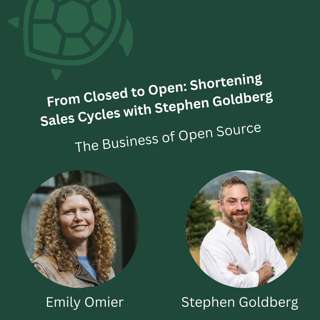
From Closed to Open: Shortening Sales Cycles with Stephen Goldberg

From Closed to Open: Shortening Sales Cycles with Stephen Goldberg

This week on The Business of Open Source, I chatted with Stephen Goldberg, co-founder of Harper, about the process of taking Harper from a closed-source software company to a open source company. I al...

6 Heinä 33min
Does AI Make Open Core Models More Difficult? with Sam Alba

Does AI Make Open Core Models More Difficult? with Sam Alba

Today on The Business of Open Source I spoke with Sam Alba, co-founder of Mendral, formerly of Dagger, and the first hire at Docker. We talked a lot about about how AI is changing the developer tools ...

2 Heinä 39min
Closed to Open Source Series: Doing Open Source "Right" with Ethan Arrowood

Closed to Open Source Series: Doing Open Source "Right" with Ethan Arrowood

One of the myths that swirl around the open source company ecosystem is that all open source companies started as an open source project that then suddenly got traction, and followed by the founders f...

22 Kesä 40min
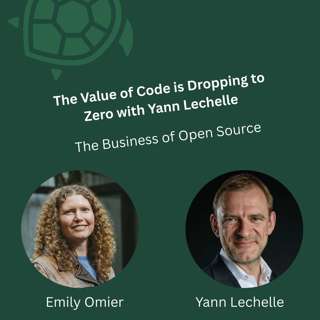
The Value of Code is Dropping to Zero with Yann Lechelle

The Value of Code is Dropping to Zero with Yann Lechelle

In this episode of The Business of Open Source, I talked with Yann Lechelle, Executive President of :Probabl.Perhaps the most interesting part of the conversation was about whether or not there is a r...

15 Kesä 42min

Why the World Needs the Agentic AI Foundation with Manik Surtani

Why the World Needs the Agentic AI Foundation with Manik Surtani

In this episode of The Business of Open Source, I spoke with Manik Surtani, one of the co-founders of the Agentic AI Foundation and the CTO at the foundation. This is part of the series I’m working on...

8 Kesä 34min

The AI-Induced Death of A Bug Bounty Program with Glauber Costa

The AI-Induced Death of A Bug Bounty Program with Glauber Costa

The Business of Open Source is back! I’m starting a series about AI and open source this week. I reached out to Glauber Costa, founder of Turso, after reading a post of his on LinkedIn about how bot-w...

1 Kesä 43min

Changing Your Price Anchor with Anais Concepcion

Changing Your Price Anchor with Anais Concepcion

There’s a new episode of The Business of Open Source today! It’s been a while. I talked with Anais Concepcion about a program she’s been testing at Grist to give free activation codes for the enterpri...

11 Helmi 32min

Earning Trust with Tom Hacohen

Earning Trust with Tom Hacohen

This week on The Business of Open Source, I spoke with Tom Hacohen, CEO and founder at Svix. We kicked off the conversation by talking about why Svix is an open core company… but Tom still initially d...

8 Loka 202535min

Suosittua kategoriassa Liike-elämä ja talous

sijotuskasti
psykopodiaa-podcast
mimmit-sijoittaa
ostan-asuntoja-podcast
rss-oivalluksia-rahasta-elamasta
rss-rahapodi
rahapuhetta
rss-sami-miettinen-neuvottelija
rss-rahamania
rss-markkinointitrippi
rss-inderes
syo-nuku-saasta
vapauta-supervoimasi-podcast
asuntoasiaa-paivakirjat
rss-kahavia-ja-markkinointia-podcast
rss-kaikki-koroista
rss-ammattipodcast
rss-stressivapaa-johtaja-nakokulmia-henkilokohtaiseen-kasvuun
rss-perho-rajoilla
rss-ainin-sekatoimisto