The Power of Aligning Engineering and Operations with Dave Mangot

The Power of Aligning Engineering and Operations with Dave Mangot

Some of the highlights of the show include:


  • The difference between cloud computing and cloud native.
  • Why operations teams often struggle to keep up with development teams, and the problems that this creates for businesses.
  • How Dave works with operations teams and trains them how to approach cloud native so they can keep up with developers, instead of being a drag on the organization.
  • Dave’s philosophy on introducing processes, and why he prefers to use as few as possible for as long as possible and implement them only when problems arise.
  • Why executives should strive to keep developers happy, productive, and empowered.
  • Why operations teams need to stop thinking about themselves as people who merely complete ticket requests, and start viewing themselves as key enablers who help the organization move faster.
  • Viewing wait time as waste.
  • The importance of aligning operations and development teams, and having them work towards the same goal. This also requires using the same reporting structure.


Links:

Transcript


Announcer: Welcome to The Business of Cloud Native podcast, where we explore how end users talk and think about the transition to Kubernetes and cloud-native architectures.


Emily: Welcome to The Business of Cloud Native. I'm your host, Emily Omier, and today I am chatting with Dave Mangot. And Dave is a consultant who works with companies on improving their web operations. He has experience working with a variety of companies making the transition to cloud-native and in various stages of their cloud computing journey. So, Dave, my first question is, can you go into detail about, sort of, the nitty-gritty of what you do?


Dave: Sure. I've spent my whole technical professional career mostly in Silicon Valley, after moving out to California from Maryland. And really, I got early into web operations working in Unix systems administration as a sysadmin, and then we all changed the names of all those things over the years from sysadmin to Technical Infrastructure Engineer, and then Site Reliability Engineer, and all the other fun stuff. But I've been involved in the DevOps movement, kind of, since the beginning, and I've been involved in cloud computing, kind of, since the beginning.


And so I'm lucky enough in my day job to be able to work with companies on their, like you said, transitions into Cloud, but really I'm helping companies, at least for their cloud stuff, think about what does cloud computing even mean? What does it mean to operate in a cloud computing manner? It's one thing to say, “We're going to move all of our stuff from the data center into Cloud,” but most people you'll hear talk about lift and shift; does that really the best way? And obviously, it's not. I think most of the studies will prove that and things like the State of DevOps report, and those other things, but really love working with companies on, like, what is so unique about the Cloud, and what advantages does that give, and how do we think about these problems in order to be able to take the best advantage that we can?


Emily: Dive into a little bit more. What is the difference between cloud computing and cloud-native? And where does some confusion sometimes seep in there?


Dave: I think cloud-native is just really talking about the fact that something was designed specifically for running in a cloud computing environment. To me, I don't really get hung up on those differences because, ultimately, I don't think they matter all that much. You can take memcached, which was designed to run in the data center, and you can buy that as a service on AWS. So, does that mean because it wasn't designed for the Cloud from the beginning, that it's not going to work? No, you're buying that as a service from AWS.


I think cloud-native is really referring to these tools that were designed with that as a first-class citizen. And there's times where that really matters. I remember, we did an analysis of the configuration management tools years back, and what would work best on AWS and things like that, and it was pretty obvious that some of those tools were not designed for the Cloud. They were not cloud-native. They really had this distinct feel that their cloud capabilities were bolted on much later, and it was clunky, and it was hard to work with, whereas some of the other tools, really felt like that was a very natural fit, like that was the way that they had been created. But ultimately, I think the differences aren't all that great, it just, really, matters how you're going to take advantage of those tools.


Emily: And with the companies that you work with, what is the problem or problems that they are usually facing that lead them to hire you?


Dave: Generally the question, or the statement, I guess, that I get from the CIOs and CTOs, and CEOs is, “My production web operations team can't keep up with my development teams.” And there's a lot of reasons why those kinds of things can happen, but with the dawn of all these cloud-native type things, which is pretty cool, like containers, and all this other stuff, and CI/CD is a big popular thing now, and all kinds of other stuff. What happens, tends to be is the developers are really able to take advantage of these things, and consume them, and use them because look at AWS. AWS is API, API, API. Make an API call for this, make an API call for that.


And for developers, they're really comfortable in that environment. Making an API call is kind of a no brainer. And then a lot of the operations teams are struggling because that's not normal for them. Maybe they were used to clicking around in a VMware console, and now that's not a thing because everything's API, API, API. And so what happens is the development teams start to rocket ahead of the operations teams, and the operations teams are running around struggling to keep up because they're kind of in a brand new world that the developers are dragging them into, and they have to figure out how they're going to swim in that world.


And so I tend to work with operations teams to help them get to a point where they're way more comfortable, and they're thinking about the problems differently, and they're really enabling development to go as quickly as development wants to go. Which, you know, that's going to be pretty fast, especially when you're working with cloud-native stuff. But I mean, kind of to the point earlier, we built—at one of the companies I worked at years ago—what I would say, like, a cloud environment in a data center, where everything was API first, and you didn't have to run around, and click in consoles, and try to find information, and manually specify things, and stuff like that; it just worked. Just like if you make a call for VM in AWS, an EC2 instance. And so, really, it's much more about the way that we look at the problems, then it is about where this thing happens to be located because obviously cloud-native is going to be Azure, it's going ...

Tämä jakso on lisätty Podme-palveluun avoimen RSS-syötteen kautta eikä se ole Podmen omaa tuotantoa. Siksi jakso saattaa sisältää mainontaa.

Jaksot(275)

From Closed to Open: Shortening Sales Cycles with Stephen Goldberg

From Closed to Open: Shortening Sales Cycles with Stephen Goldberg

This week on The Business of Open Source, I chatted with Stephen Goldberg, co-founder of Harper, about the process of taking Harper from a closed-source software company to a open source company. I al...

6 Heinä 33min
Does AI Make Open Core Models More Difficult? with Sam Alba

Does AI Make Open Core Models More Difficult? with Sam Alba

Today on The Business of Open Source I spoke with Sam Alba, co-founder of Mendral, formerly of Dagger, and the first hire at Docker. We talked a lot about about how AI is changing the developer tools ...

2 Heinä 39min
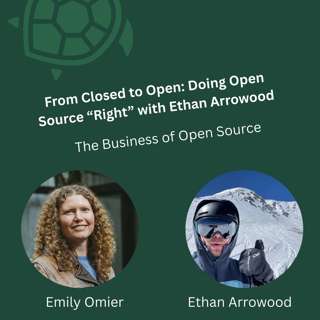
Closed to Open Source Series: Doing Open Source "Right" with Ethan Arrowood

Closed to Open Source Series: Doing Open Source "Right" with Ethan Arrowood

One of the myths that swirl around the open source company ecosystem is that all open source companies started as an open source project that then suddenly got traction, and followed by the founders f...

22 Kesä 40min
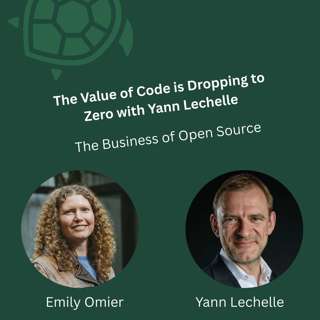
The Value of Code is Dropping to Zero with Yann Lechelle

The Value of Code is Dropping to Zero with Yann Lechelle

In this episode of The Business of Open Source, I talked with Yann Lechelle, Executive President of :Probabl.Perhaps the most interesting part of the conversation was about whether or not there is a r...

15 Kesä 42min

Why the World Needs the Agentic AI Foundation with Manik Surtani

Why the World Needs the Agentic AI Foundation with Manik Surtani

In this episode of The Business of Open Source, I spoke with Manik Surtani, one of the co-founders of the Agentic AI Foundation and the CTO at the foundation. This is part of the series I’m working on...

8 Kesä 34min

The AI-Induced Death of A Bug Bounty Program with Glauber Costa

The AI-Induced Death of A Bug Bounty Program with Glauber Costa

The Business of Open Source is back! I’m starting a series about AI and open source this week. I reached out to Glauber Costa, founder of Turso, after reading a post of his on LinkedIn about how bot-w...

1 Kesä 43min

Changing Your Price Anchor with Anais Concepcion

Changing Your Price Anchor with Anais Concepcion

There’s a new episode of The Business of Open Source today! It’s been a while. I talked with Anais Concepcion about a program she’s been testing at Grist to give free activation codes for the enterpri...

11 Helmi 32min

Earning Trust with Tom Hacohen

Earning Trust with Tom Hacohen

This week on The Business of Open Source, I spoke with Tom Hacohen, CEO and founder at Svix. We kicked off the conversation by talking about why Svix is an open core company… but Tom still initially d...

8 Loka 202535min

Suosittua kategoriassa Liike-elämä ja talous

sijotuskasti
psykopodiaa-podcast
mimmit-sijoittaa
ostan-asuntoja-podcast
rss-oivalluksia-rahasta-elamasta
rss-rahapodi
rahapuhetta
rss-sami-miettinen-neuvottelija
rss-rahamania
rss-markkinointitrippi
rss-inderes
syo-nuku-saasta
vapauta-supervoimasi-podcast
asuntoasiaa-paivakirjat
rss-kahavia-ja-markkinointia-podcast
rss-kaikki-koroista
rss-ammattipodcast
rss-stressivapaa-johtaja-nakokulmia-henkilokohtaiseen-kasvuun
rss-perho-rajoilla
rss-ainin-sekatoimisto