CERN’s Transition to Containerization and Kubernetes with Ricardo Rocha

CERN’s Transition to Containerization and Kubernetes with Ricardo Rocha

Some of the highlights of the show include:


  • The challenges that CERN was facing when storing, processing, and analyzing data, and why it pushed them to think about containerization.
  • CERN’s evolution from using mainframes, to physical commodity hardware, to virtualization and private clouds, and eventually to containers. Ricardo also explains how the migration to containerization and Kubernetes was started.
  • Why there was a big push from groups that focus on reproducibility to explore containerization.
  • How end users have responded to Kubernetes and containers. Ricardo talks about the steep Kubernetes learning curve, and how they dealt with frustration and resistance.
  • Some of top benefits of migrating to Kubernetes, and the impact that the move has had on their end users.
  • Current challenges that CERN is working through, regarding hybrid infrastructure and rising data loads. Ricardo also talks about how CERN optimizes system resources for their scientists, and what it’s like operating as a public sector organization.
  • How CERN handles large data transfers.


Links:


Transcript

Emily: Hi everyone. I’m Emily Omier, your host, and my day job is helping companies position themselves in the cloud-native ecosystem so that their product’s value is obvious to end-users. I started this podcast because organizations embark on the cloud naive journey for business reasons, but in general, the industry doesn’t talk about them. Instead, we talk a lot about technical reasons. I’m hoping that with this podcast, we focus more on the business goals and business motivations that lead organizations to adopt cloud-native and Kubernetes. I hope you’ll join me.


Emily: Welcome to the Business of Cloud Native. I'm your host, Emily Omier, and today I'm here with Ricardo Rocha. Ricardo, thank you so much for joining us.


Ricardo: It's a pleasure.


Emily: Ricardo, can you actually go ahead and introduce yourself: where you work, and what you do?


Ricardo: Yeah, yes, sure. I work at CERN, the European Organization for Nuclear Research. I'm a software engineer and I work in the CERN IT department. I've done quite a few different things in the past in the organization, including software development in the areas of storage and monitoring, and also distributed computing. But right now, I'm part of the CERN Cloud Team, and we manage the CERN private cloud and all the resources we have. And I focus mostly on networking and containerization, so Kubernetes and all these new technologies.


Emily: And on a day to day basis, what do you usually do? What sort of activities are you actually doing?


Ricardo: Yeah. So, it's mostly making sure we provide the infrastructure that our physics users and experiments require, and also the people on campus. So, CERN is a pretty large organization. We have around 10,000 people on-site, and many more around the world that depend on our resources. So, we operate private clouds, we basically do DevOps-style work. And we have a team dedicated for the Cloud, but also for other areas of the data center. And it's mostly making sure everything operates correctly; try to automate more and more, so we do some improvements gradually; and then giving support to our users.


Emily: Just so everyone knows, can you tell a little bit more about what kind of work is done at CERN? What kind of experiments people are running?


Ricardo: Our main goal is fundamental research. So, we try to answer some questions about the universe. So, what's dark matter? What's dark energy? Why don't we see antimatter? And similar questions. And for that, we build very large experiments.


So, the biggest experiment we have, which is actually the biggest scientific experiment ever built, is the Large Hadron Collider, and this is a particle accelerator that accelerates two beams of protons in opposite directions, and we make them collide at very specific points where we build this very large physics experiments that try to understand what happens in these collisions and try to look for new physics. And in reality, what happens with these collisions is that we generate large amounts of data that need to be stored, and processed, and analyzed, so the IT infrastructure that we support, it’s larger fraction dedicated to this physics analysis.


Emily: Tell me a little bit more about some of the challenges related to processing and storing the huge amount of data that you have. And also, how this has evolved, and how it pushed you to think about containerization.


Ricardo: The big challenge we have is the amount of data that we have to support. So, these experiments, each of the experiments, at the moment of the collisions, it can generate data in the order of one petabyte a second. This is, of course, not something we can handle, so the first thing we do, we use these hardware triggers to filter this data quite significantly, but we still generate, per experiment, something like a few gigabytes a second, so up to 10 gigabytes a second. And this we have to store, and then we have large farms that will handle the processing and the reconstruction of all of this. So, we've had these sort of experiments since quite a while, and to analyze all of this, we need a large amount of resources, and with time.


If you come and visit CERN, you can see a bit of the history of computing, kind of evolving with what we used to have in the past in our data center. But it's mostly—we used to have large mainframes, that now it's more in the movies that we see them, but we used to have quite a few of those. And then we transitioned to physical commodity hardware with Linux servers. Eventually introduced virtualization and private clouds to improve the efficiency and the provisioning of these resources to our users, and then eventually, we moved to containers and the main motivation is always to try to be as efficient as possible, and to speed up this process of provisioning resources, and be more flexible in the way we assign compute and also storage.


What we've seen is that in the move from physical to virtualization, we saw that the provisioning and maintenance got significantly improved. What we see with containerization is the extra speed in also deployment and update of the applications that run on those resources. And we also see an improving resource utilization. We already had the possibility to improve quite a bit with virtualization by doing things like overcommit, but with containers, we can go one step further by doing more efficient resource sharing for the different applications we have to run.


Emily: Is the amount of data that you're processing stable? Is it steadily increasing, have spikes, a combination?


Ricardo: So, the way it works is, we have what we call ‘beam’ which is when we actually have protons circulating in the accelerator. And during these periods, we try to get as much collisions as ...

Tämä jakso on lisätty Podme-palveluun avoimen RSS-syötteen kautta eikä se ole Podmen omaa tuotantoa. Siksi jakso saattaa sisältää mainontaa.

Jaksot(275)

From Closed to Open: Shortening Sales Cycles with Stephen Goldberg

From Closed to Open: Shortening Sales Cycles with Stephen Goldberg

This week on The Business of Open Source, I chatted with Stephen Goldberg, co-founder of Harper, about the process of taking Harper from a closed-source software company to a open source company. I al...

6 Heinä 33min

Does AI Make Open Core Models More Difficult? with Sam Alba

Does AI Make Open Core Models More Difficult? with Sam Alba

Today on The Business of Open Source I spoke with Sam Alba, co-founder of Mendral, formerly of Dagger, and the first hire at Docker. We talked a lot about about how AI is changing the developer tools ...

2 Heinä 39min
Closed to Open Source Series: Doing Open Source "Right" with Ethan Arrowood

Closed to Open Source Series: Doing Open Source "Right" with Ethan Arrowood

One of the myths that swirl around the open source company ecosystem is that all open source companies started as an open source project that then suddenly got traction, and followed by the founders f...

22 Kesä 40min
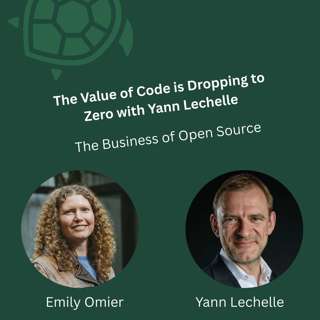
The Value of Code is Dropping to Zero with Yann Lechelle

The Value of Code is Dropping to Zero with Yann Lechelle

In this episode of The Business of Open Source, I talked with Yann Lechelle, Executive President of :Probabl.Perhaps the most interesting part of the conversation was about whether or not there is a r...

15 Kesä 42min

Why the World Needs the Agentic AI Foundation with Manik Surtani

Why the World Needs the Agentic AI Foundation with Manik Surtani

In this episode of The Business of Open Source, I spoke with Manik Surtani, one of the co-founders of the Agentic AI Foundation and the CTO at the foundation. This is part of the series I’m working on...

8 Kesä 34min

The AI-Induced Death of A Bug Bounty Program with Glauber Costa

The AI-Induced Death of A Bug Bounty Program with Glauber Costa

The Business of Open Source is back! I’m starting a series about AI and open source this week. I reached out to Glauber Costa, founder of Turso, after reading a post of his on LinkedIn about how bot-w...

1 Kesä 43min

Changing Your Price Anchor with Anais Concepcion

Changing Your Price Anchor with Anais Concepcion

There’s a new episode of The Business of Open Source today! It’s been a while. I talked with Anais Concepcion about a program she’s been testing at Grist to give free activation codes for the enterpri...

11 Helmi 32min

Earning Trust with Tom Hacohen

Earning Trust with Tom Hacohen

This week on The Business of Open Source, I spoke with Tom Hacohen, CEO and founder at Svix. We kicked off the conversation by talking about why Svix is an open core company… but Tom still initially d...

8 Loka 202535min

Suosittua kategoriassa Liike-elämä ja talous

sijotuskasti
psykopodiaa-podcast
mimmit-sijoittaa
ostan-asuntoja-podcast
rss-oivalluksia-rahasta-elamasta
rss-rahapodi
rahapuhetta
rss-sami-miettinen-neuvottelija
rss-rahamania
rss-markkinointitrippi
rss-inderes
syo-nuku-saasta
vapauta-supervoimasi-podcast
asuntoasiaa-paivakirjat
rss-kahavia-ja-markkinointia-podcast
rss-kaikki-koroista
rss-ammattipodcast
rss-stressivapaa-johtaja-nakokulmia-henkilokohtaiseen-kasvuun
rss-perho-rajoilla
rss-ainin-sekatoimisto