
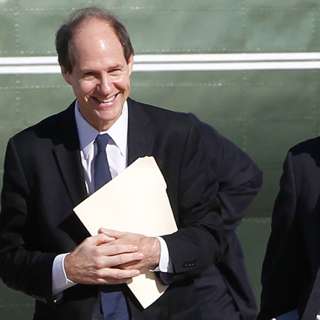
#140 Classic episode – Bear Braumoeller on the case that war isn’t in decline

#140 Classic episode – Bear Braumoeller on the case that war isn’t in decline

Is war in long-term decline? Steven Pinker's The Better Angels of Our Nature brought this previously obscure academic question to the centre of public debate, and pointed to rates of death in war to argue energetically that war is on the way out.

But that idea divides war scholars and statisticians, and so Better Angels has prompted a spirited debate, with datasets and statistical analyses exchanged back and forth year after year. The lack of consensus has left a somewhat bewildered public (including host Rob Wiblin) unsure quite what to believe.

Today's guest, professor in political science Bear Braumoeller, is one of the scholars who believes we lack convincing evidence that warlikeness is in long-term decline. He collected the analysis that led him to that conclusion in his 2019 book, Only the Dead: The Persistence of War in the Modern Age.

Rebroadcast: this episode was originally released in November 2022.

Links to learn more, highlights, and full transcript.

The question is of great practical importance. The US and PRC are entering a period of renewed great power competition, with Taiwan as a potential trigger for war, and Russia is once more invading and attempting to annex the territory of its neighbours.

If war has been going out of fashion since the start of the Enlightenment, we might console ourselves that however nerve-wracking these present circumstances may feel, modern culture will throw up powerful barriers to another world war. But if we're as war-prone as we ever have been, one need only inspect the record of the 20th century to recoil in horror at what might await us in the 21st.

Bear argues that the second reaction is the appropriate one. The world has gone up in flames many times through history, with roughly 0.5% of the population dying in the Napoleonic Wars, 1% in World War I, 3% in World War II, and perhaps 10% during the Mongol conquests. And with no reason to think similar catastrophes are any less likely today, complacency could lead us to sleepwalk into disaster.

He gets to this conclusion primarily by analysing the datasets of the decades-old Correlates of War project, which aspires to track all interstate conflicts and battlefield deaths since 1815. In Only the Dead, he chops up and inspects this data dozens of different ways, to test if there are any shifts over time which seem larger than what could be explained by chance variation alone.

In a nutshell, Bear simply finds no general trend in either direction from 1815 through today. It seems like, as philosopher George Santayana lamented in 1922, "only the dead have seen the end of war."

In today's conversation, Bear and Rob discuss all of the above in more detail than even a usual 80,000 Hours podcast episode, as well as:

  • Why haven't modern ideas about the immorality of violence led to the decline of war, when it's such a natural thing to expect?
  • What would Bear's critics say in response to all this?
  • What do the optimists get right?
  • How does one do proper statistical tests for events that are clumped together, like war deaths?
  • Why are deaths in war so concentrated in a handful of the most extreme events?
  • Did the ideas of the Enlightenment promote nonviolence, on balance?
  • Were early states more or less violent than groups of hunter-gatherers?
  • If Bear is right, what can be done?
  • How did the 'Concert of Europe' or 'Bismarckian system' maintain peace in the 19th century?
  • Which wars are remarkable but largely unknown?

Chapters:

  • Cold open (00:00:00)
  • Rob's intro (00:01:01)
  • The interview begins (00:05:37)
  • Only the Dead (00:08:33)
  • The Enlightenment (00:18:50)
  • Democratic peace theory (00:28:26)
  • Is religion a key driver of war? (00:31:32)
  • International orders (00:35:14)
  • The Concert of Europe (00:44:21)
  • The Bismarckian system (00:55:49)
  • The current international order (01:00:22)
  • The Better Angels of Our Nature (01:19:36)
  • War datasets (01:34:09)
  • Seeing patterns in data where none exist (01:47:38)
  • Change-point analysis (01:51:39)
  • Rates of violent death throughout history (01:56:39)
  • War initiation (02:05:02)
  • Escalation (02:20:03)
  • Getting massively different results from the same data (02:30:45)
  • How worried we should be (02:36:13)
  • Most likely ways Only the Dead is wrong (02:38:31)
  • Astonishing smaller wars (02:42:45)
  • Rob’s outro (02:47:13)

Producer: Keiran Harris
Audio mastering: Ryan Kessler
Transcriptions: Katy Moore

Jaksot(324)

#59 Classic episode - Cass Sunstein on how change happens, and why it's so often abrupt & unpredictable

#59 Classic episode - Cass Sunstein on how change happens, and why it's so often abrupt & unpredictable

Rebroadcast: this episode was originally released in June 2019. It can often feel hopeless to be an activist seeking social change on an obscure issue where most people seem opposed or at best indiff...

27 Joulu 20211h 43min

#119 – Andrew Yang on our very long-term future, and other topics most politicians won’t touch

#119 – Andrew Yang on our very long-term future, and other topics most politicians won’t touch

Andrew Yang — past presidential candidate, founder of the Forward Party, and leader of the 'Yang Gang' — is kind of a big deal, but is particularly popular among listeners to The 80,000 Hours Podcast....

20 Joulu 20211h 25min
#118 – Jaime Yassif on safeguarding bioscience to prevent catastrophic lab accidents and bioweapons development

#118 – Jaime Yassif on safeguarding bioscience to prevent catastrophic lab accidents and bioweapons development

If a rich country were really committed to pursuing an active biological weapons program, there’s not much we could do to stop them. With enough money and persistence, they’d be able to buy equipment,...

13 Joulu 20212h 15min
#117 – David Denkenberger on using paper mills and seaweed to feed everyone in a catastrophe, ft Sahil Shah

#117 – David Denkenberger on using paper mills and seaweed to feed everyone in a catastrophe, ft Sahil Shah

If there's a nuclear war followed by nuclear winter, and the sun is blocked out for years, most of us are going to starve, right? Well, currently, probably we would, because humanity hasn't done much ...

29 Marras 20213h 8min

#116 – Luisa Rodriguez on why global catastrophes seem unlikely to kill us all

#116 – Luisa Rodriguez on why global catastrophes seem unlikely to kill us all

If modern human civilisation collapsed — as a result of nuclear war, severe climate change, or a much worse pandemic than COVID-19 — billions of people might die.That's terrible enough to contemplate....

19 Marras 20213h 45min
#115 – David Wallace on the many-worlds theory of quantum mechanics and its implications

#115 – David Wallace on the many-worlds theory of quantum mechanics and its implications

Quantum mechanics — our best theory of atoms, molecules, and the subatomic particles that make them up — underpins most of modern physics. But there are varying interpretations of what it means, all o...

12 Marras 20213h 9min

#114 – Maha Rehman on working with governments to rapidly deliver masks to millions of people

#114 – Maha Rehman on working with governments to rapidly deliver masks to millions of people

It’s hard to believe, but until recently there had never been a large field trial that addressed these simple and obvious questions:1. When ordinary people wear face masks, does it actually reduce the...

22 Loka 20211h 42min
We just put up a new compilation of ten core episodes of the show

We just put up a new compilation of ten core episodes of the show

We recently launched a new podcast feed that might be useful to you and people you know. It's called Effective Altruism: Ten Global Problems, and it's a collection of ten top episodes of this show, se...

20 Loka 20213min

Suosittua kategoriassa Koulutus

rss-murhan-anatomia
voi-hyvin-meditaatiot-2
rss-narsisti
psykopodiaa-podcast
adhd-podi
rss-vapaudu-voimaasi
rss-niinku-asia-on
psykologia
rss-duodecim-lehti
rss-valo-minussa-2
aamukahvilla
rss-uskonto-on-tylsaa
kesken
koulu-podcast-2
rss-liian-kuuma-peruna
rahapuhetta
jari-sarasvuo-podcast
filocast-filosofian-perusteet
rss-turun-yliopisto
rss-opi-espanjaa