#139 Classic episode – Alan Hájek on puzzles and paradoxes in probability and expected value

#139 Classic episode – Alan Hájek on puzzles and paradoxes in probability and expected value

A casino offers you a game. A coin will be tossed. If it comes up heads on the first flip you win $2. If it comes up on the second flip you win $4. If it comes up on the third you win $8, the fourth you win $16, and so on. How much should you be willing to pay to play?

The standard way of analysing gambling problems, ‘expected value’ — in which you multiply probabilities by the value of each outcome and then sum them up — says your expected earnings are infinite. You have a 50% chance of winning $2, for '0.5 * $2 = $1' in expected earnings. A 25% chance of winning $4, for '0.25 * $4 = $1' in expected earnings, and on and on. A never-ending series of $1s added together comes to infinity. And that's despite the fact that you know with certainty you can only ever win a finite amount!

Today's guest — philosopher Alan Hájek of the Australian National University — thinks of much of philosophy as “the demolition of common sense followed by damage control” and is an expert on paradoxes related to probability and decision-making rules like “maximise expected value.”

Rebroadcast: this episode was originally released in October 2022.

Links to learn more, highlights, and full transcript.

The problem described above, known as the St. Petersburg paradox, has been a staple of the field since the 18th century, with many proposed solutions. In the interview, Alan explains how very natural attempts to resolve the paradox — such as factoring in the low likelihood that the casino can pay out very large sums, or the fact that money becomes less and less valuable the more of it you already have — fail to work as hoped.

We might reject the setup as a hypothetical that could never exist in the real world, and therefore of mere intellectual curiosity. But Alan doesn't find that objection persuasive. If expected value fails in extreme cases, that should make us worry that something could be rotten at the heart of the standard procedure we use to make decisions in government, business, and nonprofits.

These issues regularly show up in 80,000 Hours' efforts to try to find the best ways to improve the world, as the best approach will arguably involve long-shot attempts to do very large amounts of good.

Consider which is better: saving one life for sure, or three lives with 50% probability? Expected value says the second, which will probably strike you as reasonable enough. But what if we repeat this process and evaluate the chance to save nine lives with 25% probability, or 27 lives with 12.5% probability, or after 17 more iterations, 3,486,784,401 lives with a 0.00000009% chance. Expected value says this final offer is better than the others — 1,000 times better, in fact.

Ultimately Alan leans towards the view that our best choice is to “bite the bullet” and stick with expected value, even with its sometimes counterintuitive implications. Where we want to do damage control, we're better off looking for ways our probability estimates might be wrong.

In this conversation, originally released in October 2022, Alan and Rob explore these issues and many others:

  • Simple rules of thumb for having philosophical insights
  • A key flaw that hid in Pascal's wager from the very beginning
  • Whether we have to simply ignore infinities because they mess everything up
  • What fundamentally is 'probability'?
  • Some of the many reasons 'frequentism' doesn't work as an account of probability
  • Why the standard account of counterfactuals in philosophy is deeply flawed
  • And why counterfactuals present a fatal problem for one sort of consequentialism

Chapters:

  • Cold open {00:00:00}
  • Rob's intro {00:01:05}
  • The interview begins {00:05:28}
  • Philosophical methodology {00:06:35}
  • Theories of probability {00:40:58}
  • Everyday Bayesianism {00:49:42}
  • Frequentism {01:08:37}
  • Ranges of probabilities {01:20:05}
  • Implications for how to live {01:25:05}
  • Expected value {01:30:39}
  • The St. Petersburg paradox {01:35:21}
  • Pascal’s wager {01:53:25}
  • Using expected value in everyday life {02:07:34}
  • Counterfactuals {02:20:19}
  • Most counterfactuals are false {02:56:06}
  • Relevance to objective consequentialism {03:13:28}
  • Alan’s best conference story {03:37:18}
  • Rob's outro {03:40:22}

Producer: Keiran Harris
Audio mastering: Ben Cordell and Ryan Kessler
Transcriptions: Katy Moore

Jaksot(324)

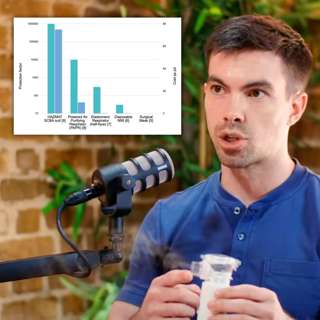
#224 – There's a cheap and low-tech way to save humanity from any engineered disease | Andrew Snyder-Beattie

#224 – There's a cheap and low-tech way to save humanity from any engineered disease | Andrew Snyder-Beattie

Conventional wisdom is that safeguarding humanity from the worst biological risks — microbes optimised to kill as many as possible — is difficult bordering on impossible, making bioweapons humanity’s ...

2 Loka 20252h 31min
Inside the Biden admin’s AI policy approach | Jake Sullivan, Biden’s NSA | via The Cognitive Revolution

Inside the Biden admin’s AI policy approach | Jake Sullivan, Biden’s NSA | via The Cognitive Revolution

Jake Sullivan was the US National Security Advisor from 2021-2025. He joined our friends on The Cognitive Revolution podcast in August to discuss AI as a critical national security issue. We thought i...

26 Syys 20251h 5min
#223 – Neel Nanda on leading a Google DeepMind team at 26 – and advice if you want to work at an AI company (part 2)

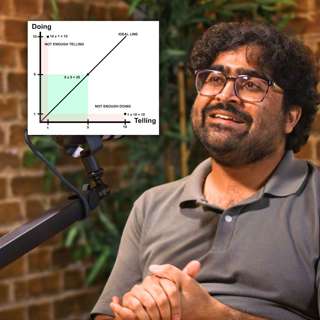
#223 – Neel Nanda on leading a Google DeepMind team at 26 – and advice if you want to work at an AI company (part 2)

At 26, Neel Nanda leads an AI safety team at Google DeepMind, has published dozens of influential papers, and mentored 50 junior researchers — seven of whom now work at major AI companies. His secret?...

15 Syys 20251h 46min
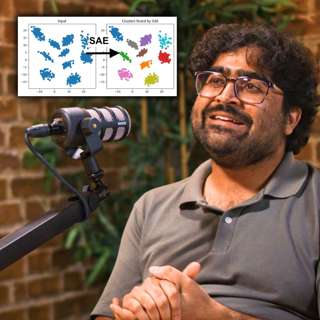
#222 – Can we tell if an AI is loyal by reading its mind? DeepMind's Neel Nanda (part 1)

#222 – Can we tell if an AI is loyal by reading its mind? DeepMind's Neel Nanda (part 1)

We don’t know how AIs think or why they do what they do. Or at least, we don’t know much. That fact is only becoming more troubling as AIs grow more capable and appear on track to wield enormous cultu...

8 Syys 20253h 1min

#221 – Kyle Fish on the most bizarre findings from 5 AI welfare experiments

#221 – Kyle Fish on the most bizarre findings from 5 AI welfare experiments

What happens when you lock two AI systems in a room together and tell them they can discuss anything they want?According to experiments run by Kyle Fish — Anthropic’s first AI welfare researcher — som...

28 Elo 20252h 28min

How not to lose your job to AI (article by Benjamin Todd)

How not to lose your job to AI (article by Benjamin Todd)

About half of people are worried they’ll lose their job to AI. They’re right to be concerned: AI can now complete real-world coding tasks on GitHub, generate photorealistic video, drive a taxi more sa...

31 Heinä 202551min

Rebuilding after apocalypse: What 13 experts say about bouncing back

Rebuilding after apocalypse: What 13 experts say about bouncing back

What happens when civilisation faces its greatest tests?This compilation brings together insights from researchers, defence experts, philosophers, and policymakers on humanity’s ability to survive and...

15 Heinä 20254h 26min

#220 – Ryan Greenblatt on the 4 most likely ways for AI to take over, and the case for and against AGI in <8 years

#220 – Ryan Greenblatt on the 4 most likely ways for AI to take over, and the case for and against AGI in <8 years

Ryan Greenblatt — lead author on the explosive paper “Alignment faking in large language models” and chief scientist at Redwood Research — thinks there’s a 25% chance that within four years, AI will b...

8 Heinä 20252h 50min

Suosittua kategoriassa Koulutus

rss-murhan-anatomia
voi-hyvin-meditaatiot-2
rss-narsisti
psykopodiaa-podcast
rss-vapaudu-voimaasi
rss-niinku-asia-on
psykologia
rss-liian-kuuma-peruna
rss-duodecim-lehti
rss-uskonto-on-tylsaa
rss-valo-minussa-2
adhd-podi
aamukahvilla
kesken
koulu-podcast-2
adhd-tyylilla
jari-sarasvuo-podcast
rss-turun-yliopisto
rss-luonnollinen-synnytys-podcast
rss-laiska-joogi