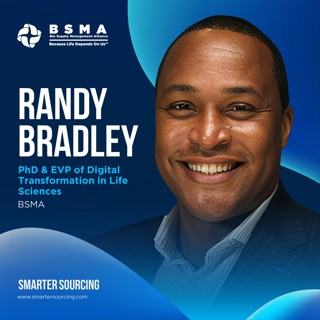
EP 21 - BSMA’s Randy Bradley on Transforming Supply Chains into Strategic Assets
Smarter Sourcing18 Maalis 2025

EP 21 - BSMA’s Randy Bradley on Transforming Supply Chains into Strategic Assets

"If your supply chain only reduces costs, it's not a strategic asset — it's a commodity," Randy Bradley, PhD & EVP of Digital Transformation in Life Sciences at BSMA, tells John in this episode of Smarter Sourcing. When 80% of executives claim their supply chain is strategic but expect it only to cut costs, Randy helps expose the disconnect that keeps procurement leaders trapped in operational thinking.

Drawing from 25+ years bridging technology and supply chain, he explains why healthcare organizations relegate their supply chains to "the basement next to the morgue" and provides a roadmap for elevating procurement's role through liquid data assets and a critical mindset shift from resilience to agility.

For procurement professionals tired of being cost-cutters instead of value-creators, Randy's frameworks for translating operational metrics into C-suite language will transform how you position your function's strategic impact.

Topics discussed:

  • How to distinguish between commoditized and strategic supply chains by examining whether they contribute to top-line revenue generation rather than just cost reduction.
  • Translating operational metrics into C-suite language and how to convert supply chain KPIs like inventory turns into financial metrics that executives care about.
  • Why healthcare's operational excellence mindset and failure to reconcile competing global supply dynamics has prevented innovation and strategic elevation.
  • The "resilience vs. agility" framework for supply chain strategy and why organizations should strive for agility (emerging with new capabilities) rather than mere resilience (weathering challenges) when facing disruptions.
  • A three-part methodology for developing data that can be easily recombined, monetized, and shared through engaged data democracies that break down departmental barriers.
  • Why focusing on using AI to eliminate distractions rather than replace jobs allows organizations to unlock human intellectual potential and avoid the resistance that causes organizations to fall behind.
  • Embedding risk management as core business practice and how to shift from reactive disruption response to proactive capability building that prevents supply chain disruptions from causing business interruptions.

Tämä jakso on lisätty Podme-palveluun avoimen RSS-syötteen kautta eikä se ole Podmen omaa tuotantoa. Siksi jakso saattaa sisältää mainontaa.

Jaksot(58)

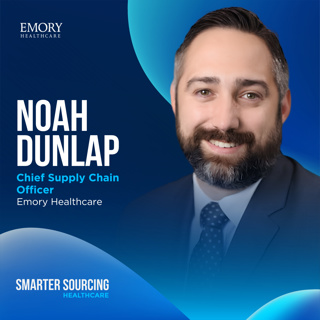
EP 58 - Emory Healthcare's Noah Dunlap On Building A Three-Tier Supply Chain Transformation Framework

EP 58 - Emory Healthcare's Noah Dunlap On Building A Three-Tier Supply Chain Transformation Framework

Noah Dunlap, Chief Supply Chain Officer at Emory Healthcare, walked into a federated, fragmented supply chain and built a three-tier transformation framework: foundation, optimization, innovation. Eig...

18 Elo 44min
EP 57 - Cleveland Clinic's Stephen Downey On Centralizing, Standardizing, And Automating Supply Chain

EP 57 - Cleveland Clinic's Stephen Downey On Centralizing, Standardizing, And Automating Supply Chain

Cleveland Clinic performs 300,000 surgeries a year and processes 80,000 instrument sets. Stephen Downey manages the supply chain behind all of it through three words: centralize, standardize, automate...

5 Elo 43min
EP 56 - Johns Hopkins Medicine's Burton Fuller On Building The Data Foundation To Measure Every Facet Of Supply Chain Performance

EP 56 - Johns Hopkins Medicine's Burton Fuller On Building The Data Foundation To Measure Every Facet Of Supply Chain Performance

Eric O'Daffer speaks with Burton Fuller, Vice President and Chief Supply Chain Officer at Johns Hopkins Medicine. Burton's team is connecting case schedule data from the EHR to their demand planning f...

14 Heinä 34min
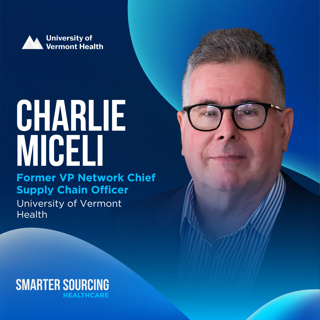
EP 55 - University of Vermont Health's Charlie Miceli On AI As The New ERP In Healthcare Supply Chain

EP 55 - University of Vermont Health's Charlie Miceli On AI As The New ERP In Healthcare Supply Chain

When over 250,000 patients are mortally injured by medical error annually, supply chain has a direct stake that most organizations underestimate. Charlie Miceli, Former VP Network Chief Supply Chain O...

30 Kesä 30min

EP 54 - Grady Health's Kevin Gordon On The Back-To-Basics Approach To Rebuild Supply Chain Credibility

EP 54 - Grady Health's Kevin Gordon On The Back-To-Basics Approach To Rebuild Supply Chain Credibility

When Kevin Gordon joined Grady Health System four years ago, he inherited a supply chain function that lacked credibility, documented processes, and modern technology. Before asking for a single dolla...

16 Kesä 32min

EP 53 - Piedmont Healthcare's Ben Haygood on Why Consolidating Vendors Can Cost Patients More Than It Saves Your Org

EP 53 - Piedmont Healthcare's Ben Haygood on Why Consolidating Vendors Can Cost Patients More Than It Saves Your Org

Ben Haygood built his healthcare supply chain career from the ground up, starting on third shift stocking an ER at 19. Now, as Director of Strategic Sourcing at Piedmont Healthcare, the largest health...

26 Touko 32min

EP 52 - REHVÉAL's Regine Honore Villain on Flipping the Sourcing-to-Adoption Ratio

EP 52 - REHVÉAL's Regine Honore Villain on Flipping the Sourcing-to-Adoption Ratio

Regine Honoré Villain spent 30 years inside complex enterprise environments watching brilliant strategies get handed off and quietly die. Not because the strategy was wrong, but because nothing was bu...

20 Touko 34min

EP 51 - Multicare's Jason Moulding on Building Strategy around People, Process, Performance, & Partnership

EP 51 - Multicare's Jason Moulding on Building Strategy around People, Process, Performance, & Partnership

Jason Moulding, Chief Supply Chain Officer at MultiCare Health System, has spent 25 years building toward a supply chain function that leads M&A integrations, runs enterprise performance analytics, an...

5 Touko 29min