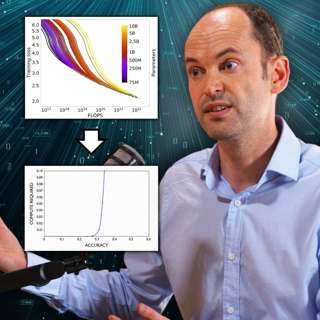
#219 – Toby Ord on graphs AI companies would prefer you didn't (fully) understand

#219 – Toby Ord on graphs AI companies would prefer you didn't (fully) understand

The era of making AI smarter just by making it bigger is ending. But that doesn’t mean progress is slowing down — far from it. AI models continue to get much more powerful, just using very different methods, and those underlying technical changes force a big rethink of what coming years will look like.

Toby Ord — Oxford philosopher and bestselling author of The Precipice — has been tracking these shifts and mapping out the implications both for governments and our lives.

Links to learn more, video, highlights, and full transcript: https://80k.info/to25

As he explains, until recently anyone can access the best AI in the world “for less than the price of a can of Coke.” But unfortunately, that’s over.

What changed? AI companies first made models smarter by throwing a million times as much computing power at them during training, to make them better at predicting the next word. But with high quality data drying up, that approach petered out in 2024.

So they pivoted to something radically different: instead of training smarter models, they’re giving existing models dramatically more time to think — leading to the rise in “reasoning models” that are at the frontier today.

The results are impressive but this extra computing time comes at a cost: OpenAI’s o3 reasoning model achieved stunning results on a famous AI test by writing an Encyclopedia Britannica’s worth of reasoning to solve individual problems at a cost of over $1,000 per question.

This isn’t just technical trivia: if this improvement method sticks, it will change much about how the AI revolution plays out, starting with the fact that we can expect the rich and powerful to get access to the best AI models well before the rest of us.

Toby and host Rob discuss the implications of all that, plus the return of reinforcement learning (and resulting increase in deception), and Toby's commitment to clarifying the misleading graphs coming out of AI companies — to separate the snake oil and fads from the reality of what's likely a "transformative moment in human history."

Recorded on May 23, 2025.

Chapters:

  • Cold open (00:00:00)
  • Toby Ord is back — for a 4th time! (00:01:20)
  • Everything has changed (and changed again) since 2020 (00:01:37)
  • Is x-risk up or down? (00:07:47)
  • The new scaling era: compute at inference (00:09:12)
  • Inference scaling means less concentration (00:31:21)
  • Will rich people get access to AGI first? Will the rest of us even know? (00:35:11)
  • The new regime makes 'compute governance' harder (00:41:08)
  • How 'IDA' might let AI blast past human level — or not (00:50:14)
  • Reinforcement learning brings back 'reward hacking' agents (01:04:56)
  • Will we get warning shots? Will they even help? (01:14:41)
  • The scaling paradox (01:22:09)
  • Misleading charts from AI companies (01:30:55)
  • Policy debates should dream much bigger (01:43:04)
  • Scientific moratoriums have worked before (01:56:04)
  • Might AI 'go rogue' early on? (02:13:16)
  • Lamps are regulated much more than AI (02:20:55)
  • Companies made a strategic error shooting down SB 1047 (02:29:57)
  • Companies should build in emergency brakes for their AI (02:35:49)
  • Toby's bottom lines (02:44:32)


Tell us what you thought! https://forms.gle/enUSk8HXiCrqSA9J8

Video editing: Simon Monsour
Audio engineering: Ben Cordell, Milo McGuire, Simon Monsour, and Dominic Armstrong
Music: Ben Cordell
Camera operator: Jeremy Chevillotte
Transcriptions and web: Katy Moore

Tämä jakso on lisätty Podme-palveluun avoimen RSS-syötteen kautta eikä se ole Podmen omaa tuotantoa. Siksi jakso saattaa sisältää mainontaa.

Jaksot(334)

#64 – Bruce Schneier on how insecure electronic voting could break the United States — and surveillance without tyranny

#64 – Bruce Schneier on how insecure electronic voting could break the United States — and surveillance without tyranny

November 3 2020, 10:32PM: CNN, NBC, and FOX report that Donald Trump has narrowly won Florida, and with it, re-election.  November 3 2020, 11:46PM: The NY Times and Wall Street Journal report that so...

25 Loka 20192h 11min
Rob Wiblin on plastic straws, nicotine, doping, & whether changing the long-term is really possible

Rob Wiblin on plastic straws, nicotine, doping, & whether changing the long-term is really possible

Today's episode is a compilation of interviews I recently recorded for two other shows, Love Your Work and The Neoliberal Podcast.  If you've listened to absolutely everything on this podcast feed, y...

25 Syys 20193h 14min

Have we helped you have a bigger social impact? Our annual survey, plus other ways we can help you.

Have we helped you have a bigger social impact? Our annual survey, plus other ways we can help you.

1. Fill out our annual impact survey here. 2. Find a great vacancy on our job board. 3. Learn about our key ideas, and get links to our top articles. 4. Join our newsletter for an email about what's n...

16 Syys 20193min

#63 – Vitalik Buterin on better ways to fund public goods, blockchain's failures, & effective giving

#63 – Vitalik Buterin on better ways to fund public goods, blockchain's failures, & effective giving

Historically, progress in the field of cryptography has had major consequences. It has changed the course of major wars, made it possible to do business on the internet, and enabled private communicat...

3 Syys 20193h 18min

#62 – Paul Christiano on messaging the future, increasing compute, & how CO2 impacts your brain

#62 – Paul Christiano on messaging the future, increasing compute, & how CO2 impacts your brain

Imagine that – one day – humanity dies out. At some point, many millions of years later, intelligent life might well evolve again. Is there any message we could leave that would reliably help them out...

5 Elo 20192h 11min

#61 - Helen Toner on emerging technology, national security, and China

#61 - Helen Toner on emerging technology, national security, and China

From 1870 to 1950, the introduction of electricity transformed life in the US and UK, as people gained access to lighting, radio and a wide range of household appliances for the first time. Electricit...

17 Heinä 20191h 54min
#60 - Phil Tetlock on why accurate forecasting matters for everything, and how you can do it better

#60 - Phil Tetlock on why accurate forecasting matters for everything, and how you can do it better

Have you ever been infuriated by a doctor's unwillingness to give you an honest, probabilistic estimate about what to expect? Or a lawyer who won't tell you the chances you'll win your case? Their beh...

28 Kesä 20192h 11min
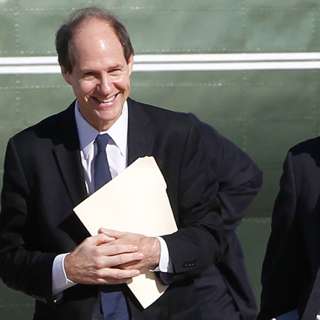
#59 – Cass Sunstein on how change happens, and why it's so often abrupt & unpredictable

#59 – Cass Sunstein on how change happens, and why it's so often abrupt & unpredictable

It can often feel hopeless to be an activist seeking social change on an obscure issue where most people seem opposed or at best indifferent to you. But according to a new book by Professor Cass Sunst...

17 Kesä 20191h 43min

Suosittua kategoriassa Koulutus

rss-murhan-anatomia
psykopodiaa-podcast
voi-hyvin-meditaatiot-2
adhd-podi
rss-niinku-asia-on
psykologia
rss-rahamania
rss-hereilla
rahapuhetta
rss-liian-kuuma-peruna
kesken
rss-arkea-ja-aurinkoa-podcast-espanjasta
taytta-tavaraa
rss-duodecim-lehti
rss-valo-minussa-2
rss-tietoinen-yhteys-podcast-2
rss-vapaudu-voimaasi
dear-ladies
rss-naiseuden-helmoissa-tiipiituokioita-marikan-kanssa
rss-koira-haudattuna