#219 – Toby Ord on graphs AI companies would prefer you didn't (fully) understand

#219 – Toby Ord on graphs AI companies would prefer you didn't (fully) understand

The era of making AI smarter just by making it bigger is ending. But that doesn’t mean progress is slowing down — far from it. AI models continue to get much more powerful, just using very different methods, and those underlying technical changes force a big rethink of what coming years will look like.

Toby Ord — Oxford philosopher and bestselling author of The Precipice — has been tracking these shifts and mapping out the implications both for governments and our lives.

Links to learn more, video, highlights, and full transcript: https://80k.info/to25

As he explains, until recently anyone can access the best AI in the world “for less than the price of a can of Coke.” But unfortunately, that’s over.

What changed? AI companies first made models smarter by throwing a million times as much computing power at them during training, to make them better at predicting the next word. But with high quality data drying up, that approach petered out in 2024.

So they pivoted to something radically different: instead of training smarter models, they’re giving existing models dramatically more time to think — leading to the rise in “reasoning models” that are at the frontier today.

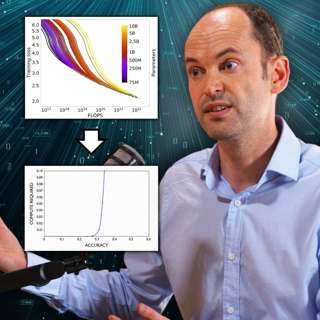
The results are impressive but this extra computing time comes at a cost: OpenAI’s o3 reasoning model achieved stunning results on a famous AI test by writing an Encyclopedia Britannica’s worth of reasoning to solve individual problems at a cost of over $1,000 per question.

This isn’t just technical trivia: if this improvement method sticks, it will change much about how the AI revolution plays out, starting with the fact that we can expect the rich and powerful to get access to the best AI models well before the rest of us.

Toby and host Rob discuss the implications of all that, plus the return of reinforcement learning (and resulting increase in deception), and Toby's commitment to clarifying the misleading graphs coming out of AI companies — to separate the snake oil and fads from the reality of what's likely a "transformative moment in human history."

Recorded on May 23, 2025.

Chapters:

  • Cold open (00:00:00)
  • Toby Ord is back — for a 4th time! (00:01:20)
  • Everything has changed (and changed again) since 2020 (00:01:37)
  • Is x-risk up or down? (00:07:47)
  • The new scaling era: compute at inference (00:09:12)
  • Inference scaling means less concentration (00:31:21)
  • Will rich people get access to AGI first? Will the rest of us even know? (00:35:11)
  • The new regime makes 'compute governance' harder (00:41:08)
  • How 'IDA' might let AI blast past human level — or not (00:50:14)
  • Reinforcement learning brings back 'reward hacking' agents (01:04:56)
  • Will we get warning shots? Will they even help? (01:14:41)
  • The scaling paradox (01:22:09)
  • Misleading charts from AI companies (01:30:55)
  • Policy debates should dream much bigger (01:43:04)
  • Scientific moratoriums have worked before (01:56:04)
  • Might AI 'go rogue' early on? (02:13:16)
  • Lamps are regulated much more than AI (02:20:55)
  • Companies made a strategic error shooting down SB 1047 (02:29:57)
  • Companies should build in emergency brakes for their AI (02:35:49)
  • Toby's bottom lines (02:44:32)


Tell us what you thought! https://forms.gle/enUSk8HXiCrqSA9J8

Video editing: Simon Monsour
Audio engineering: Ben Cordell, Milo McGuire, Simon Monsour, and Dominic Armstrong
Music: Ben Cordell
Camera operator: Jeremy Chevillotte
Transcriptions and web: Katy Moore

Jaksot(321)

#47 - Catherine Olsson & Daniel Ziegler on the fast path into high-impact ML engineering roles

#47 - Catherine Olsson & Daniel Ziegler on the fast path into high-impact ML engineering roles

After dropping out of a machine learning PhD at Stanford, Daniel Ziegler needed to decide what to do next. He’d always enjoyed building stuff and wanted to shape the development of AI, so he thought a...

2 Marras 20182h 4min

#46 - Hilary Greaves on moral cluelessness & tackling crucial questions in academia

#46 - Hilary Greaves on moral cluelessness & tackling crucial questions in academia

The barista gives you your coffee and change, and you walk away from the busy line. But you suddenly realise she gave you $1 less than she should have. Do you brush your way past the people now waitin...

23 Loka 20182h 49min

#45 - Tyler Cowen's case for maximising econ growth, stabilising civilization & thinking long-term

#45 - Tyler Cowen's case for maximising econ growth, stabilising civilization & thinking long-term

I've probably spent more time reading Tyler Cowen - Professor of Economics at George Mason University - than any other author. Indeed it's his incredibly popular blog Marginal Revolution that prompted...

17 Loka 20182h 30min

#44 - Paul Christiano on how we'll hand the future off to AI, & solving the alignment problem

#44 - Paul Christiano on how we'll hand the future off to AI, & solving the alignment problem

Paul Christiano is one of the smartest people I know. After our first session produced such great material, we decided to do a second recording, resulting in our longest interview so far. While challe...

2 Loka 20183h 51min

#43 - Daniel Ellsberg on the institutional insanity that maintains nuclear doomsday machines

#43 - Daniel Ellsberg on the institutional insanity that maintains nuclear doomsday machines

In Stanley Kubrick’s iconic film Dr. Strangelove, the American president is informed that the Soviet Union has created a secret deterrence system which will automatically wipe out humanity upon detect...

25 Syys 20182h 44min

#42 - Amanda Askell on moral empathy, the value of information & the ethics of infinity

#42 - Amanda Askell on moral empathy, the value of information & the ethics of infinity

Consider two familiar moments at a family reunion. Our host, Uncle Bill, takes pride in his barbecuing skills. But his niece Becky says that she now refuses to eat meat. A groan goes round the table; ...

11 Syys 20182h 46min

#41 - David Roodman on incarceration, geomagnetic storms, & becoming a world-class researcher

#41 - David Roodman on incarceration, geomagnetic storms, & becoming a world-class researcher

With 698 inmates per 100,000 citizens, the U.S. is by far the leader among large wealthy nations in incarceration. But what effect does imprisonment actually have on crime? According to David Roodman...

28 Elo 20182h 18min

#40 - Katja Grace on forecasting future technology & how much we should trust expert predictions

#40 - Katja Grace on forecasting future technology & how much we should trust expert predictions

Experts believe that artificial intelligence will be better than humans at driving trucks by 2027, working in retail by 2031, writing bestselling books by 2049, and working as surgeons by 2053. But ho...

21 Elo 20182h 11min

Suosittua kategoriassa Koulutus

rss-murhan-anatomia
psykopodiaa-podcast
voi-hyvin-meditaatiot-2
rss-narsisti
rss-liian-kuuma-peruna
rss-vapaudu-voimaasi
dear-ladies
aamukahvilla
psykologia
leveli
kesken
ihminen-tavattavissa-tommy-hellsten-instituutti
rss-uskonto-on-tylsaa
rss-duodecim-lehti
rss-valo-minussa-2
rahapuhetta
adhd-podi
rss-tietoinen-yhteys-podcast-2
rss-hereilla
rss-xamk-podcast