Portrait of a Scientist: A Conversation with Psyche mission leader Lindy Elkins-Tanton

Portrait of a Scientist: A Conversation with Psyche mission leader Lindy Elkins-Tanton

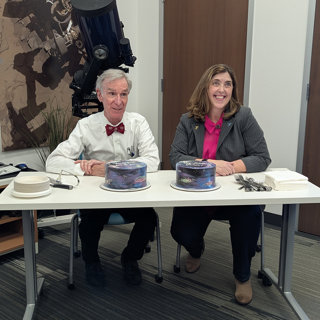
Lindy Elkins-Tanton’s wonderful new memoir is titled, “A Portrait of the Scientist as a Young Woman.” Host Mat Kaplan talks with Lindy about this sometimes harrowing, often heroic, and adventurous chronicle of her path toward leadership of the Psyche asteroid mission. This new conversation follows their brief encounter in a Jet Propulsion Lab clean room that we presented last May. Your chance to win Lindy’s book arrives in this week’s What’s Up segment with Bruce Betts. Discover more at https://www.planetary.org/planetary-radio/2022-lindy-elkins-tanton-portrait-of-the-scientist-book

See omnystudio.com/listener for privacy information.

Jaksot(1305)

Epic Spaceman: Making cosmic scale human

Epic Spaceman: Making cosmic scale human

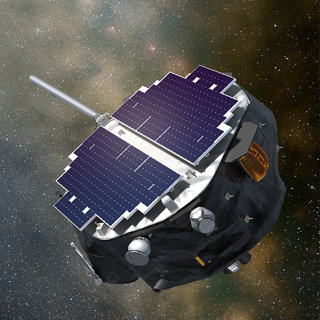
When his filmmaking career stalled during the pandemic, Toby Lockerbie turned to the one place that had never stopped inspiring him: the Universe. With no background in visual effects, he taught himself the tools needed to transform complex space science into cinematic stories using everyday objects and beautifully crafted visuals to make the Cosmos feel human. His channel, Epic Spaceman, now reaches millions and has earned multiple Webby Awards for its innovative approach to visualizing scale, awe, and accessible science. This week on Planetary Radio, Toby joins host Sarah Al-Ahmed to discuss the creation of Epic Spaceman, how visual metaphors can change how we understand the Universe, and why awe remains one of the most powerful tools for science communication. Then we welcome Bruce Betts back for What’s Up, where we reflect on the end of the Japanese Aerospace Exploration Agency’s Akatsuki mission to Venus. Discover more at: https://www.planetary.org/planetary-radio/2025-epic-spacemanSee omnystudio.com/listener for privacy information.

19 Marras 59min

The Planetary Society goes to TwitchCon 2025

The Planetary Society goes to TwitchCon 2025

The Planetary Society heads to TwitchCon 2025 to explore how scientists and educators use livestreaming to share the excitement of discovery. We begin with Moohoodles, one of Twitch’s pioneering space science streamers and co-host of the live panel “The Planetary Society: Space, Time, and You.” She explains how she built a thriving community around astrobiology and space exploration long before Twitch even had a Science & Technology category. Then we share moments from the panel, featuring a special video message from Bill Nye, CEO of The Planetary Society, and highlights of how livestreaming helps inspire new audiences to look up. At the Science & Technology Meet and Greet, Sharkg33k and Paleontologizing explain how their streams connect life on Earth to exploration beyond our planet. Later, Jack Kiraly, The Planetary Society’s Director of Government Relations, joins the show for a Space Policy Update on Jared Isaacman’s renomination as NASA Administrator, examining what it could mean for the agency’s leadership and direction. The episode wraps up with What’s Up with Bruce Betts, The Planetary Society’s chief scientist, celebrating the third anniversary of the end of the LightSail 2 mission and sharing a new random space fact. Discover more at: https://www.planetary.org/planetary-radio/2025-twitchconSee omnystudio.com/listener for privacy information.

12 Marras 1h 1min

Space Policy Edition: Should a (potential) biosignature revive Mars Sample Return?

Space Policy Edition: Should a (potential) biosignature revive Mars Sample Return?

In 1996, a controversial claim of fossilized life in a Martian meteorite ignited a golden age of Mars exploration. Nearly 30 years later, a potential biosignature detected by the Perseverance rover at Jezero Crater has sparked…nothing, not even a formal effort to revive the beleaguered robotic Mars Sample Return project. Why did the claims surrounding the Allan Hills meteorite (which were ultimately rejected) kick off 25 years of unprecedented robotic exploration of the Red Planet? And why did the discovery at Cheyava Falls fail to ignite the same level of interest? Lou Friedman, former Executive Director of The Planetary Society and longtime proponent of Mars Sample Return, joins the show to contrast these to tipping points of Mars exploration, and argues why space scientists should seize this discovery to push for a scientific future at the Red Planet. Discover more at: https://www.planetary.org/planetary-radio/spe-lou-friedman-on-msr-and-tipping-point-eventsSee omnystudio.com/listener for privacy information.

7 Marras 1h 21min

Do Aliens Speak Physics?

Do Aliens Speak Physics?

If we ever meet intelligent extraterrestrials, will we even be able to talk about physics? Physicist Daniel Whiteson of UC Irvine and cartoonist Andy Warner join Sarah Al-Ahmed to explore one of science’s strangest and most profound questions: if alien civilizations exist, would their understanding of the Universe look anything like ours? Their new book, “Do Aliens Speak Physics?”, discusses the nature of knowledge itself, asking whether math and physics are truly universal, or if even our most “objective” truths are shaped by our human perspective. Together, they consider what it would take to communicate with alien intelligence and how humor and illustration can make those big cosmic ideas feel surprisingly down-to-Earth. Then, stick around for What’s Up with Bruce Betts, as we discuss how difficult it is to explain physics to humans, let alone extraterrestrial life. Discover more at: https://www.planetary.org/planetary-radio/2025-do-aliens-speak-physicsSee omnystudio.com/listener for privacy information.

5 Marras 59min

Ripples on the Cosmic Ocean

Ripples on the Cosmic Ocean

What happens in space doesn’t stay in space. Historian Dagomar Degroot joins Planetary Radio host Sarah Al-Ahmed to explore how shifting solar cycles, volcanic eruptions on Venus, Martian dust storms, and even mistaken sightings of lunar forests have influenced life, science, and society on Earth. His new book, “Ripples on the Cosmic Ocean: An Environmental History of Our Place in the Solar System,” reframes the Solar System as part of our cosmic environment, one that has shaped humanity’s past and will define our future. Then, Planetary Society Director of Government Relations Jack Kiraly updates us on the latest developments in space policy, including the ongoing search for NASA’s next administrator and proposed changes to the Artemis program’s launch vehicles. And stick around for Bruce Betts, The Planetary Society’s chief scientist, in What’s Up. Discover more at: https://www.planetary.org/planetary-radio/2025-ripples-on-the-cosmic-oceanSee omnystudio.com/listener for privacy information.

29 Loka 1h 9min

2025 NASA’s Innovative Advanced Concepts Symposium: Part 2 — Hopping robots and the search for exoplanet magnetospheres

2025 NASA’s Innovative Advanced Concepts Symposium: Part 2 — Hopping robots and the search for exoplanet magnetospheres

In this second installment of Planetary Radio’s coverage from the 2025 NASA Innovative Advanced Concepts Symposium in Philadelphia, Pennsylvania, host Sarah Al-Ahmed highlights more of the technologies presented by the NIAC fellows. Mary Knapp of MIT Haystack Observatory shares her team’s Great Observatory for Long Wavelengths project, a space-based radio array designed to detect magnetic fields around distant exoplanets. Michael Hecht, also from MIT Haystack Observatory and principal investigator for the MOXIE experiment on NASA’s Perseverance rover, discusses Exploring Venus with Electrolysis, a concept that could turn Venus’s dense atmosphere into fuel for long-duration flight and exploration. Benjamin Hockman from NASA’s Jet Propulsion Laboratory introduces two projects: Gravity Poppers, tiny hopping probes that could map the interiors of asteroids and comets, and his team’s concept for a Venus balloon observatory. Finally, Justin Yim from the University of Illinois Urbana-Champaign presents LEAP, a legged robot designed to hop through the icy plumes of Saturn’s moon Enceladus in search of clues to its hidden ocean. Then stay tuned for What’s Up with Dr. Bruce Betts, chief scientist of The Planetary Society. Discover more at: https://www.planetary.org/planetary-radio/2025-niac-symposium-part-2See omnystudio.com/listener for privacy information.

22 Loka 1h 1min

Book Club Edition: Space Craze by Margaret Weitekamp

Book Club Edition: Space Craze by Margaret Weitekamp

The American fascination with spaceflight and what we might find out there began long before any human left Earth. It’s Dr. Margaret Weitekamp’s job to collect, document, and preserve the cultural artifacts that display our deep attraction to all things spacey. Her book, Space Craze, explores how these objects, ranging from 1930s Flash Gordon ray guns to Mercury space capsule cookie jars, have represented our Earthbound fears and hopes. She joined the Society’s space-crazed Mat Kaplan for a live and lively conversation. Discover more at: https://www.planetary.org/planetary-radio/book-club-margaret-weitekampSee omnystudio.com/listener for privacy information.

17 Loka 55min

2025 NASA’s Innovative Advanced Concepts Symposium: Part 1 — Lunar glass and starshades

2025 NASA’s Innovative Advanced Concepts Symposium: Part 1 — Lunar glass and starshades

Each year, NASA’s Innovative Advanced Concepts program (NIAC) funds visionary ideas that could shape the future of space exploration. In this first of two episodes from the 2025 NIAC Symposium in Philadelphia, Pennsylvania, USA, Planetary Radio host Sarah Al-Ahmed introduces some of the concepts presented at this year’s event. You’ll hear from Martin Bermudez and Josh Simpson from Skyeports LLC. Bermudez is the company’s CEO and principal investigator for the LUNGS Project, and Simpson is a glass artist and co-investigator. Together, their team is exploring how to build glass-blown lunar habitats from melted Moon dust. You’ll also meet Christine Gregg, research engineer at NASA’s Ames Research Center, who’s developing architected metamaterials to stabilize giant space structures. And finally, John Mather, Nobel laureate and senior astrophysicist at NASA’s Goddard Space Flight Center, shares his team’s work on an inflatable starshade that could help us see Earth-like worlds around distant stars. Then stick around for What’s Up with Dr. Bruce Betts, chief scientist of The Planetary Society. Discover more at: https://www.planetary.org/planetary-radio/2025-niac-symposium-part-1See omnystudio.com/listener for privacy information.

15 Loka 53min

Suosittua kategoriassa Tiede

tiedekulma-podcast
rss-mita-tulisi-tietaa
utelias-mieli
rss-tiedetta-vai-tarinaa
rss-poliisin-mieli
hippokrateen-vastaanotolla
docemilia
rss-metsanomistaja-podcast
mielipaivakirja
filocast-filosofian-perusteet
rss-murremyytin-murtajat