257. Iron Lady out, Grey Man in

257. Iron Lady out, Grey Man in

With the poll tax, Thatcher took one bad decision to many.

From the point of view of orthodox Thatcherite thought, it sounded like a good idea. She’d been working for years to shrink the state but, while she could herself cut public spending at national level, local government could keep racking it up if it so chose. She’d introduced rate capping to limit how far local councils could raise local taxes.

The poll tax – officially the Community Charge – was the next step. In the old system, with local taxation based on house values, it was the rich that paid the most even though it was the poor that mainly benefited from local services. A flat rate tax per head – which the Community Charge was, hence the derogatory name Poll Tax – would, the theory suggested, give poor voters a direct relationship with local taxation and expenditure, making them less likely to vote for council candidates who would push for increased local spending.

In fact, the tax was seen as unfair and its introduction led angry protests that on occasion led to rioting.

It wasn’t, though, the poll tax that directly ended Thatcher’s time at the top. Instead, it was another row with one of her closest colleagues. Already Michael Heseltine, in 1986, and Nigel Lawson, in 1989, had been significant figures – so-called ‘big beasts’ – leaving her government. Now, in the autumn of 1990, she fell out with Geoffrey Howe. He too resigned and in his resignation speech talked about how his loyalty was divided between Thatcher herself and the country or party.

The day after his resignation, Heseltine announced he would challenge Thatcher for the Tory leadership. In the resulting election, like Heath against her, she won the first round but by too narrow a margin to prevent a second round. Like Health against her, she resigned.

It wasn’t Heseltine, however, who replaced her. On the contrary, much to many people’s surprise, it was John Major, who’d only been elected to parliament in 1979 and only served in cabinet since 1986, who came through as the compromise candidate Tory MPs could rally behind. He became party leader and Prime Minister.

And then, much to everyone’s surprise again, he went on, partly helped by campaigning errors by Neil Kinnock’s Labour Party, to win the election in 1992. The Tories had won four general elections in a row. But now that would return the grey man to Downing Street rather than the Iron Lady.

A very different proposition…


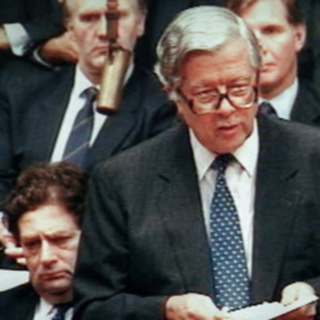
Illustration: Geoffrey Howe delivering his resignation speech to the Commons, 13 November 1990, with Nigel Lawson sitting next to him. Photo PA from the Guardian.

Music: Bach Partita #2c by J Bu licensed under an Attribution-NonCommercial-No Derivatives (aka Music Sharing) 3.0 International License


Jaksot(275)

250. Return of the crisis man

250. Return of the crisis man

When Harold Wilson formed his second government, he immediately faced a major crisis inherited from Heath’s administration: the coalminers were on strike, a state of Emergency (Heath’s fifth in four y...

6 Heinä 202514min
249. Who governs Britain?

249. Who governs Britain?

How did Heath end up calling an election on the question of who governed the country? Especially as the choice he seemed to be offering was between him and the minders. This episode traces the impact ...

5 Heinä 202514min
248. Withered Heath

248. Withered Heath

Ted Heath’s government had to deal with two problems drawn from Britain’s postimperial standing: • adapting to its loss of global status, by negotiating, at the third time of asking and for the first ...

22 Kesä 202514min
247. Hopes dashed

247. Hopes dashed

After talking last week about his government’s achievements in the social sphere, this episode looks at the difficulties Wilson faced in economics and foreign affairs.One way Wilson explored to addres...

15 Kesä 202514min
246. The sixties, swinging - high and low

246. The sixties, swinging - high and low

According to the English poet Philip Larkin, the sixties saw the invention of sexual intercourse. While that may not be quite the case, it was certainly a time when a lot of people decided that it was...

8 Kesä 202514min
245. Pressures preventing progress

245. Pressures preventing progress

The Wilson government got off to a pretty sticky start, with the new Prime Minister learning, more or less as he arrived at Downing Street in October 1964, that the trade deficit for the year was like...

1 Kesä 202514min
244. Harold gets Home

244. Harold gets Home

Here we’re focusing on the changes that took place in Britain after Supermac (Harold Macmillan) stood down as Prime Minister.A lot of how that went depended on the Opposition formed by the Labour Part...

25 Touko 202514min

243. Sex, spies and a slippery slope

243. Sex, spies and a slippery slope

Last time we looked at the continuing disintegration of the British Empire. In this episode we look at two other key aspects of Macmillan’s foreign policy, Britain’s relations with the US and with pot...

18 Touko 202515min

Suosittua kategoriassa Historia

olipa-kerran-otsikko
gogin-ja-janin-maailmanhistoria
mayday-fi
huijarit
mystista
rss-ikiuni
totuus-vai-salaliitto
konginkangas
tsunami
sotaa-ja-historiaa-podi
rouva-diktaattori
rss-subjektiivinen-todistaja
rss-i-dont-like-mondays-2
rss-sattuu-sita-suomessakin
rss-kirkon-ihmeellisimmat-tarinat
apinan-vuosi
rss-peter-peter
maailmanpuu
rss-historian-pitka-oppimaara
slangiradio-helsingin-historiaa-lahiradiossa