60. Nicholas A. Christakis — Blueprint: The Evolutionary Origins of a Good Society

60. Nicholas A. Christakis — Blueprint: The Evolutionary Origins of a Good Society

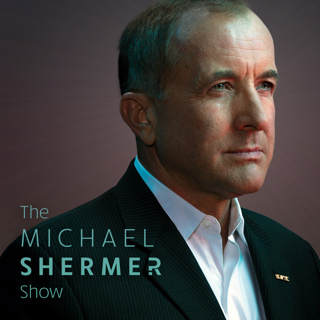
In this exceptionally important conversation Dr. Shermer discusses at length the background to and research of Dr. Nicholas Christakis, a physician and evolutionary sociologist famous for his study of social networks in humans and other animals. Drawing on advances in social science, evolutionary biology, genetics, neuroscience, and network science, Blueprint shows how and why evolution has placed us on a humane path—and how we are united by our common humanity. For too long, scientists have focused on the dark side of our biological heritage: our capacity for aggression, cruelty, prejudice, and self-interest. But natural selection has given us a suite of beneficial social features, including our capacity for love, friendship, cooperation, and learning. Beneath all our inventions—our tools, farms, machines, cities, nations—we carry with us innate proclivities to make a good society. In Blueprint, Nicholas A. Christakis introduces the compelling idea that our genes affect not only our bodies and behaviors, but also the ways in which we make societies, ones that are surprisingly similar worldwide. With many vivid examples—including diverse historical and contemporary cultures, communities formed in the wake of shipwrecks, commune dwellers seeking utopia, online groups thrown together by design or involving artificially intelligent bots, and even the tender and complex social arrangements of elephants and dolphins that so resemble our own—Christakis shows that, despite a human history replete with violence, we cannot escape our social blueprint for goodness. Shermer and Christakis also discuss:

  • his background and how he got into studying social networks and society
  • why evolutionary psychology is an equal opportunity offender (Right: biological creationism; Left: cognitive creationism)
  • the 8-character suite of human nature that goes into building a good society
  • Unintentional Communities like shipwrecks
  • Intentional Communities like communes
  • Artificial Communities like Seasteading
  • love and why it matters for a good society, and not just a good life
  • friends and social networks
  • genes and culture co-evolution
  • boo words like positivism, reductionism, essentialism, determinism and why we need not fear them
  • Hume's Wall: is-ought naturalistic fallacy
  • engineering new social worlds and governing mars.

Nicholas A. Christakis is a physician and sociologist who explores the ancient origins and modern implications of human nature. He directs the Human Nature Lab at Yale University, where he is the Sterling Professor of Social and Natural Science, in the Departments of Sociology, Medicine, Ecology and Evolutionary Biology, Statistics and Data Science, and Biomedical Engineering. He is the Co-Director of the Yale Institute for Network Science and the co-author of Connected: The Surprising Power of Our Social Networks and How They Shape Our Lives.

Listen to Science Salon via iTunes, Spotify, Google Play Music, Stitcher, iHeartRadio, TuneIn, and Soundcloud.

This Science Salon was recorded on March 27, 2019.

You play a vital part in our commitment to promote science and reason. If you enjoy the Science Salon Podcast, please show your support by making a donation, or by becoming a patron.

Tämä jakso on lisätty Podme-palveluun avoimen RSS-syötteen kautta eikä se ole Podmen omaa tuotantoa. Siksi jakso saattaa sisältää mainontaa.

Jaksot(636)

Is There a Second Arrow of Time? A New Law of Evolution, Information, and Complexity

Is There a Second Arrow of Time? A New Law of Evolution, Information, and Complexity

Why does the universe produce ever more elaborate forms, from atoms and minerals to cells, organisms, brains, technology, and civilization? The familiar laws of physics can explain much of what happen...

18 Elo 1h 18min

Why Good People Disagree About Right and Wrong

Why Good People Disagree About Right and Wrong

Why do reasonable people disagree so strongly about right and wrong? And why are we so quick to assume that people on the other side of a moral or political issue are irrational, selfish, ignorant, or...

11 Elo 1h 57min

Are We Building a God? AI, Superintelligence, and the Coming Singularity

Are We Building a God? AI, Superintelligence, and the Coming Singularity

Robert Wright joins Michael Shermer to discuss his new book, The God Test: Artificial Intelligence and Our Coming Cosmic Reckoning, and why he thinks the AI revolution may be moving much faster than m...

5 Elo 1h 22min

Can You Trust Wikipedia? Co-Founder Larry Sanger on Wikipedia's Bias and Why He Was Banned

Can You Trust Wikipedia? Co-Founder Larry Sanger on Wikipedia's Bias and Why He Was Banned

Michael Shermer speaks with Wikipedia co-founder Larry Sanger shortly after Sanger was permanently banned from editing the site he helped create. Sanger tells the story of Wikipedia's founding, how it...

30 Heinä 2h 3min

How to Think Clearly About a World in Crisis: Iran, China, Russia, and the West's Economic Pessimism

How to Think Clearly About a World in Crisis: Iran, China, Russia, and the West's Economic Pessimism

Michael Shermer speaks with political scientist Marlene Laruelle about Russia's turbulent transformation during the 1990s and the rise of Vladimir Putin, why the Kremlin so badly misjudged Ukraine, Ch...

18 Heinä 1h 4min

The Truth About Sex Differences (Steve Stewart-Williams)

The Truth About Sex Differences (Steve Stewart-Williams)

How do men and women differ? Where do the differences come from? And how do they shape modern life? Drawing on a century of research and a billion years of evolution, Steve Stewart-Williams explains w...

11 Heinä 55min

America at 250: What Did the Founders Get Right?

America at 250: What Did the Founders Get Right?

Michael Shermer makes the case that the U.S. Founding Fathers were not only steeped in Enlightenment values on which the Declaration of Independence was based, but they were also scientists searching ...

6 Heinä 17min

When History Goes on Trial: Demjanjuk, Eichmann, and Justice After Atrocity

When History Goes on Trial: Demjanjuk, Eichmann, and Justice After Atrocity

John Demjanjuk lived for decades as a retired autoworker in suburban Cleveland. Then investigators accused him of being "Ivan the Terrible," one of the most notorious guards at Treblinka. What followe...

27 Kesä 1h 32min

Suosittua kategoriassa Tiede

rss-poliisin-mieli
tiedekulma-podcast
utelias-mieli
rss-mita-tulisi-tietaa
rss-duodecim-lehti
rss-tiedetta-vai-tarinaa
rss-astetta-parempi-elama-podcast
rss-ammamafia
rss-hereilla
rss-luontopodi-samuel-glassar-tutkii-luonnon-ihmeita
rss-tervetta-skeptisyytta
rss-kasvikutsut
rss-bios-podcast
ihanat-ipanat
rss-ylistys-elaimille
sotataidon-ytimessa