Pratima Singh - Exploring Alternatives to Biological Psychiatry

Pratima Singh - Exploring Alternatives to Biological Psychiatry

This week, we interview Dr. Pratima Singh. Dr. Singh completed her medical degree in India, before moving to the UK to work at the Maudsley NHS Hospital in London as an adult Psychiatrist. Dr. Singh has a deep interest in alternatives to biological approaches to psychiatry and the use of psychotropic medications.

I was keen to ask Dr. Singh about her background, what led her towards psychiatry as a medical speciality and what she feels about the future of psychiatric care.

In this episode, we discuss:

▪How Dr. Singh completed her medical degree in India and became interested in psychiatry

▪That Dr. Singh felt uncomfortable with the predominantly biological approach to psychiatry including the use of medications and that her interest was in psychotherapy as a therapeutic intervention

▪That there is a recruitment and retention problem within psychiatry

▪That 15 years in psychiatry has given Dr. Singh a nuanced and humble attitude to helping people with their mental health

▪That Dr. Singh felt that her discontent with biological psychiatry continued during her training

▪That, in the UK, General Practitioners (family doctors) actually deal with 80% of mental health problems

▪Patients may then be referred by the GP to therapy teams in secondary care, commonly known as Community Mental Health Teams (CMHT)

▪These teams include psychiatrists, occupational health specialists to try and address a range of service user needs

▪That there is also acute care, or crisis teams, where support is given for psychiatric emergencies

▪Recently there has been diversification to include specialisms like eating disorders, learning disabilities or neuropsychiatry but provision differs across the UK

▪That Dr. Singh feels that we have too rapidly and too dramatically cut down the amount of in-patient beds, leaving a gap and increasing the pressure on the community teams

▪That in the UK we struggle to provide a brief intervention model because many service users often require more time

▪That Dr. Singh feels that the majority of people that she sees have already been put onto psychotropic medications by their GP and often this is too early in the process

▪That there are patients now that say they do to want to try medication

▪That the evidence for using so much medication for emotional distress is weak

▪That psychiatrists do not have tests to help predict how a medication will affect a patient or if they will struggle to withdraw

▪That Dr. Singh would like us to understand the medications better especially why some people struggle even if they try to withdraw slowly

▪That, as professionals we need to listen to patients experiences of adverse effects or withdrawal difficulties

▪That Dr. Singh feels that it is a privilege to be able to engage with patients in this way but that we must be very carful not take advantage or to harm the patient despite our best intentions

▪That we need a completely different mindset to better manage mental health difficulties

▪That Dr. Singh prefers to look at the wider issues in a persons life to try and find the best way to support them including diet, exercise or other potential issues such as metabolic problems or nutritional deficiencies

▪How sometimes a therapeutic relationship can feel like an arranged marriage

▪That a new model would only work if the intervention is early enough in the process, if we engage with people too late, it can be more difficult to help

▪How Dr. Singh remembers her first interaction with a patient and uses this to guide her in listening to the patients own wisdom and experience

▪That Dr. Singh took some time to undertake a Leadership and Management fellowship and that this really helped her to stand back and appreciate the issues and to listen to the customer

▪That full disclosure and informed consent is so important

▪Functional medicine and how it differs to mainstream psychiatric approaches

▪That functional medicine is a holistic approach that considers the whole person

▪and underlying root cause of chronic illness

▪In a functional approach there are no specialities

▪The place of recovery colleges in co-producing training in holistic ways of

▪maintaining health

▪That we still tend to think about contemplative practices as something to try rather than a core skill necessary for good mental health

▪That there is not enough evidence to influence a closed mind

▪That many of the best discoveries in medicine come from observation rather than from a laboratory

▪Dr Singh's hope that psychiatry can return to a place of creativity and openness

To listen on Mad in America: https://goo.gl/tyyLmt

Podcast show notes: https://goo.gl/zbxncn

To get in touch with us email: podcasts@madinamerica.com

© Mad in America 2017

Jaksot(290)

Examining Psychiatric Medication Tapering and Withdrawal: The Evolving Role of Pharmacists — A Conversation with Agnes Higgins and Cathal Cadogan

Examining Psychiatric Medication Tapering and Withdrawal: The Evolving Role of Pharmacists — A Conversation with Agnes Higgins and Cathal Cadogan

Welcome to the Mad in America podcast, my name is James. Today, we are discussing the experiences of people who have attempted to stop taking psychiatric drugs. These experiences are captured in a sur...

1 Huhti 32min
Spiritual Emergency and the Collective Work of Staying Alive: An Interview with Nisha Gupta

Spiritual Emergency and the Collective Work of Staying Alive: An Interview with Nisha Gupta

Nisha Gupta is an existential phenomenologist, a depth psychotherapist, a creativity scholar, and an artist. She's an Associate Professor of Psychology at the University of West Georgia and earned her...

25 Maalis 48min
The Political Systems Driving Abuse in Psychiatry: An Interview with Human Rights Lawyer Alicia Ely Yamin

The Political Systems Driving Abuse in Psychiatry: An Interview with Human Rights Lawyer Alicia Ely Yamin

Alicia Ely Yamin is the Director of the Global Health and Rights Project and a lecturer at Harvard Law School. She's also an adjunct senior lecturer on health policy and management at the Harvard T.H....

18 Maalis 45min
History, Eugenics, and an Inquiry into Mad Consciousness: A Conversation With Susanne Paola Antonetta

History, Eugenics, and an Inquiry into Mad Consciousness: A Conversation With Susanne Paola Antonetta

Susanne Paola Antonetta is an accomplished writer and poet, the author of numerous books, and in 2001 her book Body Toxic: An Environmental Memoir, won a prestigious American Book Award. Her latest bo...

11 Maalis 49min
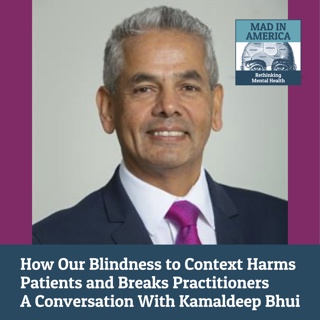
How Our Blindness to Context Harms Patients and Breaks Practitioners: A Conversation With Kamaldeep Bhui

How Our Blindness to Context Harms Patients and Breaks Practitioners: A Conversation With Kamaldeep Bhui

Kamaldeep Bhui is Professor of Psychiatry at the University of Oxford and Honorary Professor at Queen Mary University of London. He is internationally recognized for his groundbreaking work on cultura...

4 Maalis 51min
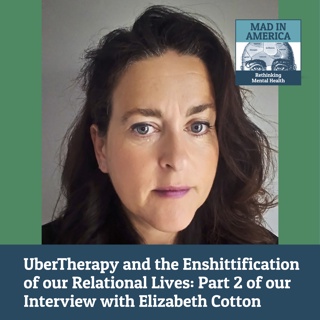
UberTherapy and the Enshittification of our Relational Lives: Part 2 of our Interview with Elizabeth Cotton

UberTherapy and the Enshittification of our Relational Lives: Part 2 of our Interview with Elizabeth Cotton

Elizabeth Cotton is Associate Professor of Responsible Business at the University of Leicester and the founder of Surviving Work, which carries out socially engaged research on mental health and work....

18 Helmi 39min
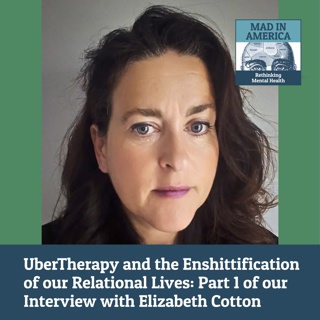
UberTherapy and the Enshittification of our Relational Lives: Part 1 of our Interview with Elizabeth Cotton

UberTherapy and the Enshittification of our Relational Lives: Part 1 of our Interview with Elizabeth Cotton

Elizabeth Cotton is Associate Professor of Responsible Business at the University of Leicester and the founder of Surviving Work, which carries out socially engaged research on mental health and work....

11 Helmi 46min
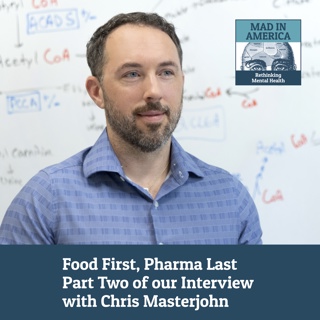
Food First, Pharma Last - Part Two of our Interview with Chris Masterjohn

Food First, Pharma Last - Part Two of our Interview with Chris Masterjohn

This week, we are joined by Chris Masterjohn, PhD. Chris is a nutritional scientist, a former professor, and the founder of Mitome. With a PhD in nutritional science and years of research in mitochond...

28 Tammi 44min

Suosittua kategoriassa Terveys ja hyvinvointi

unicast
psykopodiaa-podcast
voi-hyvin-meditaatiot-2
tiedenaiset-podcast
rss-pitaisko-erota
vakeva-elama-viisaampi-mieli-vahvempi-keho
meditaatiot-suomeksi
rss-narsisti
puhu-muru
junnut-pelissa
terapiassa
aamukahvilla
mielen-puolikkaat
rss-mighty-finland-podcast
rss-kuumilla-aalloilla
paritellen
rss-pt-paahtio
rss-adama-mindful-hetki
rss-en-saa-unta
rss-vapaudu-voimaasi