Kermit Cole - Dialogical Approaches to Extreme States

Kermit Cole - Dialogical Approaches to Extreme States

This week, we interview Kermit Cole. Kermit's first career was in film and television, directing, amongst others, Living Proof: HIV and the Pursuit of Happiness in 1994.

Kermit has undergraduate and master's degrees in psychology from Harvard and he has over two decades experience working with people in extreme states. He likes to say that he likes to work with trauma, especially when it's being called something else – such as "psychosis". Together with his partner Louisa Putnam, he works with couples and families with members who have been labeled as having a mental illness, seeking other ways to understand their struggles – ways that often lead to better outcomes.

Kermit has been part of the team at Mad in America since it was founded in January 2012.

I was keen to ask Kermit about what led to his interest in therapeutic work, his experiences of supporting those in extreme states and his thoughts on Open Dialogue and dialogical approaches in general.

In this episode, we discuss:

  • How Kermit came to be involved with a photo project that aimed to change the dominant image usually portrayed for those with HIV or AIDS and how that led to his 1994 film: Living Proof: HIV and the Pursuit of Happiness
  • How Kermit came to feel that a persons life should not be appraised based on its duration
  • How Kermit went on to make the transition from film maker to supporting others with their mental health and wellbeing
  • That Kermit came to feel that having a camera got in the way of the connection that he wanted to make with people
  • How he went back to study and developed an interest in trauma and its impact on people and came to develop the skills necessary to be comfortable dealing with extreme states
  • His experiences working on a helpline for people experiencing suicidal thoughts and in a group home setting
  • How it felt to support those in distress without judgement or control, but just being with them and how not being alone sometimes makes a big difference
  • How sometimes supporting someone means not judging but also not colluding with beliefs that may come across as delusional, and how this is different to the approach of trying to medicate away behaviour that has been classified as aberrant
  • That Kermit feels blessed that he could choose between schooling and study or the risk of depression, diagnosis and hospital, but that many are not so fortunate
  • How Kermit and Louisa work together to support people struggling with their mental health through a family therapeutic approach and based on Open Dialog principles
  • That it is important to respond to a network that is in crisis, such as the family unit, rather than a single individual
  • That this approach used in Tornio, Finland resulted in excellent outcomes for patients and a lowering of municipal expenditure on mental health crises
  • How Louisa and Kermit approach working together in an open dialog model
  • How, if you can find a way for people to safely do what they would naturally want to do, then it can be helpful
  • How Kermit became involved with Mad in America after reading Robert Whitaker's books
  • That taking medication could almost be viewed as an act of communion
  • That life, being human, hurts, but by learning to connect we can ameliorate the trauma

To listen on Mad in America: https://goo.gl/tyyLmt

Podcast show notes: https://goo.gl/AiNFNk

To get in touch with us email: podcasts@madinamerica.com

© Mad in America 2017

Jaksot(290)

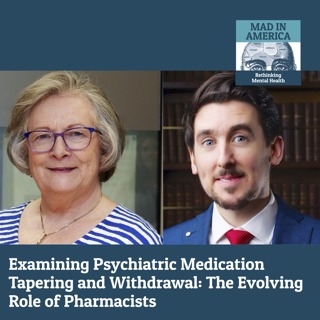
Examining Psychiatric Medication Tapering and Withdrawal: The Evolving Role of Pharmacists — A Conversation with Agnes Higgins and Cathal Cadogan

Examining Psychiatric Medication Tapering and Withdrawal: The Evolving Role of Pharmacists — A Conversation with Agnes Higgins and Cathal Cadogan

Welcome to the Mad in America podcast, my name is James. Today, we are discussing the experiences of people who have attempted to stop taking psychiatric drugs. These experiences are captured in a sur...

1 Huhti 32min
Spiritual Emergency and the Collective Work of Staying Alive: An Interview with Nisha Gupta

Spiritual Emergency and the Collective Work of Staying Alive: An Interview with Nisha Gupta

Nisha Gupta is an existential phenomenologist, a depth psychotherapist, a creativity scholar, and an artist. She's an Associate Professor of Psychology at the University of West Georgia and earned her...

25 Maalis 48min

The Political Systems Driving Abuse in Psychiatry: An Interview with Human Rights Lawyer Alicia Ely Yamin

The Political Systems Driving Abuse in Psychiatry: An Interview with Human Rights Lawyer Alicia Ely Yamin

Alicia Ely Yamin is the Director of the Global Health and Rights Project and a lecturer at Harvard Law School. She's also an adjunct senior lecturer on health policy and management at the Harvard T.H....

18 Maalis 45min
History, Eugenics, and an Inquiry into Mad Consciousness: A Conversation With Susanne Paola Antonetta

History, Eugenics, and an Inquiry into Mad Consciousness: A Conversation With Susanne Paola Antonetta

Susanne Paola Antonetta is an accomplished writer and poet, the author of numerous books, and in 2001 her book Body Toxic: An Environmental Memoir, won a prestigious American Book Award. Her latest bo...

11 Maalis 49min

How Our Blindness to Context Harms Patients and Breaks Practitioners: A Conversation With Kamaldeep Bhui

How Our Blindness to Context Harms Patients and Breaks Practitioners: A Conversation With Kamaldeep Bhui

Kamaldeep Bhui is Professor of Psychiatry at the University of Oxford and Honorary Professor at Queen Mary University of London. He is internationally recognized for his groundbreaking work on cultura...

4 Maalis 51min
UberTherapy and the Enshittification of our Relational Lives: Part 2 of our Interview with Elizabeth Cotton

UberTherapy and the Enshittification of our Relational Lives: Part 2 of our Interview with Elizabeth Cotton

Elizabeth Cotton is Associate Professor of Responsible Business at the University of Leicester and the founder of Surviving Work, which carries out socially engaged research on mental health and work....

18 Helmi 39min
UberTherapy and the Enshittification of our Relational Lives: Part 1 of our Interview with Elizabeth Cotton

UberTherapy and the Enshittification of our Relational Lives: Part 1 of our Interview with Elizabeth Cotton

Elizabeth Cotton is Associate Professor of Responsible Business at the University of Leicester and the founder of Surviving Work, which carries out socially engaged research on mental health and work....

11 Helmi 46min
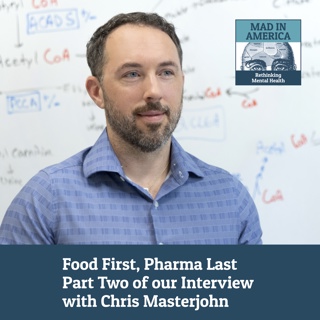
Food First, Pharma Last - Part Two of our Interview with Chris Masterjohn

Food First, Pharma Last - Part Two of our Interview with Chris Masterjohn

This week, we are joined by Chris Masterjohn, PhD. Chris is a nutritional scientist, a former professor, and the founder of Mitome. With a PhD in nutritional science and years of research in mitochond...

28 Tammi 44min

Suosittua kategoriassa Terveys ja hyvinvointi

unicast
psykopodiaa-podcast
voi-hyvin-meditaatiot-2
tiedenaiset-podcast
rss-pitaisko-erota
vakeva-elama-viisaampi-mieli-vahvempi-keho
meditaatiot-suomeksi
rss-narsisti
puhu-muru
junnut-pelissa
terapiassa
aamukahvilla
mielen-puolikkaat
rss-mighty-finland-podcast
rss-kuumilla-aalloilla
paritellen
rss-pt-paahtio
rss-adama-mindful-hetki
rss-en-saa-unta
rss-vapaudu-voimaasi