Peter Breggin - The Conscience of Psychiatry (Part 1)

Peter Breggin - The Conscience of Psychiatry (Part 1)

This week we have a very special guest for you, it has been my honour to be able to interview Dr. Peter Breggin.

Dr. Breggin is a Harvard-trained psychiatrist and former Consultant at the National Institute of Mental Health (NIMH). He has been called "The Conscience of Psychiatry" for his many decades of successful efforts to reform the mental health field.

His work provides the foundation for modern criticism of psychiatric diagnoses and drugs, and leads the way in promoting more caring and effective therapies. His research and educational projects have brought about major changes in the FDA-approved Full Prescribing Information or labels for dozens of antipsychotic and antidepressant drugs. He continues to educate the public and professions about the tragic psychiatric drugging of America's children.

He has authored dozens of scientific articles and more than twenty books, including medical books and the bestsellers Toxic Psychiatry and Talking Back to Prozac. His most recent three books are Guilt, Shame and Anxiety: Understanding and Overcoming Negative Emotions; Medication Madness: the Role of Psychiatric Drugs in Cases of Violence, Suicide and Murder; and Psychiatric Drug Withdrawal: A Guide for Prescribers, Therapists, Patients and their Families.

As a medical-legal expert, Dr. Breggin has unprecedented and unique knowledge about how the pharmaceutical industry too often commits fraud in researching and marketing psychiatric drugs. He has testified many times in malpractice, product liability and criminal cases, often in relation to adverse drug effects and more occasionally electroshock and psychosurgery. A list of his trial testimony since 1985 is contained in the last section of his Resume on Dr. Breggin's website.

Dr. Breggin has taught at many universities and has a private practice of psychiatry in Ithaca, New York.

For a career as long and distinguished as Dr. Breggin's we have decided to devote two episodes to hearing him speak. This first part covers Dr. Breggin's career, his views on psychiatry and psychiatric drugs and also recent developments with the trial involving Michelle Carter.

Part 2 of the interview will focus more on the trial and Dr. Breggin's involvement.

In this episode, we discuss:

How, age just 18, Dr. Breggin worked as a volunteer in a metropolitan state hospital in 1954.

That his immediate impression was a comparison with German concentration camps as he witnessed the brutality including lobotomy and insulin coma therapy.

How when the drugs were introduced, primarily Thorazine, the patients would quieten, becoming docile and obedient.

That this was brain damage for the purpose of control.

That Dr. Breggin then wanted to go to medical school and become part of the reform movement.

That, in the 1950s, there were still psychiatrists that had an interest and training in psychological therapy or psychoanalytic approaches, and social and community psychology.

That this also resulted in psychiatry becoming very hostile towards psychosocial approaches, which were less expensive and better.

Then, in the 1960s, psychiatry went into partnership with the drug companies and got richer.

That Dr. Breggin then entered private practice and learned that lobotomy was making a comeback. This led to a multi year, international campaign to halt the use of lobotomy and psychosurgery in the western world.

Since then, Dr. Breggin has also campaigned tirelessly to make changes in the FDA labelling of psychotropic drugs.

That Dr. Breggin feels blessed to have been able to stand up for others but also occasionally feels worried by the attacks from the psychiatric establishment.

How Dr. Breggin feels that we should tell the truth about psychiatric drugs and that claims of 'scaremongering' is a mechanism to reduce criticism of the drugs.

That informing people is very different compared to frightening them.

That each individual person is still the best judge of when and how to go about withdrawing from psychiatric medications.

That Dr. Breggin feels that psychiatry has no economic incentive to change, so the consumer has to stop going to psychiatrists for medications.

How the District Attorney in the Michelle Carter case is now trying to stop Dr. Breggin's Mad in America blogs about her case.

Relevant Links

Peter Breggin's personal website

Dr. Breggin's blogs on Mad in America:

Part 1

Part 2

Michelle Carter Blogs and Archives

The handwritten note from the DA to the Judge about stopping Dr. Breggin's blog

Toxic Psychiatry

Talking Back to Prozac

Guilt, Shame and Anxiety: Understanding and Overcoming Negative Emotions

Medication Madness: the Role of Psychiatric Drugs in Cases of Violence, Suicide and Murder

Psychiatric Drug Withdrawal: A Guide for Prescribers, Therapists, Patients and their Families.

To get in touch with us email: podcasts@madinamerica.com

© Mad in America 2017

Jaksot(290)

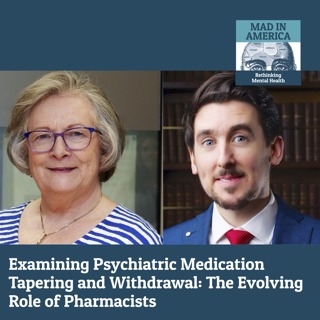
Examining Psychiatric Medication Tapering and Withdrawal: The Evolving Role of Pharmacists — A Conversation with Agnes Higgins and Cathal Cadogan

Examining Psychiatric Medication Tapering and Withdrawal: The Evolving Role of Pharmacists — A Conversation with Agnes Higgins and Cathal Cadogan

Welcome to the Mad in America podcast, my name is James. Today, we are discussing the experiences of people who have attempted to stop taking psychiatric drugs. These experiences are captured in a sur...

1 Huhti 32min
Spiritual Emergency and the Collective Work of Staying Alive: An Interview with Nisha Gupta

Spiritual Emergency and the Collective Work of Staying Alive: An Interview with Nisha Gupta

Nisha Gupta is an existential phenomenologist, a depth psychotherapist, a creativity scholar, and an artist. She's an Associate Professor of Psychology at the University of West Georgia and earned her...

25 Maalis 48min
The Political Systems Driving Abuse in Psychiatry: An Interview with Human Rights Lawyer Alicia Ely Yamin

The Political Systems Driving Abuse in Psychiatry: An Interview with Human Rights Lawyer Alicia Ely Yamin

Alicia Ely Yamin is the Director of the Global Health and Rights Project and a lecturer at Harvard Law School. She's also an adjunct senior lecturer on health policy and management at the Harvard T.H....

18 Maalis 45min
History, Eugenics, and an Inquiry into Mad Consciousness: A Conversation With Susanne Paola Antonetta

History, Eugenics, and an Inquiry into Mad Consciousness: A Conversation With Susanne Paola Antonetta

Susanne Paola Antonetta is an accomplished writer and poet, the author of numerous books, and in 2001 her book Body Toxic: An Environmental Memoir, won a prestigious American Book Award. Her latest bo...

11 Maalis 49min
How Our Blindness to Context Harms Patients and Breaks Practitioners: A Conversation With Kamaldeep Bhui

How Our Blindness to Context Harms Patients and Breaks Practitioners: A Conversation With Kamaldeep Bhui

Kamaldeep Bhui is Professor of Psychiatry at the University of Oxford and Honorary Professor at Queen Mary University of London. He is internationally recognized for his groundbreaking work on cultura...

4 Maalis 51min
UberTherapy and the Enshittification of our Relational Lives: Part 2 of our Interview with Elizabeth Cotton

UberTherapy and the Enshittification of our Relational Lives: Part 2 of our Interview with Elizabeth Cotton

Elizabeth Cotton is Associate Professor of Responsible Business at the University of Leicester and the founder of Surviving Work, which carries out socially engaged research on mental health and work....

18 Helmi 39min
UberTherapy and the Enshittification of our Relational Lives: Part 1 of our Interview with Elizabeth Cotton

UberTherapy and the Enshittification of our Relational Lives: Part 1 of our Interview with Elizabeth Cotton

Elizabeth Cotton is Associate Professor of Responsible Business at the University of Leicester and the founder of Surviving Work, which carries out socially engaged research on mental health and work....

11 Helmi 46min
Food First, Pharma Last - Part Two of our Interview with Chris Masterjohn

Food First, Pharma Last - Part Two of our Interview with Chris Masterjohn

This week, we are joined by Chris Masterjohn, PhD. Chris is a nutritional scientist, a former professor, and the founder of Mitome. With a PhD in nutritional science and years of research in mitochond...

28 Tammi 44min

Suosittua kategoriassa Terveys ja hyvinvointi

unicast
psykopodiaa-podcast
voi-hyvin-meditaatiot-2
tiedenaiset-podcast
rss-pitaisko-erota
vakeva-elama-viisaampi-mieli-vahvempi-keho
meditaatiot-suomeksi
rss-narsisti
puhu-muru
junnut-pelissa
terapiassa
aamukahvilla
mielen-puolikkaat
rss-mighty-finland-podcast
rss-kuumilla-aalloilla
paritellen
rss-pt-paahtio
rss-adama-mindful-hetki
rss-en-saa-unta
rss-vapaudu-voimaasi