John Read - What the Science and Evidence Tell Us About Electroshock (ECT)

John Read - What the Science and Evidence Tell Us About Electroshock (ECT)

This week we have an interview with Professor John Read. Professor Read worked for nearly 20 years as a Clinical Psychologist and manager of mental health services in the UK and the USA, before joining the University of Auckland, New Zealand, where he worked until 2013.

He has served as Director of the Clinical Psychology professional graduate programmes at both Auckland and, more recently, the University of Liverpool.

He has published over 120 papers in research journals, primarily on the relationship between adverse life events (eg child abuse/neglect, poverty etc.) and psychosis. He also researches the negative effects of bio-genetic causal explanations on prejudice, the opinions and experiences of recipients of anti-psychotic and anti-depressant medication, and the role of the pharmaceutical industry in mental health research and practice.

John is on the Executive Committee of the International Society for Psychological and Social Approaches to Psychosis (www.isps.org) and is the Editor of the ISPS's scientific journal 'Psychosis'.

He also a member of the BPS's Alternatives to Diagnosis working group.

In this episode we discuss professor Read's research interests and in particular, the science and evidence base for Electroconvulsive Therapy or Electroshock as its known in the United States.

In this episode we discuss:

  • How Professor Read became interested in psychology, partly because of difficulties in his younger years and he wanted to understand those experiences
  • That his first experiences with patients in a psychiatric ward would be that people often wanted to share traumatic experiences, but that the psychiatrists didn't seem that interested
  • That, by and large, mental health services around the world prefer to count symptoms and to medicate rather than to understand what has happened in a person's life
  • How John came to have an interest in and research the efficacy and safety of Electroconvulsive Therapy (Electroshock)
  • That ECT is designed to induce a grand mal seizure and it started as a treatment for people diagnosed as schizophrenic
  • That the justification in the 1940s was that schizophrenics did not suffer with epilepsy and epileptics did not suffer with schizophrenia, so psychiatry made the leap to inducing epileptic seizures as a 'cure' for schizophrenia
  • That nowadays it is not used for people labelled as schizophrenic but it is most often used for treating depression
  • How actually it is not the diagnosis that is the best predictor of who gets ECT, it's age and gender
  • Women aged over 60 are twice as often given ECT as men, and people over 60 are given it 2-3 times more often as those under 60
  • That the other rationale given for ECT treatment is the tendency for ECT to obscure traumatic memories because of memory loss
  • That the science and evidence tells us that after 70 years there has never been a single study showing that ECT is better than placebo beyond the end of the treatment period
  • That placebo in this sense is like sham surgery, the anaesthetic is given but not the electricity
  • That during the treatment (usually 3-4 weeks and an average of 8-10 sessions) roughly a third of those treated gain some lift of mood but that even for this minority of responders, the effect wears off after a few weeks
  • That this explains why some people will give anecdotal evidence that ECT saved their life and that they tend to have repeated treatments because they want the same life of mood
  • That the method used to assess success of the procedure is most often a rating scale or a 'clinical judgement scale' and these methods are open to bias
  • That there is not a single study that has ever shown that ECT can 'prevent suicide' when compared to placebo, the claims that it can are based on anecdotal evidence
  • That Earnest Hemingway killed himself shortly after receiving ECT saying "it was a brilliant cure, but unfortunately we lost the patient"
  • That there are temporary effects such as headaches after the procedure, but the enduring difficulties are often with memory loss which can be short term or longer term memories
  • Roughly a third of people will have serious, debilitating and ongoing memory loss which is caused by the brain damage caused by ECT
  • That the Guardian newspaper reported in April 2017 that ECT use was increasing in the UK but that their figures were wrong
  • That a third of psychiatrists will use ECT, a third will only use it after other options have been explored and a third will not use it under any circumstances
  • That ECT can get catatonic people moving and speaking but it is not difficult to artificially stimulate mood and it should not be seen as a cure
  • That there haven't been any placebo controlled trials of ECT since 1985 and that was the last of only four that have ever been done that compared ECT with placebo after the end of treatment
  • How the fact that we do not have any successful trials showing that ECT is effective should mean that psychiatry either puts effort into proper research or that the procedure should be stopped
  • That John feels that eventually we will look back at ECT in the same way that we now view lobotomy, blood letting, rotating chairs and the like
  • How the principle should be informed consent and that people should be able to get treatment that they feel will help them but only if they know fully the risks and benefits and if they have been offered alternatives
  • There is a low but signifiant death rate from ECT, partly down to the general anaesthetic and partly due to cardiovascular failure because of the induced seizure but this death rate is never mentioned to potential patients
  • That it is probably down to the placebo effect of having attention and a procedure that expectations are created and hope is raised
  • That there is effort being put now into transcranial magnetic stimulation (TMS) and people can actually shock themselves using this method
  • That if we have large numbers of people walking round depressed, we really need to start asking questions about our society rather than trying to artificially eradicate those feelings
  • That John's view is that depression is largely cause by depressing things happening to people rather than because of depressive illness and assuming that we can identify the parts of the brain that are 'diseased'

To get in touch with us email: podcasts@madinamerica.com

© Mad in America 2017

Jaksot(291)

"Progress Only Occurs when People Make Demands" Paolo del Vecchio Reflects on a Life of Federal Service

"Progress Only Occurs when People Make Demands" Paolo del Vecchio Reflects on a Life of Federal Service

Paulo del Vecchio is a person in long-term recovery from mental health and addictions, who has been a leader in the peer recovery movement for 40 years. He recently completed a 30-year career at the U...

4 Kesä 202539min
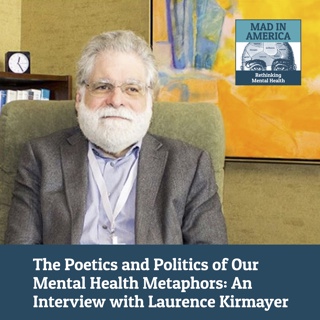
The Poetics and Politics of Our Mental Health Metaphors: An Interview with Laurence Kirmayer

The Poetics and Politics of Our Mental Health Metaphors: An Interview with Laurence Kirmayer

Laurence Kirmayer is one of the most influential figures in cultural psychiatry today. A psychiatrist, researcher, and theorist, he serves as James McGill Professor and Director of the Division of Soc...

21 Touko 202537min
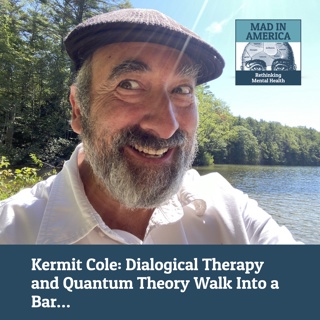
Kermit Cole: Dialogical Therapy and Quantum Theory Walk Into a Bar…

Kermit Cole: Dialogical Therapy and Quantum Theory Walk Into a Bar…

Hello, my name is Bob Whitaker, and today I have the pleasure of speaking with Kermit Cole. We'll be speaking about a philosophical enterprise that Kermit is now deeply engaged in. That is, broadly sp...

7 Touko 202536min
Chemically Imbalanced: Joanna Moncrieff on the Making and Unmaking of the Serotonin Myth

Chemically Imbalanced: Joanna Moncrieff on the Making and Unmaking of the Serotonin Myth

Welcome to this Mad in America podcast. My name is Robert Whitaker, and I'm happy today to have the pleasure of speaking with Joanna Moncrieff. Dr. Moncrieff is a psychiatrist who works in the Nationa...

30 Huhti 202549min
Teralyn Sell and Jenn Schmitz: Breaking Out of the Prison of Prescribing and Finding the Freedom of Therapy

Teralyn Sell and Jenn Schmitz: Breaking Out of the Prison of Prescribing and Finding the Freedom of Therapy

On the Mad in America podcast this week, Brooke Siem, author of May Cause Side Effects, talks with Teralyn Sell and Jenn Schmitz about their journey from working in the prison system to challenging co...

16 Huhti 202548min
Psychology's Small Stories and the Call of the Other: An Interview with David Goodman

Psychology's Small Stories and the Call of the Other: An Interview with David Goodman

David Goodman is the Director of the Center for Psychological Humanities and Ethics and the Dean of the Woods College of Advancing Studies at Boston College, where he also teaches in the Department ...

9 Huhti 202543min
Psychotherapy and Psychosomatics: End of an Era for Independent Journals? An Interview With Giovanni Fava

Psychotherapy and Psychosomatics: End of an Era for Independent Journals? An Interview With Giovanni Fava

Welcome to Mad In America Radio. My name is Bob Whitaker, and today my guest is Italian psychiatrist, Giovanni Fava. From 1992 to 2022, Dr. Fava edited the journal Psychotherapy and Psychosomatics. We...

26 Maalis 202540min
Psychology, Personhood, and the Crisis of Neoliberalism: Jeff Sugarman on Theoretical and Critical Psychology

Psychology, Personhood, and the Crisis of Neoliberalism: Jeff Sugarman on Theoretical and Critical Psychology

Jeff Sugarman is a distinguished scholar in theoretical and philosophical psychology, known for his work examining the psychology of selfhood, human agency, and the sociopolitical underpinnings of psy...

19 Maalis 202553min

Suosittua kategoriassa Terveys ja hyvinvointi

unicast
psykopodiaa-podcast
voi-hyvin-meditaatiot-2
vakeva-elama-viisaampi-mieli-vahvempi-keho
tiedenaiset-podcast
rss-pitaisko-erota
rss-narsisti
puhu-muru
rss-kuumilla-aalloilla
rss-pt-paahtio
meditaatiot-suomeksi
selviytyjat-tarinoita-elamasta
terapiassa
fitnesskulmapodcast
junnut-pelissa
rss-nautinto
audio-sport-juoksu
fitnessvastaanotto
rss-addiktit
rss-seuraava-potilas