Michael O'Loughlin - Exploring Narrative Approaches to Psychological Distress

Michael O'Loughlin - Exploring Narrative Approaches to Psychological Distress

This week, Mad in America's news editor Justin Karter interviews Professor Michael O'Loughlin.

Professor O'Loughlin is a college professor and researcher at Adelphi University on Long Island. He is a licensed psychologist and a psychoanalyst in private practice in New Hyde Park, New York. Dr O'Loughlin writes critically about the biomedical model of psychiatry and psychology and also has a deep interest in psychiatric rights and social justice issues.

In 2015 as an editor he launched a book series entitled Psychoanalytic Studies: Clinical, Social, and Cultural Contexts, with Lexington Books.

In August 2017, with colleagues Dr. Awad Ibrahim (University of Ottawa), Dr, Gabrielle Ivinson (Manchester Metropolitan University), and Dr. Marek Tesar (University of Auckland), as series co-editors, he launched a book series, Critical Childhood & Youth Studies: Clinical, educational, social and cultural inquiry, to be published by Lexington Books.

Professor O'Loughlin talks about his childhood experiences and how they influenced his narrative and conversational approach to psychological distress.

In this episode we discuss

How Dr O'Loughlin's early experiences growing up in Ireland led to a deep interest in social justice issues, particularly poverty and inequality.

That as a young man in college he engaged in charity work and activism.

How, more recently, he became interested in psychiatry when he was appointed as a lecturer in clinical psychology, but realised that there weren't required courses on trauma or psychosis.

That this led to teaching courses in intergenerational trauma and the way that our history shapes us as people.

That Michael has engaged in autobiographical writing to understand the way that deprivations and injustices that he experienced had a formative impact on his own thinking and writing.

That another course on madness and psychosis was perceived by clinical psychology students as radical, leading to a realisation that mainstream psychology is a very conservative discipline.

How he became interested in interviewing psychiatric patients and telling stories that represented a diverse group of people and experiences of psychiatric services.

That this led to a project at Fountain House in New York City to see if narratives could be reinforced and shared.

That Michael does not himself use the terms mental illness or disorder because he feels that we need to be flexible and that even this terminology can be traumatising.

How he has recently focused on creating spaces where participants can share their experiences and stories and it shouldn't be a classification or categorization exercise.

That he has found many that have experienced the psychiatric system have felt that the system impeded their recovery.

That a collaborative team of Adelphi academics, Fountain House staff and Fountain House members will together publish research.

That Professor O'Loughlin feels that psychology and psychiatry are traditional and reactive disciplines and that psychiatry has been driven by pharmacological concerns.

How Michael's work with children is grounded in his own childhood experiences and a sense that human beings need nurturing spaces and validation.

That Michael is extremely disturbed about the medicating young children with drugs that are not known to be safe for them such as antipsychotic drugs.

The unwillingness to understand that a child's distress has an origin and that we have a responsibility to engage with the child and create a space for them to communicate.

How we define normality within such a narrow range that children find it very difficult to conform to society's expectations.

That there seems to be little room for a child in school, only room for a student.

That psychoanalysis has tools to understand our emotions and experiences but also has tools to help understand societal drivers that may underlie psychological distress.

The worry that talking therapies are being replaced by tick lists and categories and that we need to bring stories back into psychology.

Relevant links:

Michael O'Loughlin, PhD

Psychoanalytic Studies: Clinical, Social, and Cultural Contexts

Arthur Frank

Kathryn Bond Stockton

To get in touch with us email: podcasts@madinamerica.com

© Mad in America 2017

Jaksot(290)

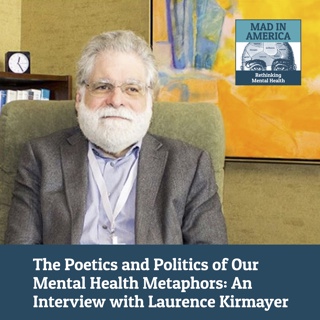
The Poetics and Politics of Our Mental Health Metaphors: An Interview with Laurence Kirmayer

The Poetics and Politics of Our Mental Health Metaphors: An Interview with Laurence Kirmayer

Laurence Kirmayer is one of the most influential figures in cultural psychiatry today. A psychiatrist, researcher, and theorist, he serves as James McGill Professor and Director of the Division of Soc...

21 Touko 202537min

Kermit Cole: Dialogical Therapy and Quantum Theory Walk Into a Bar…

Kermit Cole: Dialogical Therapy and Quantum Theory Walk Into a Bar…

Hello, my name is Bob Whitaker, and today I have the pleasure of speaking with Kermit Cole. We'll be speaking about a philosophical enterprise that Kermit is now deeply engaged in. That is, broadly sp...

7 Touko 202536min
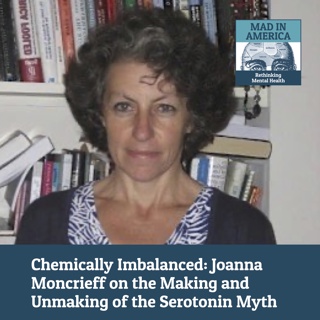
Chemically Imbalanced: Joanna Moncrieff on the Making and Unmaking of the Serotonin Myth

Chemically Imbalanced: Joanna Moncrieff on the Making and Unmaking of the Serotonin Myth

Welcome to this Mad in America podcast. My name is Robert Whitaker, and I'm happy today to have the pleasure of speaking with Joanna Moncrieff. Dr. Moncrieff is a psychiatrist who works in the Nationa...

30 Huhti 202549min
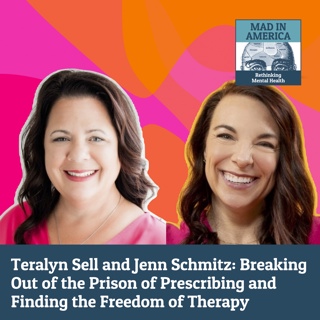
Teralyn Sell and Jenn Schmitz: Breaking Out of the Prison of Prescribing and Finding the Freedom of Therapy

Teralyn Sell and Jenn Schmitz: Breaking Out of the Prison of Prescribing and Finding the Freedom of Therapy

On the Mad in America podcast this week, Brooke Siem, author of May Cause Side Effects, talks with Teralyn Sell and Jenn Schmitz about their journey from working in the prison system to challenging co...

16 Huhti 202548min
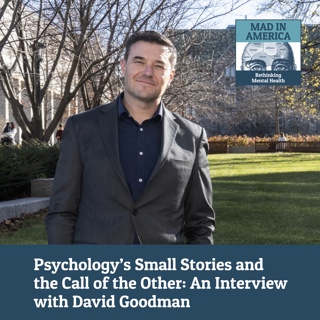
Psychology's Small Stories and the Call of the Other: An Interview with David Goodman

Psychology's Small Stories and the Call of the Other: An Interview with David Goodman

David Goodman is the Director of the Center for Psychological Humanities and Ethics and the Dean of the Woods College of Advancing Studies at Boston College, where he also teaches in the Department ...

9 Huhti 202543min
Psychotherapy and Psychosomatics: End of an Era for Independent Journals? An Interview With Giovanni Fava

Psychotherapy and Psychosomatics: End of an Era for Independent Journals? An Interview With Giovanni Fava

Welcome to Mad In America Radio. My name is Bob Whitaker, and today my guest is Italian psychiatrist, Giovanni Fava. From 1992 to 2022, Dr. Fava edited the journal Psychotherapy and Psychosomatics. We...

26 Maalis 202540min
Psychology, Personhood, and the Crisis of Neoliberalism: Jeff Sugarman on Theoretical and Critical Psychology

Psychology, Personhood, and the Crisis of Neoliberalism: Jeff Sugarman on Theoretical and Critical Psychology

Jeff Sugarman is a distinguished scholar in theoretical and philosophical psychology, known for his work examining the psychology of selfhood, human agency, and the sociopolitical underpinnings of psy...

19 Maalis 202553min
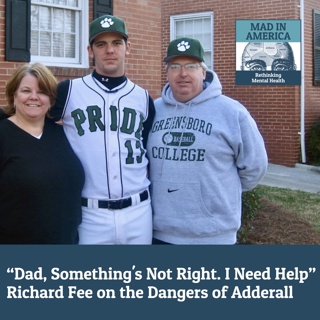
"Dad, Something's Not Right. I Need Help"- Richard Fee on the Dangers of Adderall

"Dad, Something's Not Right. I Need Help"- Richard Fee on the Dangers of Adderall

Welcome to the Mad in America podcast. My name is Brooke Siem, and I'm the author of May Cause Side Effects. Today, I'm here with Rick Fee, president of the Richard Fee Foundation. Rick joins us to ta...

5 Maalis 202547min

Suosittua kategoriassa Terveys ja hyvinvointi

unicast
tiedenaiset-podcast
psykopodiaa-podcast
voi-hyvin-meditaatiot-2
rss-pitaisko-erota
vakeva-elama-viisaampi-mieli-vahvempi-keho
meditaatiot-suomeksi
junnut-pelissa
rss-mighty-finland-podcast
puhu-muru
rss-narsisti
terapiassa
paritellen
aamukahvilla
mielen-puolikkaat
rss-uplevel-by-sonja-hannus
rss-pt-paahtio
rss-vapaudu-voimaasi
rss-adama-mindful-hetki
rss-nautinto