Lucy Johnstone - The Power Threat Meaning Framework

Lucy Johnstone - The Power Threat Meaning Framework

This week, we interview Dr Lucy Johnstone. Lucy is a clinical psychologist, trainer, speaker and writer, and a long-standing critic of the biomedical model of psychiatry. She has worked in adult mental health settings for many years, alternating with academic posts.

Lucy has authored a number of books, including 'Users and Abusers of Psychiatry'(Routledge 2000), and 'A Straight-talking Introduction to Psychiatric Diagnosis' (PCCS Books 2014) as well as a number of articles and chapters on topics such as psychiatric diagnosis, formulation and the role of trauma in breakdown. She has a blog on Mad in America.

Lucy kindly took time out talk to me about the new Power Threat Meaning Framework, an ambitious attempt to outline a conceptual alternative to psychiatric diagnosis which was published on January 12th this year by the Division of Clinical Psychology of the British Psychological Society.

In this episode we discuss:

  • Lucy's background and what led her to be interested in mental health work, particularly in terms of being critical of current practice.
  • The importance of acknowledging the reality of people's experiences of distress along with questioning the dominant explanations for that distress.
  • The fact that the diagnostic model has never been supported by evidence.
  • How imposing a diagnosis often can be very damaging to people, by turning 'people with problems' into 'patients with illnesses.'
  • Why we need to move towards the survivor slogan of "Instead of asking "What is wrong with you?" ask "What has happened to you?"'
  • The inception of the Power Threat Meaning Framework, which was funded by the Division of Clinical Psychology of the British Psychological Society, and the five-year journey to its release earlier this year.
  • The composition of the core project team: Lucy, Mary Boyle, John Cromby, Jacqui Dillon, John Read, Peter Kinderman, Eleanor Longden, Dave Harper, Dave Pilgrim and a research assistant Kate Allsopp. The core team consists of psychologists and survivors/campaigners, many of whom are well known to MIA readers. Also involved were a consultancy group of service users/carers; a group of critical readers with a particular focus on diversity; and a number of others who contributed to particular sections or supplied good practice examples.
  • How the Framework itself is not an official DCP or BPS position or policy document, nor is it a plan for services or for any other specific form of implementation. Rather, it is offered as a co-produced academic and conceptual resource to anyone who wishes to take on these ideas and principles and develop them further or translate them into practice.
  • The Framework is necessarily dense because of its aim to move right away from the "DSM/ICD mindset" which is deeply rooted in Western culture. However, there are various accessible summaries of its core principles (see below.)
  • How we already have a number of ways of supporting someone non-diagnostically, but what we didn't have before was a sound, evidence-based alternative to what diagnosis claims, but fails to do, which is to outline patterns in distress.
  • How the Framework acknowledges the irreducible complexity of a person's responses to their circumstances.
  • The derivation of the title: The Power Threat Meaning Framework.
  • The four main questions, which are:
    • What has happened to you? Translated as "How is Power operating in your life?"
    • How did it affect you? Translated as "What kinds of Threats does this pose?"
    • What sense did you make of it? Translated as "What is the Meaning of these situations and experiences to you?"
    • What did you have to do to survive? Translated as "What kinds of Threat Response are you using?"
    • Finally "What are your strengths?" or "What access to Power resources do you have?" and to pull it all together, "What is your story?"
  • These are not separate questions, since each of them implies and arises out of the others.
  • That the aim is for people to be able to use these ideas and questions for themselves, not necessarily through an interaction with a professional.
  • How the PTM Framework does not recognise a separate group of people who are 'mentally ill' but describes how we are all subject to, and affected by, the negative impact of power in some aspects of our lives.
  • How it is particularly important to recognise the role of ideological power, or power over language, meaning and agendas.
  • How the PTM Framework includes the concept of formulation, which is a semi-structured way of putting together someone's story, but is much wider in scope and for that reason uses the preferred term "narrative" – which may be individual, group or community.
  • How diagnosis often obscures someone's story, and how the Framework aims to help create narratives that restore the links between personal distress and social injustice.
  • What the PTM Framework says about DSM and ICD attitudes to conceptualisations of distress in non-Western cultures.
  • That since we are meaning-making creatures, at a very basic level the principles of power, threat, meaning and threat response apply across time and across cultures, although all expressions and experiences of distress are culturally-shaped.
  • The regrettable exporting of Western psychiatric models across the world.
  • How the Framework does not exclude or deny the role of biology, but integrates it as a mediator and enabler of all human experience, although not something that is always accurate or helpful to view as a primary cause.
  • The reaction to the Framework, both positive and negative. The team very much welcomes feedback, much of which has been very helpful. Some of the more extreme reactions can be understood as predictable responses to the threat posed by the Framework to ideological power.
  • How the reaction outside social media has been overwhelmingly positive.
  • Emphasising again that the Framework is (unlike diagnosis) presented as a completely optional set of ideas, and a work in progress. The project team is very pleased that there is such widespread interest in taking these ideas forward in people's own lives and settings.
  • People are encouraged to explore these ideas for themselves via the links below. More resources will be added in due course.

Relevant links:

PTM Framework Introduction and Frequently Asked Questions

The above link will take you to the following:

Power Threat Meaning Framework Main document

Power Threat Meaning Framework Overview

PTM Framework Guided Discussion for applying these ideas to your own life or someone you are working with

Presentation slides from the PTM Framework launch

The Power Threat Meaning Framework 2 page summary

You may also be interested in these articles and blogs on the Framework:

Publication of the Power Threat Meaning Framework: Mad in America blog

A mental health nurse's first response to the launch of the Power Threat Meaning Framework

My mother took her own life – and now I know a different mental health approach could have saved her

An Alternative to Psychiatric Diagnosis?

The PTM Framework, where do we go from here?

I've Been Waiting for this Since I Was a Child

The Power Threat Meaning Framework: a radically different perspective on mental health

Lucy's interview on Let's Talk Withdrawal can be found here:

Lucy's interview on Let's Talk Withdrawal (April 2017)

To get in touch with us email: podcasts@madinamerica.com

© Mad in America 2018

Jaksot(292)

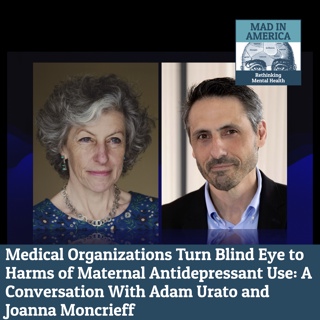
Medical Organizations Turn Blind Eye to Harms of Maternal Antidepressant Use: A Conversation With Adam Urato and Joanna Moncrieff

Medical Organizations Turn Blind Eye to Harms of Maternal Antidepressant Use: A Conversation With Adam Urato and Joanna Moncrieff

On July 21st 2025, the FDA convened a hearing on maternal use of antidepressants during pregnancy and the impact this use has on fetal development. Around 400,000 children in the United States are bor...

8 Loka 202548min
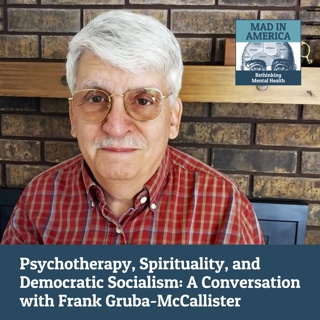
Psychotherapy, Spirituality, and Democratic Socialism: A Conversation with Frank Gruba-McCallister

Psychotherapy, Spirituality, and Democratic Socialism: A Conversation with Frank Gruba-McCallister

Frank Gruba-McCallister is a clinical psychologist, educator, and scholar whose career spans more than three decades of teaching and academic leadership. He served as Vice President of Academic Affai...

24 Syys 202544min
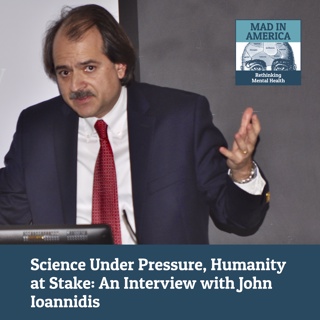
Science Under Pressure, Humanity at Stake: An Interview with John Ioannidis

Science Under Pressure, Humanity at Stake: An Interview with John Ioannidis

John Ioannidis is a Stanford professor, a physician, and one of the most eminent scholars in the world in the field of evidence-based medicine. Ioannidis has spent his career exposing the weak foundat...

10 Syys 202551min
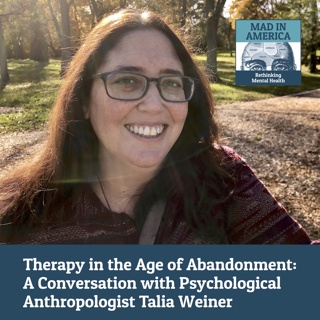
Therapy in the Age of Abandonment: A Conversation with Psychological Anthropologist Talia Weiner

Therapy in the Age of Abandonment: A Conversation with Psychological Anthropologist Talia Weiner

Talia Weiner is a psychological anthropologist, licensed professional counselor, and assistant professor of psychology at the University of West Georgia. As a medical and psychological anthropologist,...

3 Syys 202537min

How to be a Critical Psychologist Without Losing Your Soul: A Conversation With Zenobia Morrill, José Giovanni Luiggi-Hernández and Justin Karter

How to be a Critical Psychologist Without Losing Your Soul: A Conversation With Zenobia Morrill, José Giovanni Luiggi-Hernández and Justin Karter

On the Mad in America podcast this week, we explore the importance of raising awareness of psychological approaches that challenge mainstream perspectives. Joining us today are three people who are pr...

13 Elo 202545min

Is Dialogue the Best Medicine? A Conversation With Jaakko Seikkula

Is Dialogue the Best Medicine? A Conversation With Jaakko Seikkula

Welcome to MIA Radio. Today, we are pleased to have as our guest Jaakko Seikkula. Jaakko is a psychologist who helped develop the Open Dialogue practice at Keropudas Hospital in Tornio, Finland, in th...

30 Heinä 202545min
"I Made it Through the Horrors of Psychiatric Drug Withdrawal" A Conversation with Comedian Dex Carrington

"I Made it Through the Horrors of Psychiatric Drug Withdrawal" A Conversation with Comedian Dex Carrington

Jørgen Kjønø, whose stage name is Dex Carrington, is a Norwegian-American stand-up comedian based in Oslo, Norway. He is also an actor, host of the Truth Train podcast, and former travel show host who...

9 Heinä 202542min
Why Psychosis Is Not So Crazy: A Conversation with Stijn Vanheule

Why Psychosis Is Not So Crazy: A Conversation with Stijn Vanheule

Stijn Vanheule is a clinical psychologist, psychoanalyst, and professor of psychology at Ghent University. Trained in the Lacanian tradition, he has written widely on the structure of psychosis, the l...

25 Kesä 202544min

Suosittua kategoriassa Terveys ja hyvinvointi

unicast
voi-hyvin-meditaatiot-2
psykopodiaa-podcast
vakeva-elama-viisaampi-mieli-vahvempi-keho
tiedenaiset-podcast
rss-narsisti
rss-pitaisko-erota
puhu-muru
rss-kuumilla-aalloilla
terapiassa
rss-uplevel-by-sonja-hannus
katilon-kahvitunti
meditaatiot-suomeksi
junnut-pelissa
rss-rakas-mielenterveyteni
audio-sport-juoksu
rss-pt-paahtio
rss-addiktit
fitnessvastaanotto
rss-kyykkya-ja-kuoharia