

World Benzodiazepine Awareness Day 2018 - Part 2 - Robert Whitaker

World Benzodiazepine Awareness Day 2018 - Part 2 - Robert Whitaker

This week on MIA Radio, we present a special episode of the podcast to join in the many events being held for World Benzodiazepine Awareness Day, July 11, 2018.

In part 2 of the podcast, we interview Mad in America founder, Robert Whitaker. For many of us, Robert needs no introduction as he is well known for his award-winning book, Anatomy of an Epidemic: Magic Bullets, Psychiatric Drugs, and the Astonishing Rise of Mental Illness in America, which was released in 2010.

Robert has been a medical writer at the Albany Times Union newspaper, A journalism fellow at the Massachusetts Institute of Technology and Director of publications at the Harvard Medical School. Besides many papers, journals and articles, Robert has written five books which include Mad In America: Bad Science, Bad Medicine, and The Enduring Mistreatment of the Mentally Ill in 2001, Anatomy of an Epidemic in 2010 and Psychiatry Under The Influence: Institutional Corruption, Social Injury, and Prescriptions for Reform published in 2015.

We discuss:
  • What took Bob from writing as an industry insider covering clinical trials to founding Mad in America.
  • How writing a story about the botched introduction of laparoscopic surgery led to an interest in how commerce was corrupting healthcare.
  • How Freedom of Information requests led to an understanding of the corruption in the clinical trials of antipsychotic drugs.
  • What led to writing the book Mad in America: Bad Science, Bad Medicine, and The Enduring Mistreatment of the Mentally Ill in 2001.
  • That, when you look at the science, you see an enduring theme in psychiatry of treatments that are full of promise, but ultimately can lead to harm.
  • That Bob came to these issues as a journalist who felt a sense of public duty to be an honest reporter of the facts and the science.
  • The extraordinary history behind the revival of the market for benzodiazepines.
  • How Valium became the western world's most prescribed psychiatric drug during the late 1960s.
  • How, in the 1970s, it became apparent that people were struggling to get off the drugs.
  • That women's magazines started to write about the experiences of women addicted to Valium, and it was recognised as a bigger issue than heroin addiction.
  • That the reaction by the pharmaceutical manufacturers was to reconceptualize anxiety-related distress as depressive distress and move patients on to SSRIs.
  • How in 1980, in the third version of the Diagnostic and Statistical Manual, a new disorder is named: Panic Disorder, leading the maker of Alprazolam, Upjohn, to get it approved specifically for the treatment of panic disorder.
  • How the study published showed that the reduction in panic attacks in the medicated group over four weeks was greater than the unmedicated group, but the study actually ran for eight weeks, by which time there was no difference between the medicated and unmedicated groups.
  • That in the six-week withdrawal phase of the study, 44% were not able to stop the drugs.
  • How newspapers reported that Xanax (Alprazolam) was an efficacious, safe and non-addictive treatment for panic disorder.
  • That what you see in the heart of the Xanax story is a betrayal of the public.
  • The reasons why doctors often don't review the papers that would lead them to conclude that benzodiazepines are highly problematic drugs.
  • A paper from a new International Task Force on Benzodiazepines which seems to be a statement of intent to increase benzodiazepine prescribing.
  • That people should keep on telling their stories of withdrawal and iatrogenic harm.
  • The attempt in Massachusetts to pass a bill requiring informed consent.
  • The problems inherent in using the language of withdrawal when the symptoms are protracted and that it would be more appropriate to describe this as a neurological injury.
  • That the benzodiazepine community is doing an incredible service by alerting the public to what should be seen as a public health crisis.
Relevant links:

Revival of the market for Benzodiazepines

Malcolm Lader: It is more difficult to withdraw people from benzodiazepines than it is from heroin

International Task Force on Benzodiazepines

Jaksot(292)

Psychology, Personhood, and the Crisis of Neoliberalism: Jeff Sugarman on Theoretical and Critical Psychology

Psychology, Personhood, and the Crisis of Neoliberalism: Jeff Sugarman on Theoretical and Critical Psychology

Jeff Sugarman is a distinguished scholar in theoretical and philosophical psychology, known for his work examining the psychology of selfhood, human agency, and the sociopolitical underpinnings of psy...

19 Maalis 202553min
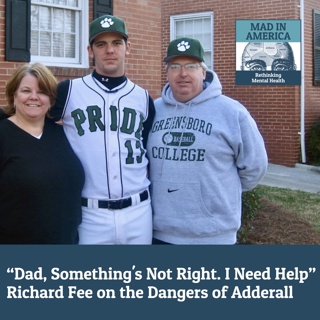
"Dad, Something's Not Right. I Need Help"- Richard Fee on the Dangers of Adderall

"Dad, Something's Not Right. I Need Help"- Richard Fee on the Dangers of Adderall

Welcome to the Mad in America podcast. My name is Brooke Siem, and I'm the author of May Cause Side Effects. Today, I'm here with Rick Fee, president of the Richard Fee Foundation. Rick joins us to ta...

5 Maalis 202547min

Psychotherapy and Social Change: Mick Cooper on Counseling, Pluralism, and Progressive Politics

Psychotherapy and Social Change: Mick Cooper on Counseling, Pluralism, and Progressive Politics

Mick Cooper is a leading voice in contemporary counseling psychology, known for his work at the intersection of psychotherapy and social change. A Professor of Counseling Psychology at the University ...

19 Helmi 202545min
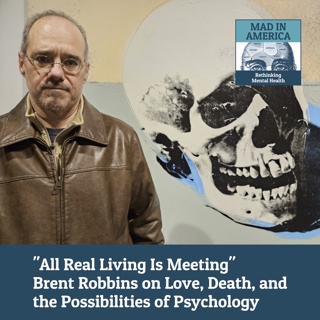
All Real Living Is Meeting - In Conversation With Brent Robbins - Part 2

All Real Living Is Meeting - In Conversation With Brent Robbins - Part 2

Brent Dean Robbins is a psychologist, scholar, and all-around thoughtful human whose work has profoundly shaped existential and humanistic psychology. He is one of those rare thinkers who makes psych...

12 Helmi 202552min

All Real Living Is Meeting - In Conversation With Brent Robbins - Part 1

All Real Living Is Meeting - In Conversation With Brent Robbins - Part 1

Brent Dean Robbins is a psychologist, scholar, and all-around thoughtful human whose work has profoundly shaped existential and humanistic psychology. He is one of those rare thinkers who makes psych...

12 Helmi 202553min

Kids Are Not The Problem: An Interview With Gretchen LeFever Watson

Kids Are Not The Problem: An Interview With Gretchen LeFever Watson

In this interview, Brooke Siem, who is the author of a memoir on antidepressant withdrawal, May Cause Side Effects, interviews Gretchen LeFever Watson, PhD. Gretchen is a developmental and clinical ps...

22 Tammi 202546min

Peer Support and Resistance - Becky Brasfield's Vision for Mental Health Justice

Peer Support and Resistance - Becky Brasfield's Vision for Mental Health Justice

Becky Brasfield has emerged as a formidable advocate for change in the complex landscape of mental health care. A certified recovery support specialist and policy researcher at the Human Services Rese...

8 Tammi 202540min

Mad Sisters: An Interview With Susan Grundy

Mad Sisters: An Interview With Susan Grundy

Susan Grundy is an author who writes about the weight of emotional distress and an easier way of being. Her book, Mad Sisters, is a highly personal account of her caregiving journey for an older siste...

11 Joulu 202448min

Suosittua kategoriassa Terveys ja hyvinvointi

unicast
voi-hyvin-meditaatiot-2
psykopodiaa-podcast
vakeva-elama-viisaampi-mieli-vahvempi-keho
tiedenaiset-podcast
rss-pitaisko-erota
puhu-muru
rss-narsisti
terapiassa
rss-kuumilla-aalloilla
rss-uplevel-by-sonja-hannus
junnut-pelissa
rss-rakas-mielenterveyteni
katilon-kahvitunti
meditaatiot-suomeksi
selviytyjat-tarinoita-elamasta
rss-duodecim-lehti
rss-ehjaksi
rss-vapaudu-voimaasi
rss-kyykkya-ja-kuoharia