Jim van Os - Towards Resilience and Possibilities and Away from Diseases and Symptoms

Jim van Os - Towards Resilience and Possibilities and Away from Diseases and Symptoms

This week on MIA Radio, we interview Professor Jim van Os. Professor van Os is Chairman of the Division of Neuroscience at Utrecht University Medical Centre, Utrecht, The Netherlands, and Visiting Professor of Psychiatric Epidemiology at King's College, Institute of Psychiatry in London. He trained in Psychiatry in Casablanca, Bordeaux and the Institute of Psychiatry and the Maudsley Royal Hospital in London.

We last spoke with Jim for the podcast in August 2017 and this time we focus on a recent paper written by Jim and co-authors that was published in the journal World Psychiatry in January 2019. The paper is entitled 'The diagnosis evidence-based group-level symptom-reduction model as organizing principle for mental health care. Time for change?'

In this episode we discuss:
  • What the diagnosis evidence-based group-level symptom-reduction model is and how it currently informs mainstream mental healthcare.
  • How mental health funding and mental health professional partners work together to monitor and assess the effects of current evidence-based interventions.
  • How this curative medical model is attractive, but often fails to work for patients.
  • That the focus on biological, brain-based diseases and symptoms conflicts with the experience of people who are attempting to develop a narrative view of their difficulties and suffering.
  • That the paper is an attempt to start a discussion about building a synthesis between the diagnosis, symptom-based medical world and the lived experience of individual people.
  • How the creation of specific and discrete diagnoses has reinforced the symptom-led approach to mental health and has also necessitated the stratification of doctors into silos of expertise.
  • How Jim favors a spectrum-based approach over a fixed diagnosis and that an example is autism spectrum disorder as described in DSM V.
  • The limitations of using 'target symptom reduction' as an outcome measure for mental health.
  • That symptom reduction can be beneficial in the short-term but is not a good long-term measure of recovery.
  • That the paper attempts to make clear how important individual experiences are and the need to be sensitive to the existential domain, saying "restoration of health is not the goal, it is the means to enable a person to find and pursue meaningful goals, accordingly, the person's existential values become central".
  • That the evidence suggests that any treatment effect or improvement is often down to meaningful interaction rather than the specific expertise of the treating professional.
  • That, in many countries, we still see a huge gulf between mental healthcare and social care which remain separate and remote from each other and that this separation is not how the person experiences their world.
  • The importance of including lived experience in the evidence base, particularly because randomized controlled trials, considered the gold standard of evidence, are often not conclusive in the field of mental health.
  • That, in mental health, evidence shows that 30% to 40% of the response is down to placebo and the expectation of being helped.
  • That the desire is to make the existential domain the primary lens through which to view human experience and to respond to mental or emotional suffering.
  • That, arguably, 'love is the most powerful evidence-based treatment in mental health'.

Relevant links:

Professor Jim van Os

The evidence-based group-level symptom-reduction model as the organizing principle for mental health care: time for change?

Tedx: Maastricht, Connecting to Madness

ISPS Liverpool Conference Jim Van Os Keynote Address

Schizophrenia does not exist

© Mad in America 2019

Tämä jakso on lisätty Podme-palveluun avoimen RSS-syötteen kautta eikä se ole Podmen omaa tuotantoa. Siksi jakso saattaa sisältää mainontaa.

Jaksot(308)

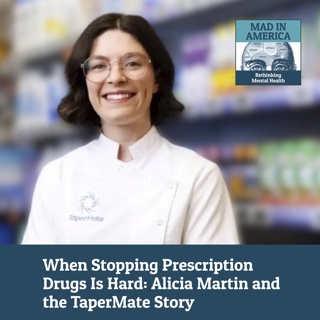
When Stopping Prescription Drugs Isn't Simple: Alicia Martin and the TaperMate Story

When Stopping Prescription Drugs Isn't Simple: Alicia Martin and the TaperMate Story

Alicia Martin is an Australian community pharmacist, a member of the Not Broken Project and founder of TaperMate. Through her work in pharmacy, Alicia saw patients struggling with unusual and severe s...

16 Syys 34min
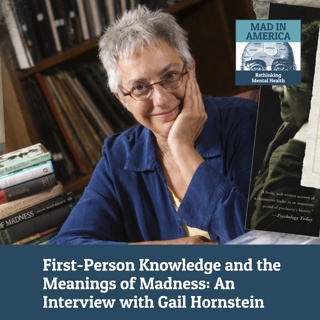
First-Person Knowledge and the Meanings of Madness: An Interview with Gail Hornstein

First-Person Knowledge and the Meanings of Madness: An Interview with Gail Hornstein

Gail Hornstein is Professor Emerita of Psychology at Mount Holyoke College. Across a long and influential career, her work has moved between psychology, psychoanalysis, history, qualitative research, ...

2 Syys 1h 8min
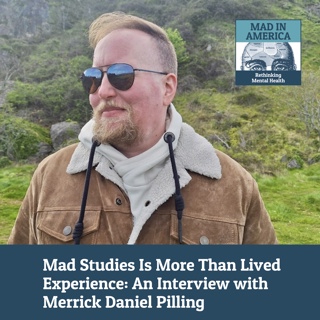
Mad Studies Is More Than Lived Experience: An Interview with Merrick Daniel Pilling

Mad Studies Is More Than Lived Experience: An Interview with Merrick Daniel Pilling

Merrick Daniel Pilling is an Associate Professor and Interim Co-Director of the School of Disability Studies at Toronto Metropolitan University. He is the author of Queer and Trans Madness: Struggles ...

19 Elo 49min

The West Doesn't Have All the Answers: An Interview with Dinesh Bhugra

The West Doesn't Have All the Answers: An Interview with Dinesh Bhugra

Dinesh Bhugra is a leading voice in social and cultural psychiatry. He is Emeritus Professor of Mental Health and Cultural Diversity at King's College London and has served as president of the Royal ...

12 Elo 36min
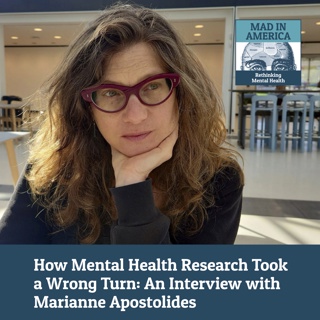
Go/No Go - How Mental Health Research Took a Wrong Turn: An Interview with Marianne Apostolides

Go/No Go - How Mental Health Research Took a Wrong Turn: An Interview with Marianne Apostolides

Marianne Apostolides is the award-winning author of eight books, four of which have been translated and published internationally. She is a two-time recipient of the Chalmers Arts Fellowship and winne...

29 Heinä 48min
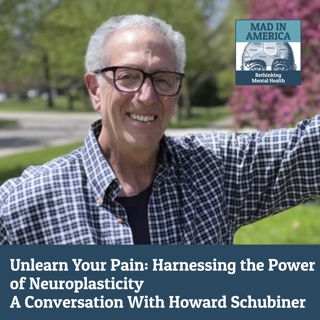
Unlearn Your Pain: Harnessing the Power of Neuroplasticity – A Conversation With Howard Schubiner

Unlearn Your Pain: Harnessing the Power of Neuroplasticity – A Conversation With Howard Schubiner

Welcome to the Mad in America podcast. My name is Brooke Siem, and I am the author of the award-winning memoir on antidepressant withdrawal, May Cause Side Effects. Today, I'm excited to have Dr. Howa...

15 Heinä 41min
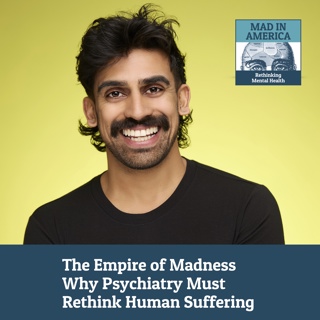
The Empire of Madness: Why Psychiatry Must Rethink Human Suffering - An Interview with Khameer Kidia

The Empire of Madness: Why Psychiatry Must Rethink Human Suffering - An Interview with Khameer Kidia

Khameer Kidia is a physician and an anthropologist, works at Harvard Medical School and the University of Zimbabwe, and spends his life between Washington DC and Harare. Kidia has many accolades to hi...

8 Heinä 48min
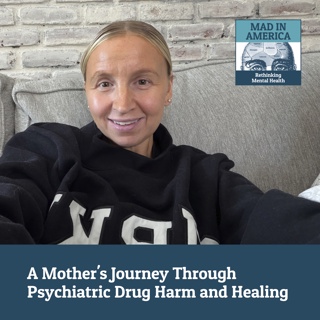
A Mother's Journey Through Psychiatric Drug Harm and Healing

A Mother's Journey Through Psychiatric Drug Harm and Healing

Chelsea McVeigh began her journey with psychiatric medications at 16, never imagining where it would lead. At 31, during a new pregnancy, she suffered a severe adverse reaction that turned her world u...

1 Heinä 24min

Suosittua kategoriassa Terveys ja hyvinvointi

unicast
aamukahvilla
vakeva-elama-viisaampi-mieli-vahvempi-keho
tiedenaiset-podcast
rss-pitaisko-erota
meditaatiot-suomeksi
psykopodiaa-podcast
terapiassa
rss-kuumilla-aalloilla
katilon-kahvitunti
voi-hyvin-meditaatiot-2
rss-sanelunpurku-podcast
rss-pt-paahtio
rss-duodecim-lehti
paritellen
fitnesskuplassa
rss-uplevel-by-sonja-hannus
rss-kehtaanko-kysya-podcast-aideille
rss-mighty-finland-podcast
selviytyjat-tarinoita-elamasta