Alita Taylor - Open Dialogue - Making Meaning

Alita Taylor - Open Dialogue - Making Meaning

This week on MIA Radio, we turn our attention to Open Dialogue and we chat with psychotherapist and Open Dialogue trainer Alita Taylor. Alita is a licensed Marriage & Family Therapist, trainer and facilitator based in Tacoma, Washington USA. Her passion is working from a community-based, non-expert, need-adapted Open Dialogue perspective, which utilizes social networks, family, and co-facilitation with other professionals.

In this recent blog, Alita shares why Open Dialogue 'cannot be taught, but needs a teacher'.

Love Is In the Air…

I am in love. I'm in love with this way of working. And I won't stop. Open Dialogue Washington began in 2018 upon my graduation/commencement from Jaakko Seikkula's dialogic approaches to couple and family therapy trainer/supervisor training, in collaboration with Dialogic Partners and the University of Jyväskylä.

In 2016, I embarked to partake in the best training course I had ever experienced as a family therapist. The embodiment I experienced working with my Open Dialogue colleagues felt like the missing key in psychiatry and psychotherapy. Something intangible, yet what I knew all along. Something ineffable, yet also a shared language. Something deeply and autonomically human, yet unrepeatable and fleeting. It led me onto a moment-by-moment path where everything I learned in my 27-year long career about systemic family therapy and emergency psychiatric protocols ebbed, and the present moment of love flowed, neither the ebbing knowledge nor the cresting wisdom having any lesser value than the other. The complete work we do in mental health care is this ocean of love.

We are in constant change when we are in crisis. Timelessness sets in. Growth is happening. We don't exactly know what we need. That is what mental health work is, sitting with this human happening. In the in-between space, something happens, and we don't know what will. This is the paradox. We are navigating the ebb and flow of incoming knowledge we have from research and the ebb and flow in each patient and family's difficulties (the meanings they make of them).

"It cannot be taught, but it needs a teacher."

After getting trained to facilitate and supervise Open Dialogue, I found that this is the crux of the work, holding more than one truth. As human beings, as a society, as mental health practitioners, we must be able to ask what is helpful, and we must be willing to co-provide this "help" creatively, without barriers, between the digitized rows and columns of tick-boxes and presumptive diagnostic menus. Remember the analog world of dials and infinite decimals? Agency lies within ourselves to expand the possibilities, to be willing to open to solutions that have not yet been tried.

Michael Pohl wrote about dialogical leadership and culture in which he referenced Karl-Martin Dietz and Thomas Kracht of the Hardenberg Institute for Cultural Studies in Heidelberg, Germany. Michael remembered a discussion on whether dialogism can be taught or experienced. It was argued that the dialogic attitude cannot be learned and that any thought of teaching it is unnecessary. Michael disagreed. He writes, "It cannot be taught, but it needs a teacher."— Medium.com, March 2018.

In Helsinki and Tornio while learning the Open Dialogue approach, I had many teachers: Jorma Ahonen, Pekka Borchers, Birgitta Alakare, Aino Maija Rautkallio, Kari Valtanen, Tom Erik Arnkil, Jaakko Seikkula, Tapio Salo, Tanja Pihlaja, Eija-Liisa Rautiainen, Pekka Holm. How did they do it? To quote Birgitta Alakare when she was asked about the beginnings of the development of Open Dialogue in the 1980's, "It was not only me, it was all of us, everyone."

When we include all the stakeholders, all the voices, polyphonically, something extraordinary is given space to emerge. This is challenging to enact when there are systems of health care based on bed occupancy, lengths of stay, productivity, staff ratios, definitions of "emergency" or "inpatient" levels of care.

Well, Open Dialogue Washington is bringing to the fore the question, "What is our role as helpers??" To quote Mia Kurtti, Open Dialogue trainer of Tornio, Finland, "What are we really doing here?"

Caring for our mental health, however defined (crises, hard times, depression, psychosis), is a human need that varies from moment to moment. I learn from every client and family I sit with. In Open Dialogue, multiple perspectives are allowed, in fact invited. Unusual experiences are uncategorized mystery, and understanding between client and family/social network is continuously underway. The course of schizophrenia was reversed in Western Lapland, and their inhabitants trust their mental health system. Hmmm… if we want to save State and Federal dollars and our own livelihoods, perhaps we should allow ourselves to practice psychotherapy and psychiatry with more questions than answers. Perhaps the ones in crisis will teach us what we didn't know. Love is somewhere, here, in the air.

Relevant links:

Open Dialogue Washington

Open Dialogue Training, April 2019

Open Dialogue UK

Jaksot(290)

Mitochondria and Energetic Failures - A New Understanding of Antidepressant Withdrawal? An Interview with Chris Masterjohn

Mitochondria and Energetic Failures - A New Understanding of Antidepressant Withdrawal? An Interview with Chris Masterjohn

This week, we are joined by Chris Masterjohn, PhD. Chris is a nutritional scientist, a former professor, and the founder of Mitome. With a PhD in nutritional science and years of research in mitochond...

21 Tammi 43min
Why Critical Mental Health Knowledge Is Essential for Ethical Practice: An Interview with Jan DeFehr

Why Critical Mental Health Knowledge Is Essential for Ethical Practice: An Interview with Jan DeFehr

Jan N. DeFehr is an associate professor in the Faculty of Education at the University of Winnipeg and an associate of The Taos Institute and a member of the Faculty for Palestine, Manitoba. She is als...

14 Tammi 47min
ADHD Diagnoses, Examining the Psyche, Withdrawal and PSSD Risks, ECT Harms and More: Robert Whitaker Answers Reader Questions

ADHD Diagnoses, Examining the Psyche, Withdrawal and PSSD Risks, ECT Harms and More: Robert Whitaker Answers Reader Questions

In our first podcast of 2026, Robert Whitaker joins us to answer questions submitted by Mad in America readers and listeners. We discuss the validity of ADHD diagnoses, withdrawal and sexual dysfuncti...

7 Tammi 48min
Learning to Soar: A Conversation With Artist Kev G Mor

Learning to Soar: A Conversation With Artist Kev G Mor

Musician and artist Kev G Mor joins us to discuss his experience of psychosis, his daily support strategies, and the pros and cons of having a hundred-pound pit bull terrier for emotional support. Kev...

17 Joulu 202543min
Antidepressant Withdrawal: Finding an Astronomical Perspective - A Conversation with Safa Askeri

Antidepressant Withdrawal: Finding an Astronomical Perspective - A Conversation with Safa Askeri

Safa Askeri joins us to discuss his experience of antidepressant withdrawal and the gaslighting he was subjected to as he raised concerns with his doctors. "After this happened to me, I know that I ca...

19 Marras 202537min
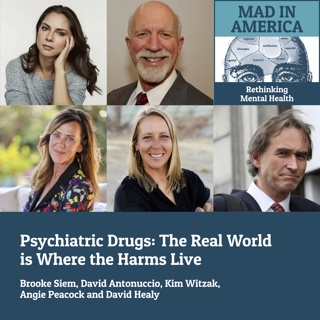
Psychiatric Drugs: The Real World is Where the Harms Live

Psychiatric Drugs: The Real World is Where the Harms Live

Joining us for a roundtable discussion are Brooke Siem, David Antonuccio, Kim Witzak, Angie Peacock and David Healy. They discuss the challenges of openly discussing psychiatric drug withdrawal, the t...

29 Loka 202545min
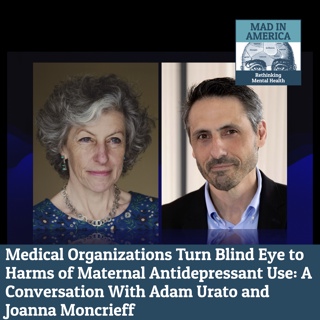
Medical Organizations Turn Blind Eye to Harms of Maternal Antidepressant Use: A Conversation With Adam Urato and Joanna Moncrieff

Medical Organizations Turn Blind Eye to Harms of Maternal Antidepressant Use: A Conversation With Adam Urato and Joanna Moncrieff

On July 21st 2025, the FDA convened a hearing on maternal use of antidepressants during pregnancy and the impact this use has on fetal development. Around 400,000 children in the United States are bor...

8 Loka 202548min
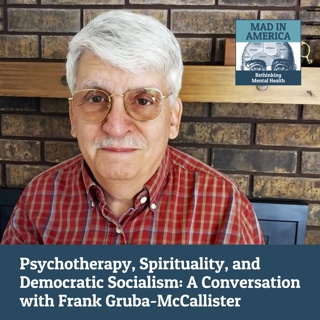
Psychotherapy, Spirituality, and Democratic Socialism: A Conversation with Frank Gruba-McCallister

Psychotherapy, Spirituality, and Democratic Socialism: A Conversation with Frank Gruba-McCallister

Frank Gruba-McCallister is a clinical psychologist, educator, and scholar whose career spans more than three decades of teaching and academic leadership. He served as Vice President of Academic Affai...

24 Syys 202544min

Suosittua kategoriassa Terveys ja hyvinvointi

unicast
tiedenaiset-podcast
psykopodiaa-podcast
voi-hyvin-meditaatiot-2
rss-pitaisko-erota
vakeva-elama-viisaampi-mieli-vahvempi-keho
meditaatiot-suomeksi
junnut-pelissa
rss-mighty-finland-podcast
puhu-muru
rss-narsisti
terapiassa
paritellen
aamukahvilla
mielen-puolikkaat
rss-uplevel-by-sonja-hannus
rss-pt-paahtio
rss-vapaudu-voimaasi
rss-adama-mindful-hetki
rss-nautinto