Kelly Brogan - The Science and Pseudoscience of Women's Mental Health

Kelly Brogan - The Science and Pseudoscience of Women's Mental Health

Science and Pseudoscience of Mental Health Podcast: Episode 3

This past week, I had the great pleasure to talk with Dr. Kelly Brogan, a leading voice in natural approaches to women's mental health. Dr. Brogan began her career as a conventional psychiatrist, but following the birth of her first child, she felt bereft of energy and mental clarity and was diagnosed with an autoimmune condition called Hashimoto's Thyroiditis. Informed by her doctor that she had a chronic illness that would require a lifetime of medication, she launched her own research into her condition which catalyzed a profound paradigm shift in her understanding of health and wellness. Her research led her to Robert Whitaker's Anatomy of an Epidemic after which time she permanently retired her prescription pad while turning towards natural interventions that support the body's innate capacity to heal.

With degrees from MIT and Weil Cornell Medical College, triple board certification in psychiatry, psychosomatic medicine and integrative holistic medicine, and direct experience practicing within the parameters of conventional psychiatry, Dr. Brogan is uniquely qualified to challenge the pseudoscience of the chemical imbalance theory and the drug regimens that it spawned. At the same time, her rigorous education conferred the investigative tools that enabled her to identify the scientific principles that support mental health. She focuses on the integrative nature of the gastrointestinal, immune, endocrine and nervous systems and their seamless communication with the ecosystem that resides within the body – the microbiome – and the ecosystem that surrounds us. This science is at the core of her thirty-day wellness protocol which she outlines in her New York Times bestselling book: A Mind of Your Own: The Truth About Depression and How Women Can Heal Their Bodies and reclaim Their Lives.

Our conversation addressed Dr. Brogan's grave concerns about the recent rollout of Zulresso (brexanolone), a drug specifically designed, and approved by the FDA for the treatment of Postpartum Depression. Drug trials that qualified Zulresso for FDA approval in fact revealed that its efficacy is weak at best, and not clinically significant. After 30 days, it was actually less effective than placebo. It requires an invasive 60-hour IV infusion with side effects that include sedation – sometimes to the point of loss of consciousness, separation of mother and infant, and cessation of breastfeeding. Women diagnosed with Postpartum Depression are suffering, but impactful interventions need to take into account the complex cultural, socioeconomic, personal and biological underpinnings of their symptoms. Masking symptoms with a drug that causes further disruption to their lives, lessens the likelihood that they will receive effective support. Dr. Brogan estimates that 80% of women who enter her practice having been diagnosed with Postpartum Depression have undetected and untreated thyroid conditions.

We also discussed the reckless prescribing of SSRI antidepressants to one in four American women, many of whom are pregnant, and the long-term epigenetic consequences of SSRIs following prenatal exposure. Dr. Brogan shared her approach to tapering from SSRIs both during pregnancy and as part of her general treatment protocol. Our conversation came to a close with a fascinating exploration of the science that informs the relationship between meditation and mental health. Dr. Brogan shared the transformative impact that her own daily meditation practice has had on her capacity to cope with stress.

To learn more about Dr. Brogan's clinical work and research, you can visit her website.

For other interviews in this series, click here.

© Mad in America

Jaksot(290)

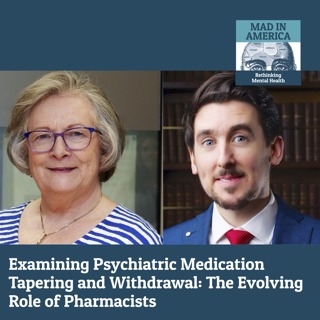
Examining Psychiatric Medication Tapering and Withdrawal: The Evolving Role of Pharmacists — A Conversation with Agnes Higgins and Cathal Cadogan

Examining Psychiatric Medication Tapering and Withdrawal: The Evolving Role of Pharmacists — A Conversation with Agnes Higgins and Cathal Cadogan

Welcome to the Mad in America podcast, my name is James. Today, we are discussing the experiences of people who have attempted to stop taking psychiatric drugs. These experiences are captured in a sur...

1 Huhti 32min
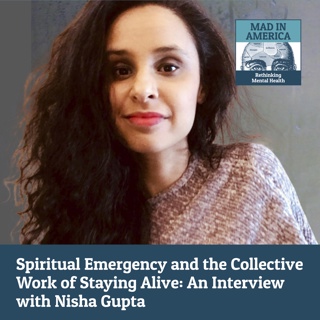
Spiritual Emergency and the Collective Work of Staying Alive: An Interview with Nisha Gupta

Spiritual Emergency and the Collective Work of Staying Alive: An Interview with Nisha Gupta

Nisha Gupta is an existential phenomenologist, a depth psychotherapist, a creativity scholar, and an artist. She's an Associate Professor of Psychology at the University of West Georgia and earned her...

25 Maalis 48min
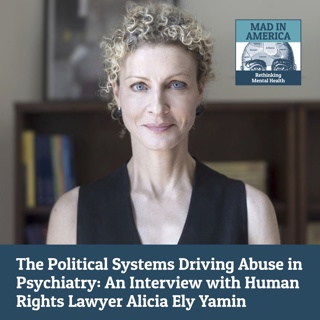
The Political Systems Driving Abuse in Psychiatry: An Interview with Human Rights Lawyer Alicia Ely Yamin

The Political Systems Driving Abuse in Psychiatry: An Interview with Human Rights Lawyer Alicia Ely Yamin

Alicia Ely Yamin is the Director of the Global Health and Rights Project and a lecturer at Harvard Law School. She's also an adjunct senior lecturer on health policy and management at the Harvard T.H....

18 Maalis 45min
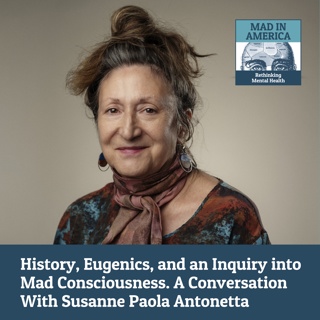
History, Eugenics, and an Inquiry into Mad Consciousness: A Conversation With Susanne Paola Antonetta

History, Eugenics, and an Inquiry into Mad Consciousness: A Conversation With Susanne Paola Antonetta

Susanne Paola Antonetta is an accomplished writer and poet, the author of numerous books, and in 2001 her book Body Toxic: An Environmental Memoir, won a prestigious American Book Award. Her latest bo...

11 Maalis 49min
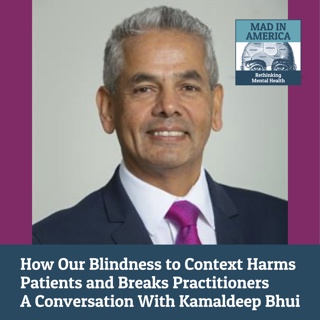
How Our Blindness to Context Harms Patients and Breaks Practitioners: A Conversation With Kamaldeep Bhui

How Our Blindness to Context Harms Patients and Breaks Practitioners: A Conversation With Kamaldeep Bhui

Kamaldeep Bhui is Professor of Psychiatry at the University of Oxford and Honorary Professor at Queen Mary University of London. He is internationally recognized for his groundbreaking work on cultura...

4 Maalis 51min
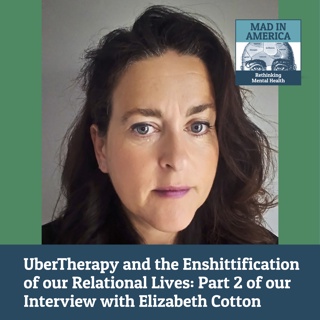
UberTherapy and the Enshittification of our Relational Lives: Part 2 of our Interview with Elizabeth Cotton

UberTherapy and the Enshittification of our Relational Lives: Part 2 of our Interview with Elizabeth Cotton

Elizabeth Cotton is Associate Professor of Responsible Business at the University of Leicester and the founder of Surviving Work, which carries out socially engaged research on mental health and work....

18 Helmi 39min
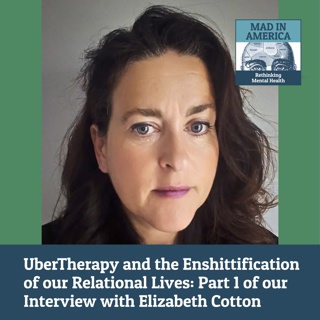
UberTherapy and the Enshittification of our Relational Lives: Part 1 of our Interview with Elizabeth Cotton

UberTherapy and the Enshittification of our Relational Lives: Part 1 of our Interview with Elizabeth Cotton

Elizabeth Cotton is Associate Professor of Responsible Business at the University of Leicester and the founder of Surviving Work, which carries out socially engaged research on mental health and work....

11 Helmi 46min
Food First, Pharma Last - Part Two of our Interview with Chris Masterjohn

Food First, Pharma Last - Part Two of our Interview with Chris Masterjohn

This week, we are joined by Chris Masterjohn, PhD. Chris is a nutritional scientist, a former professor, and the founder of Mitome. With a PhD in nutritional science and years of research in mitochond...

28 Tammi 44min

Suosittua kategoriassa Terveys ja hyvinvointi

unicast
tiedenaiset-podcast
psykopodiaa-podcast
voi-hyvin-meditaatiot-2
rss-pitaisko-erota
vakeva-elama-viisaampi-mieli-vahvempi-keho
meditaatiot-suomeksi
junnut-pelissa
rss-mighty-finland-podcast
puhu-muru
rss-narsisti
terapiassa
paritellen
aamukahvilla
mielen-puolikkaat
rss-uplevel-by-sonja-hannus
rss-pt-paahtio
rss-vapaudu-voimaasi
rss-adama-mindful-hetki
rss-nautinto