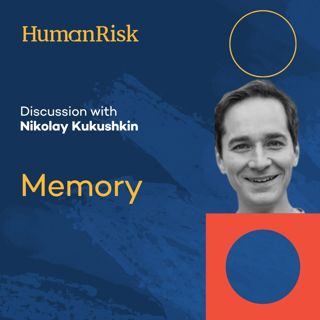
Dr Nikolay Kukushkin on Memory

Dr Nikolay Kukushkin on Memory

What if your body is learning things your mind doesn’t know? What if memory wasn't just something that our brain has?

Episode Summary
On this episode, I'm exploring a bold idea with neuroscientist Dr Nikolay Kukushkin: memory doesn’t just live in the brain. It might be a basic property of life itself. We unpack how scientists define memory (behavioural change over time) versus how the rest of us use the word, and why that distinction matters—from sea slugs to kidney cells. I ask the “muscle memory” question we all carry, and we separate the metaphor from the biology: your basal ganglia automate behaviours, but your muscle cells do literally adapt to patterned use.

We go deep on “patterns.” Nikolay’s work shows that even non-neural cells can detect minute-scale timing differences—preferring spaced pulses over a single crammed dose. That has huge implications for learning, exercise, nutrition, and even medicine; it suggests timing might be as important as quantity. We also talk about sleep as essential “synaptic housekeeping,” why false memories are an adaptive feature (not a failure), and what it really means to “run out of memory” in our overstimulated world.

Finally, we tilt at the big questions: how consciousness might have evolved, why Plato’s model of perception eerily echoes today’s top-down/bottom-up neuroscience, and what AI still lacks—learning patterns in time within an embodied world. If you’ve ever crammed for an exam, worried about forgetting your own name, or wondered what your cells are quietly learning from your daily routines, this one will rewire how you think about memory.

Guest Biography — Dr Nikolay Kukushkin
Dr Nikolay Kukushkin is a Clinical Associate Professor at NYU. His book One Hand Clapping: Unraveling the Mystery of the Human Mind traces how consciousness emerged from the natural world; the original Russian edition won the Enlightener (Prosvetitel) Award and the Alexander Belyaev Medal.

His recent research (Nature Communications, Nov 2024) showed that non-neural human cells display the classic “spacing effect,” suggesting memory-like temporal patterning beyond the brain.

AI-Generated Timestamped Summary
[00:00:00] Cold open: reframing memory as cellular, not just neural.
[00:01:00] Scientists’ definition of memory vs everyday usage.
[00:03:00] From behaviour change to cellular change; beyond “plugging a muscle into a brain.”
[00:05:00] All cells have experiences; “pattern matters.”
[00:06:00] Muscle memory: basal ganglia automation vs literal muscle adaptation.
[00:07:00] Shared molecular machinery: “use it or lose it” in brain and muscle.
[00:08:00] Nikolay’s path: from molecules to minds; bottom-up neuroscience.
[00:09:00] Protein quality control: molecular barcodes and cellular “conversations.”
[00:11:00] Why sea slugs: short path from molecules to behaviour.
[00:13:00] Hypothesis leap: if single neurons learn from pulses, could kidney cells?
[00:14:00] The experiment: four 3-min pulses vs one 12-min pulse (spacing wins).
[00:16:00] What’s uniquely neural: synapses and specific connectivity; where salience arises.
[00:19:00] Memory without awareness; non-neural systems can store patterns.
[00:20:00] Applications: exercise, diet, medicine; timing as a lever.
[00:23:00] The dark mirror: life as obsessive optimisation if we over-pattern.
[00:24:00] Personal practice: being mindful of inputs, attention as filter.
[00:26:00] Debunking “10% of the brain” and the sleep–memory link.
[00:28:00] Sleep weakens synapses; deprivation leads to saturation and hallucinations.
[00:30:00] The social-media “soup” analogy for saturated memory.
[00:32:00] Names, identity and rehearsal; de-naming as degradation.
[00:33:00] Reconsolidation: why false memories are a feature we need.
[00:34:00] 9/11/Challenger studies: how memories drift with time.
[00:36:00] Ebbinghaus and the spacing effect across species and systems.
[00:39:00] Cramming vs spacing: initial strength and decay rates.
[00:41:00] The forgetting curve and why “more” can decay slower in memory.
[00:42:00] “My whole life is one big experiment on my brain.”
[00:43:00] Practical “tip”: fix attention first; follow interest, not force.
[00:45:00] Attention economy and selective inputs as memory hygiene.
[00:48:00] From smoking to scrolling: a future of information hygiene.
[00:50:00] One Hand Clapping: why it feels special to be you.
[00:54:00] Plato’s “two fires”: ancient echoes of top-down/bottom-up perception.
[00:58:00] Intuition as hidden associations; LLMs as an analogy.
[01:00:00] AI: excitement, unease, and the risk of outsourcing humanness.
[01:03:00] What AI lacks: learning patterns in time without a body.
[01:05:00] Close and thanks.
[01:06:00] Outro and calls to action.

Links
Nikolay's website - https://www.nikolaykukushkin.com/


His NYC profile - https://liberalstudies.nyu.edu/about/faculty-listing/nikolay-kukushkin.html

His book 'One Hand Clapping' - https://www.nikolaykukushkin.com/press-1

'Memory Takes Time': research into how wemory is not confined to a particular location or locations in the brain - https://www.cell.com/neuron/fulltext/S0896-62731730467-1

Herman Ebbinghaus - https://en.wikipedia.org/wiki/Hermann_Ebbinghaus and The Ebbinghaus Illusion: https://en.wikipedia.org/wiki/Ebbinghaus_illusion

Tämä jakso on lisätty Podme-palveluun avoimen RSS-syötteen kautta eikä se ole Podmen omaa tuotantoa. Siksi jakso saattaa sisältää mainontaa.

Jaksot(368)

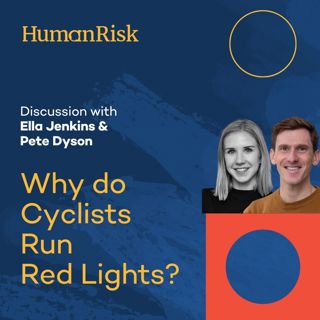
Ella Jenkins & Pete Dyson on Why Do Cyclists Run Red Lights?

Ella Jenkins & Pete Dyson on Why Do Cyclists Run Red Lights?

Why do cyclists in London run red lights? It's against the law, and yet, if you've cycled, driven or just observed London's cyclists, you'll know that many of them don't stop when there's a red light....

31 Elo 202554min
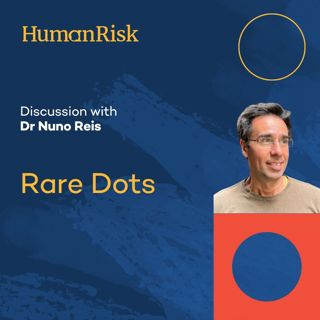
Dr Nuno Reis on Rare Dots

Dr Nuno Reis on Rare Dots

What if the ideas that linger in the back of your mind — the ones you can’t quite explain — are the ones you most need to pay attention to?Episode SummaryIn this episode, I explore that question with ...

24 Elo 20251h 7min
Professor Christian van Nieuwberg on Radical Listening

Professor Christian van Nieuwberg on Radical Listening

Is listening a hidden superpower we’ve overlooked?  You've heard of Active Listening, but what is Radical Listening and why does it matter?Episode SummaryOn this episode, I’m joined by Professor Chris...

17 Elo 20251h 9min
Dr Sunita Sah on Defiance - how to speak up when it matters

Dr Sunita Sah on Defiance - how to speak up when it matters

Why do we follow orders or go along with things that feel wrong? Why might defiance be better than compliance? And how can we go about becoming more defiant?Episode SummaryI’ve always been fascinated ...

9 Elo 20251h 2min
Dr Libby Maman on Measuring and (Re-)building Trust

Dr Libby Maman on Measuring and (Re-)building Trust

What happens when citizens lose faith in the institutions that serve them? And how can we rebuild that trust?Episode SummaryOn this episode, I'm speaking to someone who cares passionately about this s...

2 Elo 20251h
Iain Morrison on When The Show Mustn't Go On

Iain Morrison on When The Show Mustn't Go On

We’ve all heard the phrase ‘the show must go on’.  But when shouldn’t the show go on?  To help me answer that, I’m speaking to someone who has spent 35 years managing some of Australia’s most iconic l...

26 Heinä 20251h 5min
Zsike Peter on Thinkbait

Zsike Peter on Thinkbait

What if the real risk of AI isn’t job loss but brain atrophy?Episode SummaryIf you've spent any time on social media recently, you'll be familiar with the flood of low-quality AI-generated sludge. And...

19 Heinä 20251h 9min
Dr Kiran Bhatti & Professor Thomas Roulet on Wellbeing Intelligence

Dr Kiran Bhatti & Professor Thomas Roulet on Wellbeing Intelligence

What if we treated mental health like a capability instead of a crisis? On this episode, I'm talking to a business school professor and a counselling psychologist about their new book that looks at pr...

12 Heinä 20251h 2min

Suosittua kategoriassa Tiede

rss-poliisin-mieli
tiedekulma-podcast
rss-mita-tulisi-tietaa
docemilia
filocast-filosofian-perusteet
menologeja-tutkimusmatka-vaihdevuosiin
rss-duodecim-lehti
rss-tiedetta-vai-tarinaa
sotataidon-ytimessa
rss-lapsuuden-rakentajat-podcast
rss-lihavuudesta-podcast
utelias-mieli
radio-antro
rss-bios-podcast
rss-metsantuntijat-podcast
rss-luontopodi-samuel-glassar-tutkii-luonnon-ihmeita
rss-sosiopodi