
OpenAI: The nonprofit refuses to be killed (with Tyler Whitmer)
80,000 Hours Podcast11 Marras 2025

OpenAI: The nonprofit refuses to be killed (with Tyler Whitmer)

Last December, the OpenAI business put forward a plan to completely sideline its nonprofit board. But two state attorneys general have now blocked that effort and kept that board very much alive and kicking.

The for-profit’s trouble was that the entire operation was founded on the premise of — and legally pledged to — the purpose of ensuring that “artificial general intelligence benefits all of humanity.” So to get its restructure past regulators, the business entity has had to agree to 20 serious requirements designed to ensure it continues to serve that goal.

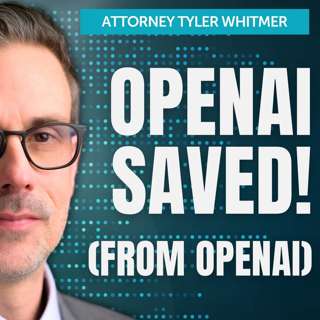
Attorney Tyler Whitmer, as part of his work with Legal Advocates for Safe Science and Technology, has been a vocal critic of OpenAI’s original restructure plan. In today’s conversation, he lays out all the changes and whether they will ultimately matter.

Full transcript, video, and links to learn more: https://80k.info/tw2

After months of public pressure and scrutiny from the attorneys general (AGs) of California and Delaware, the December proposal itself was sidelined — and what replaced it is far more complex and goes a fair way towards protecting the original mission:

  • The nonprofit’s charitable purpose — “ensure that artificial general intelligence benefits all of humanity” — now legally controls all safety and security decisions at the company. The four people appointed to the new Safety and Security Committee can block model releases worth tens of billions.
  • The AGs retain ongoing oversight, meeting quarterly with staff and requiring advance notice of any changes that might undermine their authority.
  • OpenAI’s original charter, including the remarkable “stop and assist” commitment, remains binding.

But significant concessions were made. The nonprofit lost exclusive control of AGI once developed — Microsoft can commercialise it through 2032. And transforming from complete control to this hybrid model represents, as Tyler puts it, “a bad deal compared to what OpenAI should have been.”

The real question now: will the Safety and Security Committee use its powers? It currently has four part-time volunteer members and no permanent staff, yet they’re expected to oversee a company racing to build AGI while managing commercial pressures in the hundreds of billions.

Tyler calls on OpenAI to prove they’re serious about following the agreement:

  • Hire management for the SSC.
  • Add more independent directors with AI safety expertise.
  • Maximise transparency about mission compliance.

"There’s a real opportunity for this to go well. A lot … depends on the boards, so I really hope that they … step into this role … and do a great job. … I will hope for the best and prepare for the worst, and stay vigilant throughout."

Chapters:

  • We’re hiring (00:00:00)
  • Cold open (00:00:40)
  • Tyler Whitmer is back to explain the latest OpenAI developments (00:01:46)
  • The original radical plan (00:02:39)
  • What the AGs forced on the for-profit (00:05:47)
  • Scrappy resistance probably worked (00:37:24)
  • The Safety and Security Committee has teeth — will it use them? (00:41:48)
  • Overall, is this a good deal or a bad deal? (00:52:06)
  • The nonprofit and PBC boards are almost the same. Is that good or bad or what? (01:13:29)
  • Board members’ “independence” (01:19:40)
  • Could the deal still be challenged? (01:25:32)
  • Will the deal satisfy OpenAI investors? (01:31:41)
  • The SSC and philanthropy need serious staff (01:33:13)
  • Outside advocacy on this issue, and the impact of LASST (01:38:09)
  • What to track to tell if it's working out (01:44:28)


This episode was recorded on November 4, 2025.

Video editing: Milo McGuire, Dominic Armstrong, and Simon Monsour
Audio engineering: Milo McGuire, Simon Monsour, and Dominic Armstrong
Music: CORBIT
Coordination, transcriptions, and web: Katy Moore

Jaksot(319)

#6 - Toby Ord on why the long-term future matters more than anything else & what to do about it

#6 - Toby Ord on why the long-term future matters more than anything else & what to do about it

Of all the people whose well-being we should care about, only a small fraction are alive today. The rest are members of future generations who are yet to exist. Whether they’ll be born into a world th...

6 Syys 20172h 8min

#5 - Alex Gordon-Brown on how to donate millions in your 20s working in quantitative trading

#5 - Alex Gordon-Brown on how to donate millions in your 20s working in quantitative trading

Quantitative financial trading is one of the highest paying parts of the world’s highest paying industry. 25 to 30 year olds with outstanding maths skills can earn millions a year in an obscure set of...

28 Elo 20171h 45min

#4 - Howie Lempel on pandemics that kill hundreds of millions and how to stop them

#4 - Howie Lempel on pandemics that kill hundreds of millions and how to stop them

What disaster is most likely to kill more than 10 million human beings in the next 20 years? Terrorism? Famine? An asteroid? Actually it’s probably a pandemic: a deadly new disease that spreads out o...

23 Elo 20172h 35min

#3 - Dario Amodei on OpenAI and how AI will change the world for good and ill

#3 - Dario Amodei on OpenAI and how AI will change the world for good and ill

Just two years ago OpenAI didn’t exist. It’s now among the most elite groups of machine learning researchers. They’re trying to make an AI that’s smarter than humans and have $1b at their disposal. Ev...

21 Heinä 20171h 38min

#2 - David Spiegelhalter on risk, stats and improving understanding of science

#2 - David Spiegelhalter on risk, stats and improving understanding of science

Recorded in 2015 by Robert Wiblin with colleague Jess Whittlestone at the Centre for Effective Altruism, and recovered from the dusty 80,000 Hours archives. David Spiegelhalter is a statistician at th...

21 Kesä 201733min

#1 - Miles Brundage on the world's desperate need for AI strategists and policy experts

#1 - Miles Brundage on the world's desperate need for AI strategists and policy experts

Robert Wiblin, Director of Research at 80,000 Hours speaks with Miles Brundage, research fellow at the University of Oxford's Future of Humanity Institute. Miles studies the social implications surrou...

5 Kesä 201755min

#0 – Introducing the 80,000 Hours Podcast

#0 – Introducing the 80,000 Hours Podcast

80,000 Hours is a non-profit that provides research and other support to help people switch into careers that effectively tackle the world's most pressing problems. This podcast is just one of many th...

1 Touko 20173min

Suosittua kategoriassa Koulutus

rss-murhan-anatomia
psykopodiaa-podcast
voi-hyvin-meditaatiot-2
rss-narsisti
adhd-podi
rss-liian-kuuma-peruna
rss-duodecim-lehti
jari-sarasvuo-podcast
psykologia
rss-koira-haudattuna
rahapuhetta
leveli
rss-uskonto-on-tylsaa
rss-valo-minussa-2
rss-luonnollinen-synnytys-podcast
rss-niinku-asia-on
kesken
salainen-paivakirja
ihminen-tavattavissa-tommy-hellsten-instituutti
rss-tietoinen-yhteys-podcast-2