

Getting Staff Buy In: Session 286 with Anika Costa and Paulie Gavoni
Do you ever struggle getting your message across to co-workers, parents, or teachers? I sure have. And when it comes down to implementing behavioral interventions of any kind, the consequences of not being understood can be quite high for the learners in our care. Think about it for a minute, if someone doesn't implement a behavior plan correctly, people can get hurt. If someone doesn't implement learning programs correctly, individuals will fail to acquire critical skills that could allow them more independence and freedom later on. At the same time, we know that just telling staff what we want them to do is not very effective. And that's why I've invited Dr. Paulie Gavoni and Anika Costa to join me again on the podcast. In this episode, we discuss Motivational Interviewing. MI involves facilitating conversations with stakeholders in such a way that they are more likely to overcome barriers to implementing what you'd like them to do. That's the extreme short-version, so you're going to want to listen to the show to learn the in and outs of MI in more detail. Motivational Interviewing may be a familair term to podcast listeners. A few years ago, I hosted Dr. Callie Plattner in Session 236 to discuss this topic in depth. Long time listeners might recall my conversation with Dr. Jim Murphy way back in Session 158, where we discussed the application of Motivational Interviewing to help individuals with Substance Use Disorders. In this episode, we discuss MI in the context of school consultation. Now if you don't work in schools, don't worry, you'll still get a lot out of this episode. Here's a fun example of how this might be: As you might know, the three of us have been working on a new educational platform called The Behavioral Toolbox, and we recently published our third course on the site called: Motivational Interviewing: Getting Educator Buy-In. I learned that one of the first customers for this course is someone who is a professional dog trainer. I reached out to her to ask why she bought the course, and she noted that in her line of work, it's not about working directly with the dogs, it's about getting owners to change their behavior, and she saw MI as one tool she could use to help owners follow through with the things she was teaching them. I think that's pretty cool. Our latest course, Motivational Interviewing: Getting Educator Buy-In. Their book, Quick Wins: Using Behavior Science to Accelerate and Sustain School. Other books by Dr. Paulie and colleagues, including his latest, Classroom Management Leadership: Unlocking Behavior to Unleash Student Potential Through Behavioral Science. Previous Behavioral Toolbox courses: Ready, Set, Consult! and When Not to FBA. Prior episodes with Paulie, Anika, and colleagues. This podcast is brought to you by: ACE Approved CEUs from .... Behavioral Observations. That's right, get your CEUs while driving (maybe even this episode!), walking your dog, doing the dishes, or whatever else you might have going on, all while learning from your favorite podcast guests! The Behavioral Toolbox. thebehavioraltoolbox.com is a new education and training site that my colleagues Anika Costa and Dr. Paulie Gavoni and I have been working on for over two years. Check out our latest course, Motivational Interviewing: Getting Educator Buy-In as well as the hugely popular When Not to FBA: 5 Quick Strategies for Improving Behavior in Classrooms. The Verbal Behavior Conference. Whether you attend in-person in Austin, TX, or online via BehaviorLive, you're going to love this year's Verbal Behavior Conference! Click here to get all the details! If you'd like to get BOP episodes a little earlier than everyone else, with no ads... just the interview itself, consider supporting the show with a Patreon subscription.
7 Tammi 59min
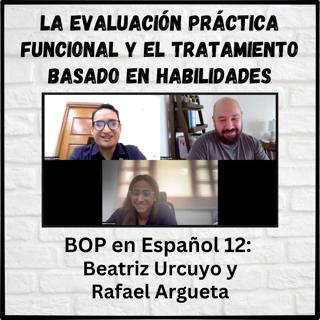
La Evaluación Práctica Funcional y el Tratamiento Basado en Habilidades: BOP en Español 12 con Beatriz Urcuyo y Rafael Argueta
La Evaluación Práctica Funcional y el Tratamiento Basado en Habilidades Con Beatriz Urcuyo y Rafael Argueta La evaluación y el tratamiento de problemas severos de conducta han sido prácticas fundamentales dentro del análisis conductual aplicado, proporcionando un apoyo esencial para las personas con desafíos en el desarrollo y sus familias. Los análisis funcionales han marcado una gran diferencia al informar y enfocar nuestros tratamientos. Entre las variaciones y refinamientos de estas evaluaciones, se encuentra la evaluación práctica funcional, que ha sido muy bien recibida por numerosos profesionales debido a su efectividad, sistematicidad, y por los valores y prioridades que promueve. Este enfoque también ofrece una continuidad hacia una secuencia de enseñanza muy detallada de habilidades imprescindibles, que son esenciales para empoderar a estos aprendices y permitirles continuar su desarrollo sin enfrentarse a desafíos conductuales. Beatriz, Rafael y su equipo en Nicaragua han sido de los primeros profesionales en Centroamérica en recibir capacitación y asesoramiento directamente de los responsables de la conceptualización, investigación y desarrollo de estos procedimientos. Esta conversación les ofrecerá una introducción a la evaluación práctica funcional y al tratamiento basado en habilidades, además de dar a conocer las experiencias de estos líderes del análisis conductual en Nicaragua. Practical Functional Assessment and Skill-based Treatment Funcional with Beatriz Urcuyo y Rafael Argueta The assessment and treatment of severe problem behavior have been fundamental practices within applied behavior analysis, providing essential support for individuals with developmental challenges and their families. Functional analyses have made a great difference in informing and focusing our treatments. Among the variations and refinements of these assessments is the practical functional assessment, which has been very well received by numerous professionals due to its effectiveness, systematicity, and the values and priorities it promotes. This approach also offers continuity towards a very detailed teaching sequence of skills, which are essential to empower these learners and allow them to continue their development without facing behavioral challenges. Beatriz, Rafael and their team in Nicaragua have been among the first professionals in Central America to receive training and advice directly from those responsible for the conceptualization, research and development of these procedures. This conversation will provide an introduction to the practical functional assessment and skill-based treatment, as well as share the experiences of these leaders in behavioral analysis in Nicaragua.
3 Tammi 1h 42min
Session 284: 2024 Year in Review
As we do every year at this time, my friends at ABA Inside Track joined me to review the year that was. This is a fun tradition, and this year, we did something a little different: We looked at the 10 most downloaded episodes from both of our shows, and counted them down. Along the way, we added some commentary as to why these shows might have resonated with you, the listener. If you're a consistent listener to both of our shows, try to see how these episodes matched up with the ones you liked the best! If you want to cheat, you can check out how the shows ranked here, along with links to the episode pages themselves. As always, this is the raw audio feed, direct from ABA Inside Track (so you'll have their intro music). That said, in the publicly available feed, I talk at length about how much I appreciate each and every listener, and that goes especially for you, the Patreon subscriber! Your support helps to keep the lights on at the BOP, so thank you so much! This podcast is brought to you with the support of: HRIC Recruting. Cut out the middleman and speak directly with Barbara Voss, who's been placing BCBAs in great jobs all across the US for 15 years. CEUs from Behavioral Observations. Learn from your favorite podcast guests while you're commuting, walking the dog, or whatever else you do while listening to podcasts. New events are being added all the time, so check them out here. The Behavioral Toolbox. Check out our courses for school-based and other behavioral professionals, including our newest one, Motivational Interviewing: Getting Educator Buy-In. The Verbal Behavior Conference. Whether you attend in-person in Austin, TX, or online via BehaviorLive, you're going to love this year's Verbal Behavior Conference! Click here to get all the details! If you'd like to get BOP episodes a little earlier than everyone else, with no ads... just the interview itself, consider supporting the show with a Patreon subscription.
25 Joulu 20241h 5min
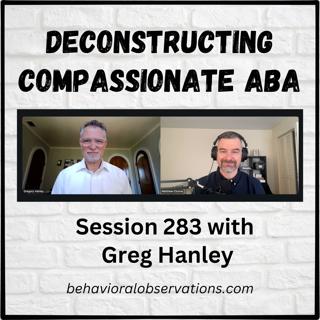
Deconstructing Compassionate ABA: Session 283 with Greg Hanley
A few weeks ago I was fortunate enough to find a few hours to catch up with many-time guest and all-around podcast fave, Dr. Greg Hanley. We had what turned out to be a lengthy conversation that included the following: His recent professional association with Action Behavior Centers. Available jobs at Action Behavior Centers. The evolution of FTF Behavioral Consulting. The term, Compassionate ABA, including some of my misgivings on whether terms like these are necessary. The nuanced role of extinction in Skills Based Treatment. Distinguishing between the immediate and long-term effects of reinforcement. Efficacy vs. effectiveness. Some historical perspectives on Functional Analysis, including the unexpected topic in which the term 'automatic reinforcement' was used. Questioning the role of descriptive functional assessment. Greg's recent thoughts on head-directed self-injury. The role of tics in self-injury. Skills-based treatment's intersection with constructional approaches to behavioral intervention. If you think that's a lot, it's just a sample of what we talk about. Here are the links to what we discussed: Session 276 with Dr. Anthony Cammilleri. Ghaemmaghami et al. (2024). Toward Compassion in the Assessment and Treatment of Severe Problem Behavior. Slaton et al. (2024). Long-term effectiveness and generality of practical functional assessment and skill-based treatment. Carr et al. (1976). Stimulus control of self-destructive behavior in a psychotic child. Dr. Jessel's ResearchGate page. van Haaren (2015). Automatic negative reinforcement: Its possible role in problem behavior with treatment implications. This podcast is brought to you by: ACE Approved CEUs from .... Behavioral Observations. That's right, get your CEUs while driving (maybe even this episode!), walking your dog, doing the dishes, or whatever else you might have going on, all while learning from your favorite podcast guests! The Behavioral Toolbox. thebehavioraltoolbox.com is a new education and training site that my colleagues Anika Costa and Dr. Paulie Gavoni and I have been working on for over two years. Check out our latest course, Motivational Interviewing: Getting Educator Buy-In as well as the hugely popular When Not to FBA: 5 Quick Strategies for Improving Behavior in Classrooms. Behavior University. Their mission is to provide university quality professional development for the busy Behavior Analyst. Learn about their CEU offerings, including their 8-hour Supervision Course, as well as their RBT offerings over at behavioruniversity.com/observations. Don't forget to use the coupon code, PODCAST to save at checkout! If you'd like to get BOP episodes a little earlier than everyone else, with no ads... just the interview itself, consider supporting the show with a Patreon subscription.
3 Joulu 20242h 6min
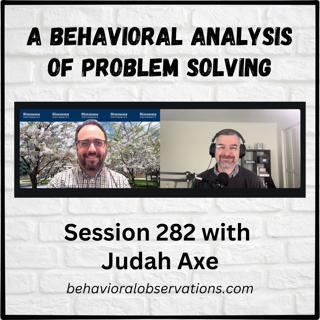
A Behavioral Analysis of Problem Solving: Session 282 with Judah Axe
Quick, what's 47 minus 12? What did you have for breakfast the day before yesterday? When is the next leap year? Hit pause real quick and try to answer these. Don't worry, I'm not going to hold you to your answers. What's more important is the processes you went through derive them. If you find this sort of thing interesting, then this is the podcast for you! Dr. Judah Axe joins me in Session 282 to discuss a behavioral interpretation of problem solving. Judah is a Professor in the Department of Behavior Analysis at Simmons University, and along with Drs. Paul Alberto and Anne Troutman, he is the author of Applied Behavior Analysis for Teachers. Here are just some of the topics we hit on: What, in behavioral terms, constitutes a problem? How Skinner first conceptualized problems and problem solving. How self-talk, visualization, and other private events play a role in problem solving. How we both wished we had stronger backgrounds in Developmental Psychology. A quick review of Blooms Taxonomy. Current educational practices that potentially impede the development of higher order problem solving. Some topics that Judah may discuss at the upcoming Verbal Behavior Conference. How to determine if or when to teach problem solving skills. How improvisation might be fostered. The role of developing rules. The challenges of studying problem solving. Here are some resources we discussed: The Verbal Behavior Conference. Marckel, Neef, and Ferreri (2013). A PRELIMINARY ANALYSIS OF TEACHING IMPROVISATION WITH THE PICTURE EXCHANGE COMMUNICATION SYSTEM TO CHILDREN WITH AUTISM. Park and Gaylord-Ross (1989). A problem-solving approach to social skills training in employment settings with mentally retarded youth. Mann and Karsten (2020). Efficacy and social validity of procedures for improving conversational skills of college students with autism. Axe, Phelan, and Irwin (2019). Empirical Evaluations of Skinner's Analysis of Problem Solving. Talk Aloud Problem Solving. A sampling of LeBlanc and Carr's work in the area of problem solving. Michael (2017). What Every Student of Behavior Analysis Ought to Learn: A System for Classifying the Multiple Effects of Behavioral Variables. Spiral bound atlases. This podcast is brought to you by: ACE Approved CEUs from .... Behavioral Observations. That's right, get your CEUs while driving (maybe even this episode!), walking your dog, doing the dishes, or whatever else you might have going on, all while learning from your favorite podcast guests! The Behavioral Toolbox. thebehavioraltoolbox.com is a new education and training site that my colleagues Anika Costa and Dr. Paulie Gavoni and I have been working on for over two years. Check out our latest course, Motivational Interviewing: Getting Educator Buy-In as well as the hugely popular When Not to FBA: 5 Quick Strategies for Improving Behavior in Classrooms. Behavior University. Their mission is to provide university quality professional development for the busy Behavior Analyst. Learn about their CEU offerings, including their 8-hour Supervision Course, as well as their RBT offerings over at behavioruniversity.com/observations. Don't forget to use the coupon code, PODCAST to save at checkout! If you'd like to get BOP episodes a little earlier than everyone else, with no ads... just the interview itself, consider supporting the show with a Patreon subscription.
23 Marras 20241h 32min
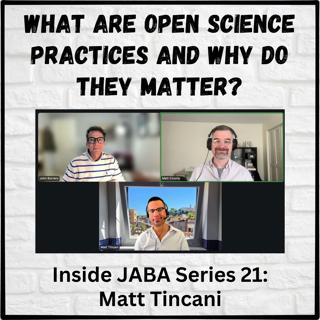
What are Open Science Practices and Why do they Matter? Inside JABA 21
Dr. Matt Tincani joins Dr. John Borrero and me for the 21st (can you believe it!?!?) installment of the Inside JABA Series on Behavioral Observations. From a research perspective, this Inside JABA episode is by far our most wonkiest one to date. By that I mean we take a deep dive into the area of Open Science Practices. If you're not familiar with the Open Science movement, Matt walks us through the basics. In doing so, we review the lead paper in the fall 2024 issue of JABA that he co-wrote with Drs. Shawn Gilroy and Art Dowdy (see Tincani, Gilroy, and Dowdy, 2024). Of the several Open Science Practices, this paper - and by extension, this episode - focuses on Preregistration. According to Tincani and colleagues, "preregistration entails outlining a research protocol and specifying the study methods and plans for analysis, which are then archived publicly in a repository before conducting the study" (see p. 4). The point of doing this, amongst others, is to increase transparency and reduce criticisms of questionable research practices in Behavior-Analytic research, such as the file drawer effect, dropping participants from analyses, and so on. While these aims sound laudable, when reading this paper, my inner skeptic began formulating a handful of objections to preregistration, such as increasing barriers to conducting research by adding additional steps, "boxing in" the work of researchers to the point if inflexibility, and so on. Both in the paper and on this podcast, Matt walks through these common objections, so if you too are skeptical, give this episode a listen and see if Matt's treatment of these resonate with you. Here are a few resources mentioned in the episode: Tincani, Gilroy, and Dowdy (2024). Extensions of open science for applied behavior analysis: Preregistration for single-case experimental designs. Tincani and Travers (2019). Replication Research, Publication Bias, and Applied Behavior Analysis. Subscribe to JABA here. Open Science Collaboration (2015). Estimating the reproducibility of psychological science. Retraction Watch. Rick Kubina, Session 39. Kubina et al. (2017). A Critical Review of Line Graphs in Behavior Analytic Journals.
16 Marras 20241h 4min

Using Behavior Analysis for Health and Fitness Coaching: Session 280 with Sarah Burby
5 Marras 202453min
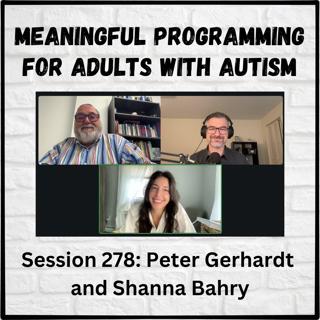
Meaningful Programming for Adults with Autism: Session 279 with Peter Gerhardt and Shanna Bahry
Drs. Peter Gerhardt and Shanna Bahry join me to talk about a range of topics centering around supporting adults with ASD and related disabilities. They are the authors of the new book, Make it Meaningful: Creating Programs that Matter into Adulthood for Learners with Autism Spectrum and Related Disorders. In this conversation, we talk about how ABA services are skewed towards younger populations, how programming for younger learners might look different if practitioners knew more about the unique needs of adult service recipients, risk aversion and other barriers to promoting independence, their 'wishlist' of skills that they'd like to see all adults with disabilities learn, having difficult conversations with parents, and lots more. Of course we discuss their book, the resources their book provides, and how these resources relate to other functional skills curricula that are out there... such as Essential for Living. You're also going to want to stay tuned for the entire conversation, because we close with some fantastic advice for just about everyone in this field. Here are links to some of the resources discussed in this episode: Where to get more info on the book, Make it Meaningful. Meaningful Hope ABA. The Epic School. Dr. Bahry on LinkedIn. Dr. Gerhardt on LinkedIn. Essential for Living. Bannerman et al. (1990). Balancing the right to habilitation with the right to personal liberties: The rights of people with Developmental Disabilities to eat too many doughnuts and take a nap. Rubin (2018). The Happiness Project, Tenth Anniversary Edition: Or, Why I Spent a Year Trying to Sing in the Morning, Clean My Closets, Fight Right, Read Aristotle, and Generally Have More Fun. This podcast is brought to you by the following: ACE Approved CEUs from .... Behavioral Observations. That's right, get your CEUs while driving (maybe even this episode!), walking your dog, doing the dishes, or whatever else you might have going on, all while learning from your favorite podcast guests! The 2024 Stone Soup Conference! Behavior Analysis' premier online event is taking place on October 25th. Come hear from pod faves including Drs. John Austin, Lina Slim, Jim Moore, and many others! 8.5 Learning CEUs are available, and when you use the promo code PODCAST24, that comes out to less than 8 bucks per credit. Learn more here! The Behavioral Toolbox. thebehavioraltoolbox.com is a new education and training site that my colleagues Anika Costa and Dr. Paulie Gavoni and I have been working on for over two years. We have two courses available: our first course, Ready, Set, Consult! and our newly released course, When Not to FBA: 5 Quick Strategies for Improving Behavior in Classrooms. Behavior University. Their mission is to provide university quality professional development for the busy Behavior Analyst. Learn about their CEU offerings, including their 8-hour Supervision Course, as well as their RBT offerings over at behavioruniversity.com/observations. Don't forget to use the coupon code, PODCAST to save at checkout!
22 Loka 202456min