
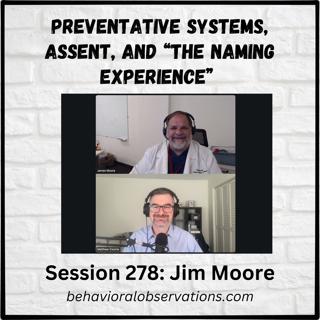
Preventative Systems, Assent, and The Naming Experience: Session 278 with Jim Moore
Many-time guest Dr. Jim Moore stopped by the podcast to talk about a range of topics that he's been working on since we last spoke. In particular, we discussed his recent move to Arizona and his new job at Therapy Matters, what he's learned as a C-Suite executive who maintains an active client caseload, the value of implementing universal behavioral protocols clinic-wide, practical approaches to thinking about the concept of assent, and what he's learned as of late implementing concepts and practices in the area of naming, and the associated benefits he's seen in his clients from these strategies. If you like what you hear, come hear Jim expand on all of these topics at the 2024 Stone Soup Conference. It's happening on October 25th, but it will also be available afterwards via Behavior Live. If you are interested in attending this fantastic conference, please be sure to use the promo code, PODCAST24 to save on your registration! Here are some helpful links: Jim's LinkedIn page. TherapyMatters.org The 2024 Stone Soup Conference (use promo code PODCAST24 to save!). Schramm and Miller: The Seven Steps to Earning Instructional Control. Session 257 with Dr. Tim Vollmer (CEU available). Morris et al. (2024): Toward a Further Understanding of Assent. Shillingsburg et al. (2019). Rapport Building and Instructional Fading Prior to Discrete Trial Instruction: Moving From Child-Led Play to Intensive Teaching. Jim's previous BOP episodes. Today's podcast is brought to you by: ACE Approved CEUs from .... Behavioral Observations. That's right, get your CEUs while driving (maybe even this episode!), walking your dog, doing the dishes, or whatever else you might have going on, all while learning from your favorite podcast guests! The 2024 Stone Soup Conference! Behavior Analysis' premier online event is taking place on October 25th. Come hear from pod faves including Drs. John Austin, Lina Slim, Jim Moore, and many others! 8.5 Learning CEUs are available, and when you use the promo code PODCAST24, that comes out to less than 8 bucks per credit. Learn more here! The Behavioral Toolbox. thebehavioraltoolbox.com is a new education and training site that my colleagues Anika Costa and Dr. Paulie Gavoni and I have been working on for over two years. We have two courses available: our first course, Ready, Set, Consult! and our newly released course, When Not to FBA: 5 Quick Strategies for Improving Behavior in Classrooms. The University of Cincinnati Online. UC Online designed a Master of Education in Behavior Analysis program that is 100% online and asynchronous, meaning you log on when it works for you. Want to learn more? Go to online.uc.edu and click the "request info" button.
16 Loka 20241h 8min
Una exploración acerca de la Latinidad en el análisis de conducta: BOP en Español 11
Una exploración acerca de la Latinidad en el análisis de conducta con la Dra. Corina Jimenez-Gomez y la Dra Sarah Lechago En este episodio nos acompaña nuestra contribuidora frecuente, la Dra. Corina Jimenez, junto con la Dra. Sarah Lechago, una de las co-autoras de un nuevo artículo publicado en Behavior Analysis in Practice acerca de la Latinidad. En esta conversación se hace evidente que definir Latinidad no es una tarea fácil. Estas investigadoras identificaron, a través de varias fuentes en la literatura, que es común agrupar a los Latinos a partir de valores compartidos como el familismo, el machismo/marianismo, y la religiosidad/espiritualidad que subyacen en las tradiciones de las culturas Latinas. El artículo busca explorar a partir de una encuesta, como se identifican los analistas de conducta latinos con respecto a estos valores. A pesar de la complejidad de estos temas, queda claro que para ser proveedores de servicios de análisis de conducta más efectivos y culturalmente adeptos, nos incumbe informarnos y auto-evaluarnos con respecto a nuestros sesgos culturales como también tener mejores sensibilidades con respecto a los valores y prácticas culturales de las personas que apoyamos. An exploration of Latinidad in behavior analysis with Dr. Corina Jimenez-Gomez and Dr. Sarah Lechago In this episode we are joined by our frequent contributor, Dr. Corina Jimenez, along with Dr. Sarah Lechago, one of the co-authors of a new article published in Behavior Analysis in Practice about Latinidad. In this conversation it becomes evident that defining Latinidad is not an easy task. These researchers identified, through various sources in the literature, that it is common to group Latinos based on shared values such as familismo, machismo/marianismo, and religiosity/spirituality that underlie the traditions of Latino cultures. The article seeks to explore, through a survey, how Latino behavior analysts identify themselves with respect to these values. Despite the complexity of these issues, it is clear that to be more effective and culturally adept providers of behavior analysis services, it is incumbent upon us to educate and self-assess regarding our cultural biases, as well as to have greater sensibilities regarding the cultural values and practices of the people we support.
9 Loka 20241h 18min
Lessons from Implementing PFA/SBT: Session 276 with Tony Cammilleri
Dr. Anthony Cammilleri - better known as Tony to friends and colleagues - joins me in Session 276. In this episode, we talked about his early experiences in Behavior Analyst, his experiences working in Greg Hanley's lab as a grad student, of course his work collaborating with Greg and other colleagues in the founding and development of the FTF consultancy, the recent news of his migration over to Action Behavior Centers, and what opportunities lie ahead in this partnership. We then talk more generally about what's new in the world of the IISCA or Practical Functional Assessment, along with Skills-Based Treatment, and how those processes have evolved over the years, common mistakes people make when implementing these procedures, and more. We also talked about my semi-misgivings about terms like Compassionate-ABA, Trauma-Informed-ABA, Trauma-Assumed-ABA, and the like, as well as Tony's upcoming talk at the 2024 Stone Soup Conference. Here are links to some of the resources we mentioned: Free State Brewing (Lawrence, KS). All thing FTF. FTF's credentialing options. Action Behavior Center's big announcement! Action Behavior Center's homepage. The 2024 Stone Soup Conference (use PODCAST24 to save at checkout!). Hanley (2012). Functional Assessment of Problem Behavior: Dispelling Myths, Overcoming Implementation Obstacles, and Developing New Lore. Anderson and St. Peter (2013). Functional Analysis With Typically Developing Children: Best Practice or Too Early to Tell?: In Response to Hanley (2012). Hanley et al. (2014). Producing meaningful improvements in problem behavior of children with autism via synthesized analyses and treatments. Rajaraman and Hanley (2020). Mand compliance as a contingency controlling problem behavior: A systematic review. Fisher et al. (1996). On the reinforcing effects of the content of verbal attention. Dr. Tim Vollmer's appearance on the podcast in Session 257. Session 176: Towards Trauma-Informed Applications of Behavior Analysis. This podcast is brought to you by: ACE Approved CEUs from .... Behavioral Observations. That's right, get your CEUs while driving (maybe even this episode!), walking your dog, doing the dishes, or whatever else you might have going on, all while learning from your favorite podcast guests! The 2024 Stone Soup Conference! Behavior Analysis' premier online event is taking place on October 25th. Come hear from pod faves including Drs. John Austin, Lina Slim, Jim Moore, and many others! 8.5 Learning CEUs are available, and when you use the promo code PODCAST24, that comes out to less than 8 bucks per credit. Learn more here! The Behavioral Toolbox. thebehavioraltoolbox.com is a new education and training site that my colleagues Anika Costa and Dr. Paulie Gavoni and I have been working on for over two years. We have two courses available: our first course, Ready, Set, Consult! and our newly released course, When Not to FBA: 5 Quick Strategies for Improving Behavior in Classrooms.
28 Syys 20241h 13min
ABA in the Spanish Speaking World: Session 275 with Miguel Avila
My partner in crime and host of the BOP en Español Series, Miguel Avila, joins me to talk about Behavior Analysis in Spanish-speaking cultures. In addition to his day job with Essential for Living, Miguel has been hard at work, and recorded over 10 Spanish language podcasts for Behavioral Observations listeners. So in this episode, which we of course conduct in English because my Spanish did not progress past my Freshman year of college, I turn the tables and interview Miguel for a change. We talk about his experience as an immigrant to the US, what constitutes "Spanglish," how he encountered Behavior Analysis, and how he ended up at Essential for Living, leading the efforts to translate those materials into Spanish. We then broaden the discussion to talk about where Behavior Analysis stands in various Spanish-speaking countries. As you'll hear in the podcast, Miguel has spent time in many of these places in Latin America and Europe, so while he humbly claims to not be the ultimate authority on these matters, he certainly has gained lots of hands-on experience in these settings. A conversation like this would not be complete if we didn't talk about efforts to provide training and consumer protections via regulatory institutions in these countries. In doing so, we touch on organizations including QABA, IBAO, LABA, ABA España, ABAI SIG Español, OMPAC, and more. Long story short, there's a lot to do in terms of supporting the profession of Behavior Analysis in these international contexts. In fact, Miguel will be speaking at the upcoming Puerto Rico ABA 2024 conference coming up in October. Here are some links to the topics we discussed: Essential for Living PCMA Winston Behavioral Solutions Session 200 of the BOP (Miguel wrote and read the intro) Elcoro, at al (2024). Behavior Analysis in Venezuela: An Unrecognized Legacy This podcast is brought to you with the support of: ACE Approved CEUs from .... Behavioral Observations. That's right, get your CEUs while driving (maybe even this episode!), walking your dog, doing the dishes, or whatever else you might have going on, all while learning from your favorite podcast guests! The 2024 Stone Soup Conference! Behavior Analysis' premier online event is taking place on October 25th. Come hear from pod faves including Drs. John Austin, Lina Slim, Jim Moore, and many others! 8.5 Learning CEUs are available, and when you use the promo code PODCAST24, that comes out to less than 8 bucks per credit. Learn more here! The Behavioral Toolbox. thebehavioraltoolbox.com is a new education and training site that my colleagues Anika Costa and Dr. Paulie Gavoni and I have been working on for over two years. We have two courses available: our first course, Ready, Set, Consult! and our newly released course, When Not to FBA: 5 Quick Strategies for Improving Behavior in Classrooms. Behavior University. Their mission is to provide university quality professional development for the busy Behavior Analyst. Learn about their CEU offerings, including their 8-hour Supervision Course, as well as their RBT offerings over at behavioruniversity.com/observations. Don't forget to use the coupon code, PODCAST to save at checkout!
24 Syys 20241h 42min
Psychological Safety in the Workplace: Session 274 with John Austin
Dr. John Austin returns to the show to discuss a topic that we touched on briefly back in Session 230: Psychological Safety. While the idea of Psychological Safety might seem overly conceptual in nature, John breaks down what he thinks about it in very easily understood and measurable terms. More importantly, he talks about why Psychological Safety matters in the workplace. Here are some of the aspects of this topic that we got into: The example of Google's Project Aristotle, where this term became popularized. Ways to measure Psychological Safety. Setting the occasion for employees saying what's on their minds. Creating conditions where feedback is accepted, and even desired. How employees might find meaning in their work. The concept of Behavioral Integrity. Leaders being surprised when employees quit unexpectedly. Other factors relating to employee retention. How to foster connections with coworkers and employees. What John will be talking about at the upcoming Stone Soup Conference (note: use promo code PODCAST24 to save $$$ at checkout!). Pivotal leadership behaviors, and lots more! If you like John's content, you're in luck, because he's agreed to come back and do an episode on having difficult conversations, which as you'll hear, is a topic that many leaders struggle with. Here are the resources we discussed in this episode: Free access to the audio version of John's book, Results: The Science-Based Approach to Better Productivity, Profitability, and Safety. Sleiman, et al. (2020). A Quantitative Review of Performance Feedback in Organizational Settings (1998-2018). John's website, drjohnaustin.com. Edmondson (2018). The Fearless Organization: Creating Psychological Safety in the Workplace for Learning, Innovation, and Growth (note: Amazon Associates Link). Google Project Aristotle - 5 Keys to Team Success. Other podcasts mentioned: Session 262 (Pat Friman) and Session 266 (Chris McGinnis). This podcast is brought to you by: How to ABA…The Bx Resource Membership saves you time, lends you support, and helps you keep up with your CEUs. It's a growing library of resources, materials, programs, datasheets, assessments, and how-to videos to help you tackle any ABA program with ease. It also includes live CEUs each month, live mentorship sessions, a full library of CEUs (60+, enough for recertification), and a community of fellow behavior professionals where you can ask questions when you need support. Join us at howtoaba.com/join. ACE Approved CEUs from .... Behavioral Observations. That's right, get your CEUs while driving (maybe even this episode!), walking your dog, doing the dishes, or whatever else you might have going on, all while learning from your favorite podcast guests! The 2024 Stone Soup Conference! Behavior Analysis' premier online event is taking place on October 25th. Come hear from pod faves including Drs. John Austin, Lina Slim, Jim Moore, and many others! 8.5 Learning CEUs are available, and when you use the promo code PODCAST24, that comes out to less than 8 bucks per credit. Learn more here! The University of Cincinnati Online. UC Online designed a Master of Education in Behavior Analysis program that is 100% online and asynchronous, meaning you log on when it works for you. Want to learn more? Go to online.uc.edu and click the "request info" button. HRIC Recruiting. Barb Voss has been placing BCBAs in permanent positions throughout the US for just about a decade, and has been in the business more generally for 30 years. When you work with HRIC, you work directly with Barb, thereby accessing highly personalized service. So if you're about to graduate, you're looking for a change of pace, or you just want to know if the grass really is greener on the other side, head over to HRIColorado.com to schedule a confidential chat right away.
12 Syys 20241h 7min
The Importance of Theory and Philosophy: Session 273 with Carol Pilgrim and Tim Hackenberg
I'm very much honored to be joined by Drs. Carol Pilgrim and Tim Hackenberg! Listeners will recognize Tim from his very informative and popular episode on Token Economies. If you haven't heard that one, I highly recommend that you go back and check out Session 205, as well as read Tim's review paper in JABA on the same topic. Dr. Carol Pilgrim is professor of psychology at the University of North Carolina Wilmington. It would take me several minutes to get through all of her contributions and accomplishments that she's imparted to the field. Here are just a few: Dr. Pilgrim has served as president of its major organizations, including ABAI (as well as its Southeastern ABA chapter), the Society for the Advancement of Behavior Analysis, and Division 25 (Behavior Analysis) of the American Psychological Association. She also served as secretary of the Society for the Experimental Analysis of Behavior, and as a board member of that organization (note: for more background, please see here). As you'll hear, Tim and Carol reached out to me to talk about the upcoming conference that they are co-chairing. It's ABAI's 2024 Theory and Philosophy Conference. It's happening on October 28th and 29th. The onsite location is Chicago, and it will be available virtually too. While we did spend some time talking about the conference, we spent the majority of the episode discussing the importance of understanding Behavior Analysis the theoretical and philosophical underpinnings of Behavior Analysis at a deep level. Specifically, we touched on: Why these topics are essential to graduate training in Behavior Analysis. Distinguishing Theory and Philosophy from Concepts and Principles. The distinctions between Theory and Meta-theory. What assumptions guide the science of behavior (and science more generally). Some examples of findings in the basic laboratory that have made their way into everyday practice. In this discussion, we also talk about this process happening in reverse too. And of course we do get in to the details about the conference itself, including how it's organized, what role this conference serves amongst the many training opportunities that exist, and much more. In short, they make their pitch for folks to come check it out. Lastly, one of the topics we touched on that I'd like to return to down the road is the epistemology of Behavior Analysis, and how that how knowing both how and why we know what we know, and distinguishing this from other disciplines, can help us interact more successfully with practitioners from other fields. Lastly, for disclosure's sake, ABAI is not sponsoring this content. However, in furthering the goal of being a transparent media outlet, I am very much open to this 😉 All kidding aside, while this might seem like an, "eat your vegetables first," or, "I swear you'll use algebra someday," type of show, I hope you come away with a broader appreciation of this topic. And I'm grateful that we have folks like Carol and Tim who can organize events like these to showcase them. This podcast is brought to you by: How to ABA…The Bx Resource Membership saves you time, lends you support, and helps you keep up with your CEUs. It's a growing library of resources, materials, programs, datasheets, assessments, and how-to videos to help you tackle any ABA program with ease. It also includes live CEUs each month, live mentorship sessions, a full library of CEUs (60+, enough for recertification), and a community of fellow behavior professionals where you can ask questions when you need support. Join us at howtoaba.com/join. ACE Approved CEUs from .... Behavioral Observations. That's right, get your CEUs while driving (maybe even this episode!), walking your dog, doing the dishes, or whatever else you might have going on, all while learning from your favorite podcast guests! The 2024 Stone Soup Conference! Behavior Analysis' premier online event is taking place on October 25th. Come hear from pod faves including Drs. John Austin, Lina Slim, Jim Moore, and many others! 8.5 Learning CEUs are available, and when you use the promo code PODCAST24, that comes out to less than 8 bucks per credit. Learn more here! The Behavioral Toolbox. thebehavioraltoolbox.com is a new education and training site that my colleagues Anika Costa and Dr. Paulie Gavoni and I have been working on for over two years. We have two courses available: our first course, Ready, Set, Consult! and our newly released course, When Not to FBA: 5 Quick Strategies for Improving Behavior in Classrooms.
30 Elo 20241h
The Ethics of Procedural Fidelity: Session 272 with Claire St. Peter
Whether one calls it Procedural Fidelity, Treatment Integrity, or any combination of those, and/or many other related terms, this is an important and often overlooked issue when it comes to implementing behavior analytic interventions. Think about it for a minute: as practitioners, we spend all this time obsessing about what assessment strategy to use and what interventions we think are the best fit for the individuals we serve. As you'll come to find out, we spend comparatively less time on ensuring that the programs we write are being implemented correctly. So it is with this in mind that I'm grateful that Dr. Claire St. Peter returned to the podcast to discuss her research in this area of procedural Fidelity. In this episode, we talk about why she prefers the term "Procedural Fidelity," the types of behavior plans that are difficult for teachers to implement, the different types of procedural errors one can make, the impact these different errors have, what types of intervention plans are more vs. less resistant to reductions in procedural fidelity, why this is a topic that practitioners should care about, whether to measure procedural fidelity via rate or percent correct, and regardless of method, how behavior analysts can start tracking procedural fidelity right away. We also talk about Claire's research in this area, going back to the work she did as part of her dissertation. We also talk about the state of reporting procedural fidelity in the behavior-analytic research literature. Lastly, I think it's important to point out that this topic is replete with ethical implications, which is why I titled this episode the way I did. When I listened to the show, I kept track of the various code elements that were indirectly outlined or addressed. For the mentors in the audience, this might be a fun exercise to do with your supervisees. Here are the resources discussed in this episode: Session 269/193: Claire's episode on Constructional Approaches to behavioral intervention. A link to Claire's multiple BOP appearances. Claire's lab website. On Claire's site, a section where you can download examples of Procedural Fidelity checklists and related resources. Bergmann et al., (2023). A detailed examination of reporting procedural fidelity in the Journal of Applied Behavior Analysis. Han et al., (2022). Trends in Reporting Procedural Integrity: A Comparison. Jones et al., (2023). Effects of Commission and Omission Errors on the Efficacy of Noncontingent Reinforcement. Jones and St. Peter (2022). Nominally acceptable integrity failures negatively affect interventions involving intermittent reinforcement. St. Peter et al. (2023). On a persisting curious double standard in behavior analysis: Behavioral scholars' perspectives on procedural fidelity. Kranak and Falligant (2023). Treatment Integrity, Commission Errors, and Reinstatement: A Primer. Campbell and Skinner (2008). Combining Explicit Timing with an Interdependent Group Contingency Program to Decrease Transition Times. This episode was brought to you with support from: The 2024 Stone Soup Conference! Behavior Analysis' premier online event is taking place on October 25th. Come hear from pod faves including Drs. John Austin, Lina Slim, Jim Moore, and many others! 8.5 Learning CEUs are available, and when you use the promo code PODCAST24, that comes out to less than 8 bucks per credit. Learn more here! How to ABA…The Bx Resource Membership saves you time, lends you support, and helps you keep up with your CEUs. It's a growing library of resources, materials, programs, datasheets, assessments, and how-to videos to help you tackle any ABA program with ease. It also includes live CEUs each month, live mentorship sessions, a full library of CEUs (60+, enough for recertification), and a community of fellow behavior professionals where you can ask questions when you need support. Join us at howtoaba.com/join. The New England Center for Children! In previous podcasts, you've heard me talk about NECC's career opportunities, but later in this episode, you'll hear about their Autism Curriculum Encyclopedia, or ACE for short. It's an evidence-based teaching technology for educators and BCBAs who teach learners with autism and related disabilities. If you must know more right now however, you can go to acenecc.org. HRIC Recruiting. Barb Voss has been placing BCBAs in permanent positions throughout the US for just about a decade, and has been in the business more generally for 30 years. When you work with HRIC, you work directly with Barb, thereby accessing highly personalized service. So if you're about to graduate, you're looking for a change of pace, or you just want to know if the grass really is greener on the other side, head over to HRIColorado.com to schedule a confidential chat right away. ACE Approved CEUs from .... Behavioral Observations. That's right, get your CEUs while driving (maybe even this episode!), walking your dog, doing the dishes, or whatever else you might have going on, all while learning from your favorite podcast guests!
22 Elo 20241h 17min
Restraint and Seclusion in Public Schools: Session 271 with Matt Brodhead
Listen on: Apple Podcasts | Spotify | YouTube Dr. Matt Brodhead returns to the podcast to talk about a topic he's dedicated the better part of nearly completed sabbatical trying to understand: restraint and seclusion practices in public school settings. In this episode, we talk about why he chose this topic to study, the difficulty in defining what constitutes a restraint, the challenges with documenting events, the terrible state of systematic, nation-wide data collection on restraint and seclusion events - particularly those that result in injuries and deaths, the pros and cons of banning these practices, potential legislation regarding these practices, and lots more. Clearly this is an issue that generates controversy, and I hope you'll find that we did our best to talk about the subject with the appropriate amount of nuance and sensitivity. In addition to his teaching and research duties at Michigan State University, Matt also provides consultation to schools and agencies, and specializes in developing systems that promote ethical decision making. If you'd like to work with Matt, you can contact him at either mattbrodhead.com or betteraba.com. At the latter website, you can purchase his excellent guide, A Workbook in Behavioral Systems Analysis and Ethical Behavior (by the way, these make for great gifts). Resources discussed in this podcast: Scheuermann et al. (2016). Professional Practice and Ethical Issues Related to Physical Restraint and Seclusion in Schools. Kern et al. (2022). A Review of U.S. Policy Guidance and Legislation on Restraint and Seclusion in Schools: Considerations for Improvement. Nunno et al. (2021). A 26-Year Study of Restraint Fatalities Among Children and Adolescents in the United States: A Failure of Organizational Structures and Processes. Merrill Winston's earlier podcast on this topic (and CEU opportunity as well). This podcast is brought to you by the following: How to ABA…The Bx Resource Membership saves you time, lends you support, and helps you keep up with your CEUs. It's a growing library of resources, materials, programs, datasheets, assessments, and how-to videos to help you tackle any ABA program with ease. It also includes live CEUs each month, live mentorship sessions, a full library of CEUs (60+, enough for recertification), and a community of fellow behavior professionals where you can ask questions when you need support. Join us at howtoaba.com/join. The New England Center for Children! In previous podcasts, you've heard me talk about NECC's career opportunities, but later in this episode, you'll hear about their Autism Curriculum Encyclopedia, or ACE for short. It's an evidence-based teaching technology for educators and BCBAs who teach learners with autism and related disabilities. If you must know more right now however, you can go to acenecc.org. The University of Cincinnati Online. UC Online designed a Master of Education in Behavior Analysis program that is 100% online and asynchronous, meaning you log on when it works for you. Want to learn more? Go to online.uc.edu and click the "request info" button. Behavior University. Their mission is to provide university quality professional development for the busy Behavior Analyst. Learn about their CEU offerings and their newly updated RBT Course, which as been getting amazing reviews over at behavioruniversity.com/observations.
9 Elo 20241h 23min