These New Vulnerabilities Could Break Your .NET Code: OWASP 2025, NuGet Supply Chain Risks & Hidden Traps in Existing Apps

These New Vulnerabilities Could Break Your .NET Code: OWASP 2025, NuGet Supply Chain Risks & Hidden Traps in Existing Apps

If you think your .NET app is “secure enough” just because you’re on the latest framework, this episode is your uncomfortable reality check. OWASP’s upcoming 2025 update shifts focus away from the usual suspects and toward architectural and ecosystem risks that can compromise your app even when your controllers and queries look clean. We unpack which new categories hit .NET teams hardest—supply chain exposure through NuGet, container and image visibility gaps, and insecure serialization and validation patterns that quietly survived every migration so far.

WHY THE NEW OWASP CATEGORIES MATTER FOR .NET

The most dangerous categories are the ones you don’t expect, because they sit above individual functions. We start with the supply chain angle: how transitive NuGet dependencies three or four levels deep can smuggle in compromised code, even when your own packages and runtimes are fully patched. Then we look at asset visibility in containerized .NET deployments—dozens of images, base layers and registries—where you can’t secure what you can’t even inventory. You’ll see why the updated OWASP view cares less about a single bad query and more about how your architecture, dependencies and deployment choices combine into an attack surface you don’t fully see.

WHAT’S MISSING (AND WHY YOU’RE NOT SAFE)

Some familiar categories drop down or disappear from the headline list—but that doesn’t mean the risks are gone. We explain why classic issues like injection, legacy components and insecure deserialization are still very much alive in real .NET systems, even if they no longer top the charts. Lower visibility simply means newer attacks (like supply chain and asset exposure) are growing faster, not that old flaws stopped working for attackers. For .NET specifically, we highlight insecure serializers and XML/JSON handling that still show up in older code, and why attackers love the moment when teams stop scanning or patching “because it’s not in the Top 10 anymore.”

THE HIDDEN TRAPS IN .NET CODE YOU ALREADY SHIPPED

The most worrying vulnerabilities aren’t in fancy new features; they’re in everyday patterns you wrote long ago and still ship today. We walk through weak input validation that relies on client‑side checks and fragile regex, outdated base images in containerized .NET apps that nobody has rebuilt in months, and nested NuGet dependencies your team never explicitly chose. You’ll see how these ordinary choices now map directly into the newer OWASP categories and how they can be exploited even when your controllers look fine and your framework is up‑to‑date. From there, we translate the theory into action: three concrete checks you can add to your pipelines this week, and one common code pattern you should plan to refactor before the next audit.

WHAT YOU’LL LEARN
  • Which upcoming OWASP 2025 categories matter most for modern .NET apps.
  • How NuGet supply chain risks and container/image visibility gaps expose you even with fully patched runtimes.
  • Why “missing” categories like injection and insecure deserialization are not gone—and still live in older .NET code.
  • Three practical things to start scanning for in your pipelines right now, plus one .NET code pattern to fix this week.
THE CORE INSIGHT

The core insight of this episode is that modern .NET security isn’t just about writing safe controllers—it’s about owning your dependencies, images and deployment paths. As OWASP shifts toward ecosystem and architecture risks, you need to zoom out: secure defaults and patches are necessary, but they won’t save you from a poisoned NuGet package, an outdated base image or a forgotten serializer still running in production.

WHO THIS EPISODE IS FOR
  • .NET developers and tech leads who assume “latest framework” equals “secure enough.”
  • Security and DevSecOps teams updating their threat models and pipeline checks for OWASP 2025.
  • Architects responsible for NuGet governance, container strategies and secure defaults in .NET environments.
ABOUT THE AUTHOR / HOST

Mirko Peters is a Microsoft 365, Azure and application security consultant and host of the M365.FM podcast, helping organizations treat .NET, NuGet, containers and pipelines as one integrated security surface instead of separate concerns. He works with teams running on Microsoft 365, Azure and modern .NET to design threat models, dependency policies and scanning strategies so new OWASP risks are caught in CI/CD—not in production.

Become a supporter of this podcast: https://www.spreaker.com/podcast/m365-fm-modern-work-security-and-productivity-with-microsoft-365--6704921/support.

Tämä jakso on lisätty Podme-palveluun avoimen RSS-syötteen kautta eikä se ole Podmen omaa tuotantoa. Siksi jakso saattaa sisältää mainontaa.

Jaksot(767)

Microsoft Entra Permissions Management - Simply Explained

Microsoft Entra Permissions Management - Simply Explained

Cloud security isn't just about protecting user accounts anymore. Modern organizations manage thousands of identities across Microsoft Azure, Amazon Web Services (AWS), and Google Cloud Platform (GCP)...

16 Heinä 13min
Managed Identities - Simply Explained

Managed Identities - Simply Explained

Managing passwords, connection strings, client secrets, and certificates has always been one of the biggest challenges when building secure cloud applications. Every application that connects to Azure...

16 Heinä 16min
Azure API Management - Simply Explained

Azure API Management - Simply Explained

Azure API Management (APIM) is one of the most important services in Microsoft Azure for organizations building modern cloud applications, microservices, and enterprise integrations. While APIs make i...

16 Heinä 14min
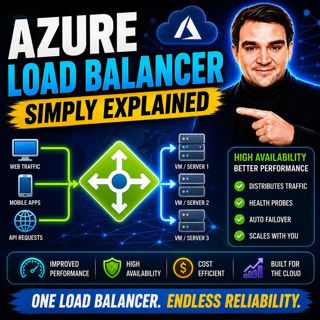
Azure Load Balancer — Simply Explained

Azure Load Balancer — Simply Explained

Every application starts small. A single virtual machine serves your website, processes customer requests, and handles all incoming traffic. At first, everything works perfectly. But as your user base...

16 Heinä 15min
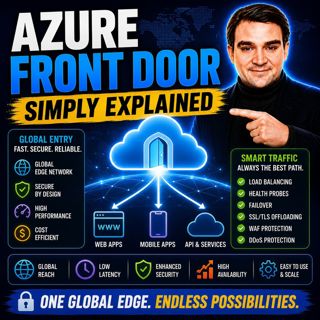
Azure Front Door - Simply Explained

Azure Front Door - Simply Explained

Building a website that performs well for users around the world is far more challenging than simply deploying a web application to Azure. A server hosted in North America may respond quickly for user...

16 Heinä 17min
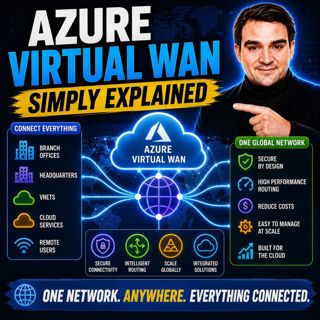
Azure Virtual WAN - Simply Explained

Azure Virtual WAN - Simply Explained

Building a global Azure network manually becomes increasingly difficult as your organization grows. What starts as a simple hub-and-spoke deployment quickly turns into a maze of virtual network peerin...

16 Heinä 14min
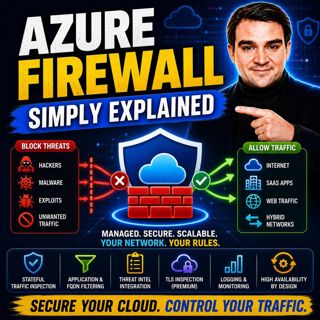
Azure Firewall - Simply Explained

Azure Firewall - Simply Explained

Securing a traditional office network was relatively straightforward—you installed a physical firewall at the edge of your network and inspected everything entering or leaving your building. But cloud...

16 Heinä 13min
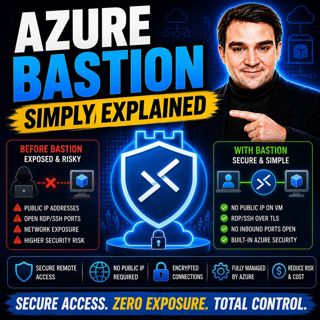
Azure Bastion - Simply Explained

Azure Bastion - Simply Explained

Secure remote access is one of the biggest challenges in cloud infrastructure. For years, administrators connected to Azure virtual machines by assigning public IP addresses and opening RDP or SSH por...

16 Heinä 11min

Suosittua kategoriassa Politiikka ja uutiset

aikalisa
uutiscast
ootsa-kuullut-tasta-2
rss-ootsa-kuullut-tasta
rss-vaalirankkurit-podcast
rss-podme-livebox
rss-seksicast
otetaan-yhdet
politiikan-puskaradio
tervo-halme
aihe
linda-maria
rss-raha-talous-ja-politiikka
viela-yksi-sivu
the-ulkopolitist
et-sa-noin-voi-sanoo-esittaa
rss-sveriges-radio-finska
rss-fingo-podcast
rss-tekoalyfoorumi
rss-girls-finish-f1rst