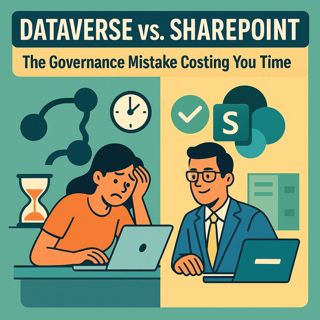
Dataverse vs SharePoint governance: when your Power Apps must move off lists to scale and stay compliant

Dataverse vs SharePoint governance: when your Power Apps must move off lists to scale and stay compliant

Dataverse vs SharePoint governance: in this episode of M365.fm, Mirko Peters explains why starting every Power Apps project with SharePoint Lists feels “free” but quietly creates governance, data quality, and scaling problems that Dataverse was built to prevent. He starts with the convenience trap: clicking “Create List” looks like instant progress, but that Monday‑morning prototype becomes a Friday‑afternoon department system—and by quarter’s end, it has mutated into an ungovernable swamp of attachments, ad‑hoc permissions, and broken relationships.

Mirko unpacks how this sprawl begins. SharePoint Lists are treated like glorified spreadsheets with a nicer UI, so teams spin up request trackers, budget lists, onboarding logs, and maintenance registers in separate sites with no shared schema or ownership. Each list evolves independently, with inconsistent column names, data types, and lookup patterns, until reporting across them becomes an archaeological dig rather than analytics. What felt like agility turns into fragmentation, with multiple “sources of truth” and no easy way to enforce retention, data quality, or access rules.

He then dives into the hard limits you only hit once it is too late: delegation boundaries, 5,000‑item view thresholds, lookup ceilings, and throttling. Power Apps begins to drop records silently, galleries slow down, and automation fails intermittently as list size and complexity grow. Meanwhile, attachments bloat storage, version history obscures intent, and business‑critical data hides inside private Team sites no one documented—creating compliance risks and operational blind spots that no amount of manual cleanup can fully fix.

Against this backdrop, Mirko positions Dataverse not as a luxury, but as the governance engine you should have started with. Dataverse brings relational schema, referential integrity, field‑level security, environment isolation, audit logs, and managed ALM—everything SharePoint was never designed to provide. He explains how modeling projects, tasks, and related entities in Dataverse gives Power Apps, Power Automate, and Power BI a stable backbone to build on, instead of duct‑taping lists together and hoping delegation does not implode your logic.

Throughout the episode, you get a practical decision framework. SharePoint Lists remain valid for small, low‑risk, collaboration‑centric scenarios—prototypes, simple trackers, static reference data—while Dataverse should be the default for anything with multiple tables, growing record counts, cross‑team access, or reporting and compliance requirements. Mirko gives you language to explain to stakeholders that Dataverse is not “expensive storage,” but the cost of avoiding the much bigger bill of migration, audit findings, and re‑platforming once a “simple list” accidentally becomes a critical system.

WHAT YOU WILL LEARN
  • Why SharePoint Lists are great for quick collaboration but fragile as a long‑term datasource.
  • How list sprawl, schema drift, and lookup hacks turn “citizen development” into data anarchy.
  • Which technical limits (delegation, thresholds, lookups, throttling) break list‑backed Power Apps at scale.
  • How Dataverse provides relational structure, security, and ALM that SharePoint Lists can’t match.
  • When to stay on Lists and when to start in Dataverse to avoid expensive migrations later.
THE CORE INSIGHT

SharePoint Lists make it easy to start; Dataverse makes it possible to govern and scale. If you treat Lists as a database, you are not saving money—you are deferring the much higher cost of cleaning up sprawl, fixing broken apps, and migrating under audit pressure to the data platform you should have chosen from day one.

WHO THIS EPISODE IS FOR

This episode is ideal for Power Apps makers, solution architects, COE teams, and IT leaders who are deciding where to build their next app—on SharePoint Lists or Dataverse. It is especially valuable if you already feel list sprawl, governance gaps, or performance issues and need a clear, business‑ready argument for using Dataverse as the standard backbone for serious Power Platform solutions.

ABOUT THE HOST

Mirko Peters is a Microsoft 365 and Power Platform consultant focused on building governed, scalable solutions with Dataverse, Power Apps, SharePoint, and Power Automate. Through M365.fm, he shares practical architecture stories, governance patterns, and migration playbooks that help organizations escape SharePoint‑as‑a‑database traps and build apps on foundations that actually scale.

Become a supporter of this podcast: https://www.spreaker.com/podcast/m365-fm-modern-work-security-and-productivity-with-microsoft-365--6704921/support.

Tämä jakso on lisätty Podme-palveluun avoimen RSS-syötteen kautta eikä se ole Podmen omaa tuotantoa. Siksi jakso saattaa sisältää mainontaa.

Jaksot(814)

From AI Hype to AI Harness Engineering – Building AI That People Can Actually Trust with Alan Buscaglia [MVP] from Gentleman Programming

From AI Hype to AI Harness Engineering – Building AI That People Can Actually Trust with Alan Buscaglia [MVP] from Gentleman Programming

Artificial Intelligence is evolving rapidly, but building AI that organizations can actually trust requires far more than choosing the latest language model. In this episode of the M365.fm podcast, Mi...

20 Heinä 0s

Agent-to-Agent (A2A) Communication - Simply Explained

Agent-to-Agent (A2A) Communication - Simply Explained

Welcome to another episode of Knowledge Nuggets with Mirko Peters. In this episode, we're exploring Agent-to-Agent (A2A) Communication, the open protocol that allows AI agents to discover one another,...

20 Heinä 18min
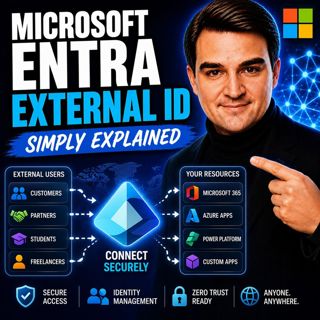
Microsoft Entra External ID - Simply Explained

Microsoft Entra External ID - Simply Explained

Welcome to another episode of Knowledge Nuggets with Mirko Peters. In this episode, we're exploring Microsoft Entra External ID, Microsoft's modern Customer Identity and Access Management (CIAM) platf...

20 Heinä 14min

Microsoft Graph Connectors - Simply Explained

Microsoft Graph Connectors - Simply Explained

Welcome to another episode of Knowledge Nuggets with Mirko Peters. In this episode, we're exploring Microsoft Graph Connectors, now increasingly referred to as Microsoft Copilot Connectors. While Micr...

20 Heinä 15min

Azure Advisor - Simply Explained

Azure Advisor - Simply Explained

Welcome to another episode of Knowledge Nuggets with Mirko Peters. In this episode, we're exploring Azure Advisor, Microsoft's free optimization service that continuously analyzes your Azure environme...

20 Heinä 15min
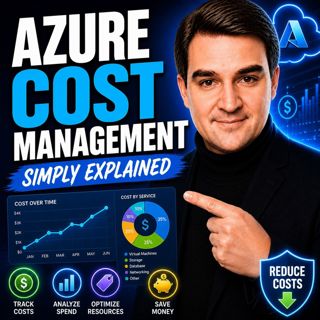
Azure Cost Management - Simply Explained

Azure Cost Management - Simply Explained

Welcome to another episode of Knowledge Nuggets with Mirko Peters. In this episode, we're exploring Azure Cost Management, Microsoft's built-in solution for monitoring, analyzing, controlling, and opt...

20 Heinä 18min

Azure Automation - Simply Explained

Azure Automation - Simply Explained

Welcome to another episode of Knowledge Nuggets with Mirko Peters. In this episode, we're exploring Azure Automation, Microsoft's cloud service for automating repetitive IT tasks across Azure and hybr...

20 Heinä 15min
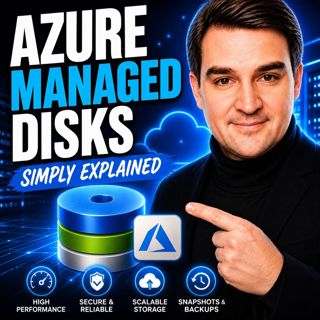
Azure Managed Disks - Simply Explained

Azure Managed Disks - Simply Explained

Welcome to another episode of Knowledge Nuggets with Mirko Peters. In this episode, we're exploring Azure Managed Disks, the storage technology that powers every Azure Virtual Machine. While many peop...

20 Heinä 15min

Suosittua kategoriassa Politiikka ja uutiset

aikalisa
uutiscast
ootsa-kuullut-tasta-2
rss-ootsa-kuullut-tasta
rss-vaalirankkurit-podcast
rss-podme-livebox
rss-seksicast
otetaan-yhdet
politiikan-puskaradio
aihe
tervo-halme
rss-girls-finish-f1rst
et-sa-noin-voi-sanoo-esittaa
rss-kovin-paikka
viela-yksi-sivu
the-ulkopolitist
rss-sveriges-radio-finska
rss-kaikki-uusiksi
rss-fingo-podcast
rss-raha-talous-ja-politiikka