Framework: The Center for Internet Security (CIS) Top 18 Controls

Framework: The Center for Internet Security (CIS) Top 18 Controls

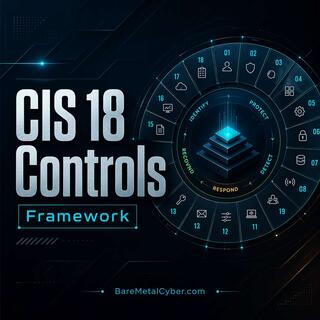
The **CIS Critical Security Controls Audio Course** is a comprehensive, audio-first training series that guides listeners through all eighteen **CIS Controls**, transforming one of the world’s most respected cybersecurity frameworks into clear, actionable learning. Designed for professionals, students, and auditors alike, this series explains each control in practical, plain language—focusing on how to implement, assess, and sustain them in real environments. With eighty-three structured episodes, the course walks you step by step through the safeguards that define effective cybersecurity, helping you understand not only what to do but why each measure matters. The **CIS Controls**, maintained by the Center for Internet Security, represent a globally recognized set of prioritized actions proven to reduce the most common and dangerous cyber risks. Organized across eighteen control families—from inventory and configuration management to incident response and data recovery—the framework provides a practical roadmap for building defensible, risk-aligned security programs. This course explores how organizations can adopt the controls incrementally, measure maturity over time, and map them to other standards such as NIST, ISO 27001, and PCI DSS for comprehensive alignment. Developed by **BareMetalCyber.com**, the CIS Critical Security Controls Audio Course delivers structured, exam-aligned instruction that bridges policy and practice. Each episode reinforces understanding through real-world context, helping listeners translate framework requirements into measurable actions that strengthen organizational resilience and long-term security maturity.

Tämä podcast on lisätty Podme-palveluun avoimen RSS-syötteen kautta eikä se ole Podmen omaa tuotantoa. Siksi podcastin jaksot saattavat sisältää mainontaa.

Jaksot(83)

Episode 27 — Remaining safeguards summary (Control 5)

Episode 27 — Remaining safeguards summary (Control 5)

The remaining safeguards in Control 5 complete the account management lifecycle by focusing on administrative segregation, service account oversight, and centralized control. Safeguard 5.4 mandates th...

18 Loka 202510min

Episode 26 — Safeguard 5.3 – Disable dormant accounts

Episode 26 — Safeguard 5.3 – Disable dormant accounts

Safeguard 5.3 requires organizations to detect and disable dormant accounts—user identities that have not been used for an extended period, typically forty-five days or more. Dormant accounts are amon...

18 Loka 202510min

Episode 25 — Safeguard 5.2 – Centralized account management

Episode 25 — Safeguard 5.2 – Centralized account management

Safeguard 5.2 emphasizes consolidating account administration through centralized identity services rather than isolated, system-specific credentials. Fragmented account management increases complexit...

18 Loka 20258min

Episode 24 — Safeguard 5.1 – Inventory of accounts

Episode 24 — Safeguard 5.1 – Inventory of accounts

Safeguard 5.1 requires organizations to maintain a comprehensive, accurate inventory of all accounts managed within the enterprise, covering user, administrator, and service identities. Each entry in ...

18 Loka 20259min

Episode 23 — Overview – Managing identity and accounts

Episode 23 — Overview – Managing identity and accounts

Control 5, Account Management, addresses one of cybersecurity’s most exploited weaknesses—mismanaged credentials. Attackers often gain entry not through advanced exploits but through valid usernames a...

18 Loka 20259min

Episode 22 — Remaining safeguards summary (Control 4)

Episode 22 — Remaining safeguards summary (Control 4)

The remaining safeguards under Control 4 extend the secure configuration principle into everyday system operation, ensuring that protections remain active and measurable. They include requirements for...

18 Loka 20259min

Episode 21 — Safeguard 4.2 – Automated configuration management

Episode 21 — Safeguard 4.2 – Automated configuration management

Safeguard 4.2 builds upon the secure baseline concept by emphasizing automation as the means to enforce and maintain configurations consistently. Manual configuration is error-prone, slow, and unsusta...

18 Loka 20259min

Episode 20 — Safeguard 4.1 – Establish secure configuration baselines

Episode 20 — Safeguard 4.1 – Establish secure configuration baselines

Safeguard 4.1 requires organizations to establish and maintain formal, secure configuration processes for all enterprise assets and software. This means defining standard settings that enforce the pri...

18 Loka 202510min

Suosittua kategoriassa Koulutus

rss-murhan-anatomia
aamukahvilla
psykopodiaa-podcast
voi-hyvin-meditaatiot-2
rss-hereilla
rss-suomen-aa-podcast
rss-arkea-ja-aurinkoa-podcast-espanjasta
kesken
aloita-meditaatio
rss-liian-kuuma-peruna
koulu-podcast-2
rss-taysi-voima
adhd-podi
rss-niinku-asia-on
psykologia
rss-spessu
rss-duodecim-lehti
rss-vapaudu-voimaasi
rss-luonnollinen-synnytys-podcast
rahapuhetta