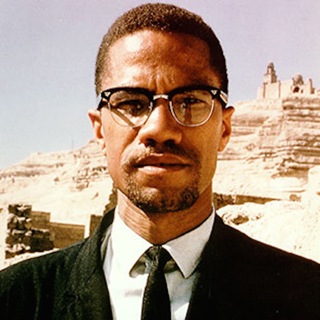
February 21, 1965 -- Malcolm X is Assassinated

February 21, 1965 -- Malcolm X is Assassinated

Malcolm X who was born in Omaha, Nebraska on May 19th 1925 from his mother Louise Norton Little and his father Earl Little. He was one of 8 children and grew up in a very proactive household. His father, Earl who was a baptist minister was very outspoken and was a large supporter of the Black Nationalist leader Marcus Garvey. Being outspoken came with its consequences, his father would receive death threats from a white supremacist organization Black Legion. They were forced to move to avoid the threats but less than a year later their house was burned, and two years later he was found dead. It was presumed an accident and after his death his mother became insane and had to go to a mental institution in which all the kids went to foster care. As Malcolm grew up he bounced from home to home and eventually in 1946 he was arrested for burglary. During his time in prison he reflected on his life and his brother would visit him, he introduced him to Nation of Islam. He then took very close following of the leader Elijah Muhammad, and when he got out he decided to get involved. He then changed his name from Malcolm Little to Malcolm X to get rid of his slave name. Most importantly he became the spokesperson for the NOI because he was very intelligent and articulate. He used television, radio and newspapers to spread his beliefs and ideas with the world. The NOI grew from 500 to 30,000 followers in 10 years. Malcolm X was very controversial and his statements brought outrage from the public. He told his followers to break away from racism “by any means necessary” which means violence is acceptable. Separate from his rival Martin Luther King who was anti-aggression, Malcolm often scolded MLK for being friends with the white man. He said “You don’t have a peaceful revolution” and “You don’t have a turn the cheek revolution. There’s no such thing as a nonviolent revolution”. These words had an effect on the people of America due to his pro-violence views. These statements won him large amounts of followers but also brought many critics. One of the critics was MLK himself saying “I feel that Malcolm has done himself and our people a great disservice.” showing the feelings he has for Malcolm’s opinions. In 1963 Malcolm was betrayed by his most coveted friend Elijah Muhammad. He had followed Muhammad’s teachings for many year only to find out that Elijah himself was breaking some of the most important rules of his religion. He was having affairs with numerous women and it caused a huge outbreak for Malcolm to handle. He then separated himself from NOI and moved on to start his own organization. The death of Malcolm X was monumental for the civil rights movement. He was killed in 1965 at the Audobon ballroom in Manhattan. He was shot 15 times at point blank range by members of the NOI. This allowed Martin Luther King to take Malcolm’s followers and move forward with the civil rights movement. Without Malcolm X the civil rights movement would have been drastically different.

Denne episoden er hentet fra en åpen RSS-feed og er ikke publisert av Podme. Den kan derfor inneholde annonser.

Episoder(20)

Freedom Rides - May 4th, 1964 Max Ranney

Freedom Rides - May 4th, 1964 Max Ranney

Over the course of the Civil Rights movement there were many events that lead to the eventual improvement of civil rights. However, one event that is seen as a breaking point for the movement were the...

1 Jun 20173min

August 28th 1963 March On Washington By Sam Katz

August 28th 1963 March On Washington By Sam Katz

Sam Katz Mael P.3 US History II May 2, 2017 Background on the March on Washington; The March On Washington was a giant gathered march to help protest for civil rights for African Americans. The lead...

1 Jun 20173min

August 6, 1965: Voting Rights Act

August 6, 1965: Voting Rights Act

August 6, 1965: Voting Rights Act by DHS US History II

14 Mai 20172min

MLK assassination

MLK assassination

MLK assassination by DHS US History II

4 Mai 201710min

June 28, 1969 -- The Stonewall Inn Riots

June 28, 1969 -- The Stonewall Inn Riots

June 28, 1969 -- The Stonewall Inn Riots by DHS US History II

3 Mai 20175min

June 11, 1963: Civil Rights Address

June 11, 1963: Civil Rights Address

Luke Bernier Mr. Mael 4/30/17 U.S. History II How the Civil Rights Address Movement Affected Civil Rights The Civil Rights Address was a speech given by John F. Kennedy, following the famous sta...

3 Mai 20174min

March 7, 1965: Bloody Sunday | Selma, Alabama

March 7, 1965: Bloody Sunday | Selma, Alabama

During 1961 and 1964, the Student Nonviolent Coordinating Committee (SNCC) had led a voting registration campaign in Selma, the seat of Dallas County, Alabama, a small town with a record of consistent...

3 Mai 20174min

September 15, 1963: 16th Street Baptist Church Bombing

September 15, 1963: 16th Street Baptist Church Bombing

In the 1960s, Birmingham, Alabama was one of the most racially segregated cities in the United States. By 1963, Birmingham had earned the nickname “Bombingham” because homemade bombs set of in homes a...

3 Mai 20176min

Populært innen Fakta

fastlegen
dine-penger-pengeradet
relasjonspodden-med-dora-thorhallsdottir-kjersti-idem
foreldreradet
jakt-og-fiskepodden
rss-bisarr-historie
treningspodden
rss-strid-de-norske-borgerkrigene
mikkels-paskenotter
rss-kunsten-a-leve
sinnsyn
hverdagspsyken
gravid-uke-for-uke
hagespiren-podcast
lederskap-nhhs-podkast-om-ledelse
dopet
rss-sunn-okonomi
uroskolen
rss-mind-body-podden
rss-kull