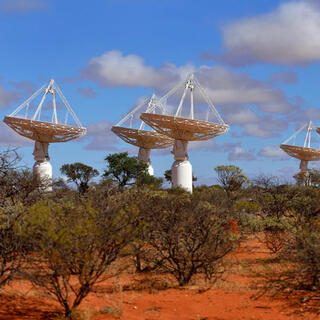
CHIME’s Cosmic Echo: The First Detection of the 21 cm Auto-Power Spectrum.

CHIME’s Cosmic Echo: The First Detection of the 21 cm Auto-Power Spectrum.

Reference Article: Detection of the Cosmological 21 cm Signal in Auto-correlation at z ∼ 1 with the Canadian Hydrogen Intensity Mapping Experiment, by The CHIME Collaboration.


Summary:

We delve into a groundbreaking astronomical achievement: the **first detection of the cosmological 21 cm intensity mapping signal in auto-correlation at $z \sim 1$** using the Canadian Hydrogen Intensity Mapping Experiment (CHIME). This discovery utilizes 94 nights of observation data, covering a frequency range from 608.2 MHz to 707.8 MHz, corresponding to a mean redshift of approximately $z \sim 1.16$.


The detection was highly significant, measured at **$12.5\sigma$**. This marks a major milestone, as it establishes the 21 cm auto-power spectrum as a direct and potent cosmological probe, eliminating the dependence on external galaxy surveys to study large-scale structure.


Key Discussion Points:

  • The Challenge: Detecting the cosmological 21 cm signal is extremely challenging because astrophysical radio foregrounds are several orders of magnitude brighter.
  • Pipeline Advancements: The success relies on significant improvements to the CHIME data processing pipeline. These advancements include novel RFI (Radio Frequency Interference) detection and masking algorithms, achromatic beamforming techniques, and applying foreground filtering *before* time averaging to minimize spectral leakage. The Hybrid Foreground Residual Subtraction (HyFoReS) algorithm was also deployed to correct residual bandpass errors.
  • Robustness and Validation: The measurement is exceptionally reliable, having been established through a comprehensive suite of validation tests. Key checks demonstrated that the signal is consistent across independent right ascension bins, declination bins, and different baseline configurations, ruling out baseline-dependent, RA-dependent, or declination-dependent systematics. Crucially, the consistency of the signal in Stokes-Q data with noise rules out significant polarized foreground leakage.
  • Consistent Results: The auto-correlation result is statistically consistent with previous cross-correlation measurements performed using the same CHIME data stacked on eBOSS quasars, providing strong evidence against contamination from systematics.
  • Cosmological Implications: The measurement constrains the clustering amplitude of neutral hydrogen (HI). For the full band, the derived amplitude parameter is $A^2_{\text{HI}} = 2.59^{+1.26}_{-0.78}(\text{stat.})^{+2.45}_{-0.47}(\text{sys.})$. Independent detections were also made in two sub-bands (9.2$\sigma$ at $z \sim 1.24$ and 8.7$\sigma$ at $z \sim 1.08$), showing consistency between the different redshift slices.
  • Future Outlook:This detection sets the stage for precision 21 cm cosmology. Future work aims to include the nearly 7 years of archival CHIME data to reduce statistical uncertainties, push measurements to higher redshifts (400–600 MHz band), and develop new techniques to recover linear scales in the power spectrum, potentially enabling measurements of Baryon Acoustic Oscillations (BAOs).


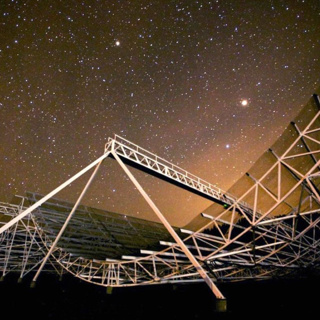
Acknowledements: Podcast prepared with Google/NotebookLM. Illustration credits: CHIME/Andre Recnik

Denne episoden er hentet fra en åpen RSS-feed og er ikke publisert av Podme. Den kan derfor inneholde annonser.

Episoder(101)

Record-Breaker: Catching Gamma Rays from the Distant Quasar OP 313

Record-Breaker: Catching Gamma Rays from the Distant Quasar OP 313

In this episode, we dive into a groundbreaking astronomical discovery: the detection of very-high-energy (VHE) gamma rays from the quasar OP 313. Located at a redshift of $z = 0.997$, OP 313 has shatt...

1 Jun 20min

Ripples in Spacetime: Unpacking the GWTC-5.0 Catalog

Ripples in Spacetime: Unpacking the GWTC-5.0 Catalog

In this episode, we dive into the monumental release of the Gravitational-Wave Transient Catalog version 5.0 (GWTC-5.0) and the open data from the second part of the fourth observing run (O4b) by the ...

29 Mai 21min

SN 2017egm : Fermi-LAT's Breakthrough Gamma-Ray Detection

SN 2017egm : Fermi-LAT's Breakthrough Gamma-Ray Detection

In today’s episode, we dive into the mystery of superluminous supernovae (SLSNe)—rare, extreme astronomical events that shine 10 to 100 times brighter than standard core-collapse supernovae. For years...

22 Mai 23min

Supernovae on the RISE: Why Dead Stars Wake Up Decades Later

Supernovae on the RISE: Why Dead Stars Wake Up Decades Later

In this episode, we explore the fascinating phenomenon of core-collapse supernovae that refuse to fade away quietly. Years, or even decades, after their initial explosion, some of these stellar deaths...

20 Mai 17min

The SVOM Satellite: A New Era in Multi-Messenger Astronomy

The SVOM Satellite: A New Era in Multi-Messenger Astronomy

In this episode, we dive into the fascinating world of gamma-ray bursts (GRBs) and high-energy transients through the lens of the SVOM (Space-based Multi-band Variable Object Monitor) mission. Launche...

29 Apr 24min

Chasing the Flash: Hunting Neutron Star Mergers with CTAO

Chasing the Flash: Hunting Neutron Star Mergers with CTAO

In this episode, we dive into the thrilling world of multi-messenger astronomy! Ever since the historic detection of GW170817, scientists have known that binary neutron star (BNS) mergers can produce ...

14 Apr 19min

Tiling the Sky: A New Strategy for Finding Elusive GRBs

Tiling the Sky: A New Strategy for Finding Elusive GRBs

In this episode, we dive into the intense and fast-paced world of **Gamma-ray bursts (GRBs)—the most luminous and rapidly evolving transients in the Universe**. While space-based instruments like the ...

13 Apr 19min

Fast Radio Bursts & Magnetar X-Rays: A Peculiar Discovery

Fast Radio Bursts & Magnetar X-Rays: A Peculiar Discovery

In this episode, we dive into the deep cosmos to explore a recent astronomical breakthrough linking Fast Radio Bursts (FRBs)—enigmatic, millisecond-long cosmic transients—to extreme stellar objects kn...

7 Apr 22min

Populært innen Vitenskap

fastlegen
tingenes-tilstand
jss
rekommandert
liberal-halvtime
sinnsyn
forskningno
tomprat-med-gunnar-tjomlid
villmarksliv
rss-paradigmepodden
fjellsportpodden
kvinnehelsepodden
tidlose-historier
dekodet-2
rss-zahid-ali-hjelper-deg
rss-overskuddsliv
hva-er-greia-med
rss-rekommandert
rss-inn-til-kjernen-med-sunniva-rose
grunnstoffene