
#231 – Paul Scharre on how AI-controlled robots will and won't change war

#231 – Paul Scharre on how AI-controlled robots will and won't change war

In 1983, Stanislav Petrov, a Soviet lieutenant colonel, sat in a bunker watching a red screen flash “MISSILE LAUNCH.” Protocol demanded he report it to superiors, which would very likely trigger a retaliatory nuclear strike. Petrov didn’t. He reasoned that if the US were actually attacking, they wouldn’t fire just 5 missiles — they’d empty the silos. He bet the fate of the world on a hunch that his machine was broken. He was right.

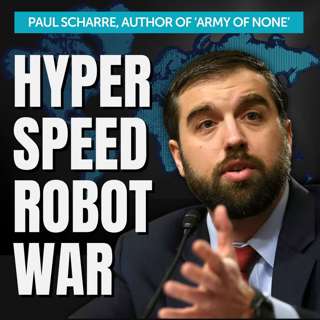
Paul Scharre, the former Army Ranger who led the Pentagon team that wrote the US military’s first policy on autonomous weapons, has a question: What would an AI have done in Petrov’s shoes? Would an AI system have been flexible and wise enough to make the same judgement? Or would it immediately launch a counterattack?

Paul joins host Luisa Rodriguez to explain why we are hurtling toward a “battlefield singularity” — a tipping point where AI increasingly replaces humans in much of the military, changing the way war is fought with speed and complexity that outpaces humans’ ability to keep up.

Links to learn more, video, and full transcript: https://80k.info/ps

Militaries don’t necessarily want to take humans out of the loop. But Paul argues that the competitive pressure of warfare creates a “use it or lose it” dynamic. As former Deputy Secretary of Defense Bob Work put it: “If our competitors go to Terminators, and their decisions are bad, but they’re faster, how would we respond?”

Once that line is crossed, Paul warns we might enter an era of “flash wars” — conflicts that spiral out of control as quickly and inexplicably as a flash crash in the stock market, with no way for humans to call a timeout.

In this episode, Paul and Luisa dissect what this future looks like:

  • Swarming warfare: Why the future isn’t just better drones, but thousands of cheap, autonomous agents coordinating like a hive mind to overwhelm defences.
  • The Gatling gun cautionary tale: The inventor of the Gatling gun thought automating fire would reduce the number of soldiers needed, saving lives. Instead, it made war significantly deadlier. Paul argues AI automation could do the same, increasing lethality rather than creating “bloodless” robot wars.
  • The cyber frontier: While robots have physical limits, Paul argues cyberwarfare is already at the point where AI can act faster than human defenders, leading to intelligent malware that evolves and adapts like a biological virus.
  • The US-China “adoption race”: Paul rejects the idea that the US and China are in a spending arms race (AI is barely 1% of the DoD budget). Instead, it’s a race of organisational adoption — one where the US has massive advantages in talent and chips, but struggles with bureaucratic inertia that might not be a problem for an autocratic country.

Paul also shares a personal story from his time as a sniper in Afghanistan — watching a potential target through his scope — that fundamentally shaped his view on why human judgement, with all its flaws, is the only thing keeping war from losing its humanity entirely.

This episode was recorded on October 23-24, 2025.

Chapters:

  • Cold open (00:00:00)
  • Who’s Paul Scharre? (00:00:46)
  • How will AI and automation transform the nature of war? (00:01:17)
  • Why would militaries take humans out of the loop? (00:12:22)
  • AI in nuclear command, control, and communications (00:18:50)
  • Nuclear stability and deterrence (00:36:10)
  • What to expect over the next few decades (00:46:21)
  • Financial and human costs of future “hyperwar” scenarios (00:50:42)
  • AI warfare and the balance of power (01:06:37)
  • Barriers to getting to automated war (01:11:08)
  • Failure modes of autonomous weapons systems (01:16:28)
  • Could autonomous weapons systems actually make us safer? (01:29:36)
  • Is Paul overall optimistic or pessimistic about increasing automation in the military? (01:35:23)
  • Paul’s takes on AGI’s transformative potential and whether natsec people buy it (01:37:42)
  • Cyberwarfare (01:46:55)
  • US-China balance of power and surveillance with AI (02:02:49)
  • Policy and governance that could make us safer (02:29:11)
  • How Paul’s experience in the Army informed his feelings on military automation (02:41:09)

Video and audio editing: Dominic Armstrong, Milo McGuire, Luke Monsour, and Simon Monsour
Music: CORBIT
Coordination, transcripts, and web: Katy Moore

Episoder(317)

Why 'Aligned AI' Would Still Kill Democracy | David Duvenaud, ex-Anthropic team lead

Why 'Aligned AI' Would Still Kill Democracy | David Duvenaud, ex-Anthropic team lead

Democracy might be a brief historical blip. That’s the unsettling thesis of a recent paper, which argues AI that can do all the work a human can do inevitably leads to the “gradual disempowerment” of ...

27 Jan 2h 31min

#145 Classic episode – Christopher Brown on why slavery abolition wasn't inevitable

#145 Classic episode – Christopher Brown on why slavery abolition wasn't inevitable

In many ways, humanity seems to have become more humane and inclusive over time. While there’s still a lot of progress to be made, campaigns to give people of different genders, races, sexualities, et...

20 Jan 2h 56min

#233 – James Smith on how to prevent a mirror life catastrophe

#233 – James Smith on how to prevent a mirror life catastrophe

When James Smith first heard about mirror bacteria, he was sceptical. But within two weeks, he’d dropped everything to work on it full time, considering it the worst biothreat that he’d seen described...

13 Jan 2h 9min

#144 Classic episode – Athena Aktipis on why cancer is a fundamental universal phenomena

#144 Classic episode – Athena Aktipis on why cancer is a fundamental universal phenomena

What’s the opposite of cancer? If you answered “cure,” “antidote,” or “antivenom” — you’ve obviously been reading the antonym section at www.merriam-webster.com/thesaurus/cancer.But today’s guest Athe...

9 Jan 3h 30min

#142 Classic episode – John McWhorter on why the optimal number of languages might be one, and other provocative claims about language

#142 Classic episode – John McWhorter on why the optimal number of languages might be one, and other provocative claims about language

John McWhorter is a linguistics professor at Columbia University specialising in research on creole languages. He's also a content-producing machine, never afraid to give his frank opinion on anything...

6 Jan 1h 35min

2025 Highlight-o-thon: Oops! All Bests

2025 Highlight-o-thon: Oops! All Bests

It’s that magical time of year once again — highlightapalooza! Stick around for one top bit from each episode we recorded this year, including:Kyle Fish explaining how Anthropic’s AI Claude descends i...

29 Des 20251h 40min

#232 – Andreas Mogensen on what we owe 'philosophical Vulcans' and unconscious beings

#232 – Andreas Mogensen on what we owe 'philosophical Vulcans' and unconscious beings

Most debates about the moral status of AI systems circle the same question: is there something that it feels like to be them? But what if that’s the wrong question to ask? Andreas Mogensen — a senior ...

19 Des 20252h 37min

Populært innen Fakta

fastlegen
dine-penger-pengeradet
relasjonspodden-med-dora-thorhallsdottir-kjersti-idem
treningspodden
foreldreradet
dopet
merry-quizmas
jakt-og-fiskepodden
sovnlos
rss-strid-de-norske-borgerkrigene
sinnsyn
podme-bio-3
rss-kull
hverdagspsyken
gravid-uke-for-uke
tomprat-med-gunnar-tjomlid
rss-kunsten-a-leve
fryktlos
level-up-med-anniken-binz
rss-var-forste-kaffe