#3 of 2025 Top Ten: Surviving Chaos

#3 of 2025 Top Ten: Surviving Chaos

In this gripping conversation, trauma surgeon Max Sirkin MD shares his harrowing experience of being a patient in a mass casualty situation following a helicopter crash. He recounts the chaos of the event, the physical and emotional trauma he endured, and the profound lessons learned about resilience, brotherhood, and the importance of being present for others in crisis. Sirkin's narrative highlights the stark realities of military medicine and the bonds formed in the face of adversity. In this conversation, Max shares his harrowing experience in the trauma bay after a serious injury, reflecting on feelings of inadequacy and failure in the face of trauma. He discusses the psychological impact of moral injury and the importance of behavioral health in recovery. The conversation emphasizes the principle of 'less is more' in trauma care, highlighting the need for careful decision-making in chaotic situations. Max also recounts his experience with ketamine during treatment, illustrating the limited situational awareness of patients in trauma. Finally, he underscores the significance of camaraderie and support among peers in the recovery process. In this conversation, Max Sirkin shares his harrowing experiences in a life-threatening situation, emphasizing the importance of training and preparation in chaotic medical environments. He discusses the critical role of behavioral health in recovery from trauma and the necessity of learning from failures in medical practice. The dialogue highlights the need for teamwork, effective communication, and continuous training to ensure readiness in emergency situations.


Takeaways

He shares his unique perspective as a patient in a mass casualty situation.

The chaos of a mass casualty requires quick and effective decision-making.

Surviving a helicopter crash was a life-altering experience for Sirkin.

The importance of brotherhood and support in crisis situations is paramount.

Sirkin emphasizes the need for medical professionals to be present for their patients.

He reflects on the emotional toll of being unable to help others in distress.

The narrative illustrates the unpredictability of trauma care in combat zones.

Sirkin's story serves as a reminder of the resilience of the human spirit.

The conversation sheds light on the realities faced by military medical personnel. It's hard to face the reality of failure in trauma situations.

Moral injury can be as impactful as physical injuries.

Behavioral health is crucial for recovery after trauma.

Less intervention can sometimes lead to better outcomes.

Situational awareness is limited when you're a patient.

Keeping injured individuals together can aid in recovery.

The importance of communication in chaotic medical situations.

Ketamine can provide pain relief but also alter perception.

Understanding the dynamics of trauma care is essential for providers.

Camaraderie among peers is vital for emotional support. Training is essential for managing chaos in medical emergencies.

Behavioral health is crucial for recovery from trauma.

Surgeons should not consider themselves special; everyone is vulnerable.

Daily medical practice is necessary for readiness.

Teaching non-medical personnel basic medical skills saves lives.

Failure in medicine is inevitable; learning from it is essential.

Hope alone is not a strategy in critical care.

Understanding trauma can lead to better coping mechanisms.

Team dynamics and communication are vital in emergency situations.

Every medical provider should be prepared for the unexpected.

For more content go to ⁠⁠⁠⁠⁠⁠⁠⁠⁠⁠www.prolongedfieldcare.org⁠⁠⁠⁠⁠⁠⁠⁠⁠⁠Consider supporting us: ⁠⁠⁠⁠⁠⁠⁠⁠⁠⁠patreon.com/ProlongedFieldCareCollective⁠⁠⁠⁠⁠⁠ or ⁠⁠⁠⁠⁠⁠www.lobocoffeeco.com/product-page/prolonged-field-care

Denne episoden er hentet fra en åpen RSS-feed og er ikke publisert av Podme. Den kan derfor inneholde annonser.

Episoder(625)

SOMA 26' - Role 1.5: Fighting Tourniquet Syndrome at the Forefront

SOMA 26' - Role 1.5: Fighting Tourniquet Syndrome at the Forefront

Ukrainian orthopedic and reconstructive surgeon describes what prolonged field care actually looks like when evacuation from the front line to Role 2 takes three to four days, and sometimes longer. Af...

3 Sep 21min

294 - Do Antibiotics Really Reduce Mortality in Trauma? Wound Care First in Prolonged Field Care

294 - Do Antibiotics Really Reduce Mortality in Trauma? Wound Care First in Prolonged Field Care

Antibiotics are not magic. In this episode of the PFC Podcast, Dennis sits down with Ryan to cut through the common myth that “I’ve given antibiotics, so the wound is protected.” They unpack why vigor...

31 Aug 36min
SOMA 26' - Fresh Whole Blood is Not The Answer: It's Still a Question

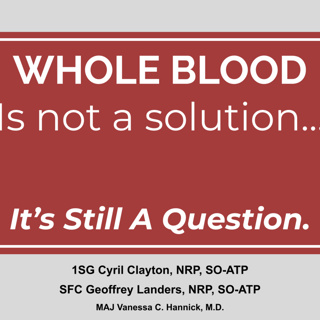
SOMA 26' - Fresh Whole Blood is Not The Answer: It's Still a Question

Whole Blood Is Not a Solution (Until Conventional Forces Can Deliver It)Recorded live at SOMA 26Dr. Vanessa Hanick (emergency physician, former active-duty Army, now National Guard) and 1SG Cy Clayton...

27 Aug 28min
293 - Dead Tissue Kills in Prolonged Field Care: 4 C’s, Early Debridement & Delayed Primary Closure Lessons from the Field

293 - Dead Tissue Kills in Prolonged Field Care: 4 C’s, Early Debridement & Delayed Primary Closure Lessons from the Field

In this episode of the PFC Podcast, Dennis sits down with missionary surgeon Jason to cut through the noise on real-world wound care in austere and unconventional warfare environments. From the bridge...

24 Aug 49min
SOMA 26' - European Medical Preparations for Major Engagements and Large-Scale Combat Operations

SOMA 26' - European Medical Preparations for Major Engagements and Large-Scale Combat Operations

Recorded live at SOMA 26Pierre Pasquier (France) and his German counterpart deliver a clear-eyed assessment of how European military medical systems are preparing for large-scale combat operations and...

20 Aug 31min
292-Building Mobile Surgical Capability in Denied Environments

292-Building Mobile Surgical Capability in Denied Environments

In this episode of the Prolonged Field Care Podcast, Dennis sits down with Mitch (U.S. family practice/ER physician) and Augustine (frontline surgeon with five years of experience) to unpack what it a...

17 Aug 41min
SOMA 26 - Optimizing the Efficacy of Commonly Used Tactical Medical Gear and Medications In The Arctic Extreme Cold Operational Environment

SOMA 26 - Optimizing the Efficacy of Commonly Used Tactical Medical Gear and Medications In The Arctic Extreme Cold Operational Environment

Recorded live at SOMA 26Dr. Emily Johnston (Cascadia Mountain Institute) and SFC Ezequiel Mendoza (Arctic Dustoff, Fairbanks) deliver a hard-hitting, field-validated look at how standard tactical medi...

13 Aug 29min
291 - Pediatric Burns In Prolonged Field Care Assessment, Resuscitation & Airway Management

291 - Pediatric Burns In Prolonged Field Care Assessment, Resuscitation & Airway Management

In this essential episode of the Prolonged Field Care Podcast, Dennis sits down with pediatric intensivist Dr. Sara Bibbens to tackle one of the most challenging and anxiety-inducing scenarios in aust...

10 Aug 30min

Populært innen Fakta

fastlegen
dine-penger-pengeradet
relasjonspodden-med-dora-thorhallsdottir-kjersti-idem
treningspodden
rss-strid-de-norske-borgerkrigene
jakt-og-fiskepodden
foreldreradet
rss-orjasater
hverdagspsyken
sinnsyn
tomprat-med-gunnar-tjomlid
rss-kunsten-a-leve
mikkels-paskenotter
rss-var-forste-kaffe
lederskap-nhhs-podkast-om-ledelse
gravid-uke-for-uke
fryktlos
rss-impressions-2
kvallm
branncast