
Voyager and the heliopause: Exploring where the Sun gives way to the stars

Voyager and the heliopause: Exploring where the Sun gives way to the stars

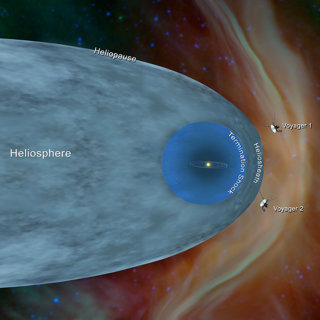
What does it really mean to enter interstellar space, and what have we learned since humanity first crossed the invisible boundary between our Sun and the stars?

In this episode of Planetary Radio, we explore the science of the heliosphere and the realm beyond with Linda Spilker, project scientist for the Voyager mission at NASA Jet Propulsion Laboratory. Drawing on decades of experience with the twin spacecraft, Spilker shares how Voyager reshaped our view of the Solar System’s outer frontier, from the nature of the heliopause to the unexpectedly rich structure of the local interstellar medium.

We unpack what Voyager 1 and Voyager 2 have taught us about charged particles, magnetic fields, and cosmic rays beyond the Sun’s protective bubble, and why those measurements have upended earlier ideas about where the Solar System truly ends. Spilker also reflects on the mission’s extraordinary longevity, the ingenuity required to keep the spacecraft communicating across the vastness of space, and what Voyager’s legacy means for future journeys between the stars.

Then, in What’s Up, Bruce Betts, chief scientist at The Planetary Society, places Voyager in context, showing how long-lived missions shape the bigger picture of space science and why observing longer can lead to some of our most profound discoveries.

Discover more at: https://www.planetary.org/planetary-radio/2026-voyagers-and-the-heliopause

See omnystudio.com/listener for privacy information.

Episoder(1318)

Bill Nye: A star in Hollywood, a voice for NASA

Bill Nye: A star in Hollywood, a voice for NASA

Bill Nye, CEO of The Planetary Society, has officially joined the Hollywood Walk of Fame. In this episode, we speak with Bill about what this rare honor means to him and to science communication. Then...

24 Sep 202556min

Book Club Edition: Cosmos Award–winning author Dava Sobel

Book Club Edition: Cosmos Award–winning author Dava Sobel

Only six people have received The Planetary Society’s Cosmos Award for Outstanding Public Presentation of Science. We were honored to present it to author and historian Dava Sobel in May of 2025. She ...

19 Sep 202550min

A cosmic travel guide: 111 Places in Space That You Must Not Miss

A cosmic travel guide: 111 Places in Space That You Must Not Miss

Pack your cosmic suitcase. This week on Planetary Radio, host Sarah Al-Ahmed is joined by Mark McCaughrean, astronomer, science communicator, and former Senior Advisor for Science & Exploration at the...

17 Sep 20251h 7min

International Observe the Moon Night 2025

International Observe the Moon Night 2025

This week on Planetary Radio, we look forward to International Observe the Moon Night on October 4, 2025. Host Sarah Al-Ahmed speaks with Staci Horvath, outreach coordinator for NASA’s Solar System Ex...

10 Sep 202559min

Space Policy Edition: Does the rise of Elon mean the decline of NASA?

Space Policy Edition: Does the rise of Elon mean the decline of NASA?

NASA, the crown jewel of 20th-century technocratic liberalism, was the first to land humans on the Moon but now depends on SpaceX for its access to space. Atlantic writer Franklin Foer believes this r...

5 Sep 20251h

Uranus revealed: Solving the ice giant’s heat mystery

Uranus revealed: Solving the ice giant’s heat mystery

For decades, Uranus has puzzled scientists. Unlike the other giant planets, Voyager 2’s 1986 flyby suggested the ice giant emitted no excess heat. Now, thanks to new analyses of Voyager data, decades ...

3 Sep 202556min

Esports and space: BASILISK’s quest for “Science Victory”

Esports and space: BASILISK’s quest for “Science Victory”

BASILISK, the first esports organization dedicated to promoting science, has teamed up with The Planetary Society and Caltech’s Institute for Quantum Information and Matter to bring the banner of “Sci...

27 Aug 202557min

Silicate clouds and a dusty ring: JWST looks at YSES-1

Silicate clouds and a dusty ring: JWST looks at YSES-1

In 2020, the YSES-1 system became the first directly imaged multiplanetary system around a Sun-like star. It features two giant exoplanets orbiting a star just 16 million years old. Now, the James Web...

20 Aug 202559min

Populært innen Vitenskap

fastlegen
rekommandert
tingenes-tilstand
jss
rss-rekommandert
liberal-halvtime
villmarksliv
sinnsyn
rss-paradigmepodden
forskningno
fjellsportpodden
nevropodden
rss-nysgjerrige-norge
vett-og-vitenskap-med-gaute-einevoll
diagnose
dekodet-2
smart-forklart
abid-nadia-skyld-og-skam
rss-lundqvist-podden
hva-er-greia-med