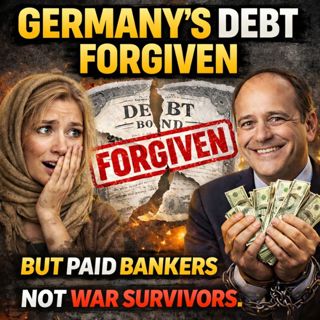

E177: Why Bankers Got Paid and Europe Recovered: The London Debt Agreement Explained

E177: Why Bankers Got Paid and Europe Recovered: The London Debt Agreement Explained

Economic historian Tobias Straumann breaks down how Germany’s debt meltdown in 1931 crashed the global economy—and how a surprisingly generous 1953 debt deal helped spark the German economic miracle by putting growth ahead of punishment.

GUEST BIO: Tobias Straumann (Switzerland) is Professor of Modern & Economic History at the University of Zurich; author of Out of Hitler’s Shadow and 1931: Debt, Crisis, and the Rise of Hitler.

TOPICS DISCUSSED:

  • 1931 as the real inflection point of the Great Depression
  • Treaty of Versailles + reparations politics (why it’s not a straight-line story)
  • Germany’s “double surplus” debt trap (budget + trade surplus) and default dynamics
  • Gold standard breakdown and global contagion
  • London Debt Agreement (1953): what it did and why it mattered
  • WWII reparations vs interwar debts vs private creditors (who got paid)
  • Cold War incentives vs the older “German problem” (balance of power since 1871)
  • 1990 reunification, the 2+4 treaty, and why reparations weren’t reopened
  • Later compensation: Israel/Claims Conference, forced labor, voluntary gestures
  • Poland/Greece reparations claims in modern politics
  • Comparisons: Japan/Italy reparations and postwar strategy
  • Modern debt parallels (domestic vs foreign-currency debt; political will)

MAIN POINTS:

  • 1931 turned a severe recession into a worldwide depression via Germany-centered financial contagion.
  • Versailles mattered, but Allied policy adjustments and domestic politics shaped outcomes more than a simple “Versailles caused WWII” line.
  • Germany’s foreign-currency debt made austerity + transfer demands self-defeating, ending in default and system collapse.
  • The 1953 London Debt Agreement was pivotal: it reduced and restructured interwar debts and made repayment compatible with recovery.
  • West Germany paid little-to-no WWII reparations (effectively deferred), while interwar private creditors recovered significant shares—morally messy but stabilizing.
  • Cold War pressures helped, but Europe’s long-running challenge was integrating a too-strong Germany into a stable order.
  • In 1990, the 2+4 framework avoided reopening WWII reparations to keep reunification politically and economically manageable.
  • Later payments (Israel, Holocaust victims, forced laborers) partially addressed moral claims outside classic state-to-state reparations.

TOP 3 QUOTES:

  • “We think that the year 1931 was the turning point… it turned into a worldwide depression.”
  • “It’s probably the biggest and most important debt settlement of the 20th century.”
  • “It’s morally hard to swallow… but it had the advantage of stabilizing Western Europe economically and politically.”

🎙 The Pod is hosted by Jesse Wright
💬 For guest suggestions, questions, or media inquiries, reach out at https://elpodcast.media/
📬 Never miss an episode – subscribe and follow wherever you get your podcasts.
⭐️ If you enjoyed this episode, please rate and review the show. It helps others find us.

Thanks for listening!

Episoder(186)

E42: Procreate or Perish: Why Population Collapse Is the Real Crisis - w/ Dr. Paul Morland

E42: Procreate or Perish: Why Population Collapse Is the Real Crisis - w/ Dr. Paul Morland

Demographer Dr. Paul Morland joins El Podcast to explore why population collapse—not overpopulation—is the defining crisis of the 21st century.Guest Bio: Dr. Paul Morland is one of the UK’s leading de...

2 Sep 20231h 7min

E41: Obama’s Real Legacy? His Biographer Tells a Different Story

E41: Obama’s Real Legacy? His Biographer Tells a Different Story

Pulitzer Prize-winning historian David Garrow discusses the making of Barack Obama, his complex transformation, and the enduring impact of his presidency.Guest bio: David Garrow is a Pulitzer Prize-wi...

26 Aug 202341min

E40: What No One Tells You About Expat Life

E40: What No One Tells You About Expat Life

Award-winning travel writer Tim Leffel and expat Mary Ellen Lee share the unfiltered realities, benefits, and challenges of living abroad in Mexico and Panama — from cost of living to healthcare, safe...

20 Aug 202358min

E39: Banana Republic: How a Fruit Company Overthrew Governments

E39: Banana Republic: How a Fruit Company Overthrew Governments

Professor Marcelo Bucheli unpacks the political and economic legacy of the United Fruit Company, exposing how bananas shaped coups, corruption, and the myth of the Banana Republic across Latin America...

14 Aug 202348min

E38: The Unabomber Was My Neighbor

E38: The Unabomber Was My Neighbor

Jamie Gehring, author of Madman in the Woods, shares her chilling firsthand account of growing up next to Ted Kaczynski, the Unabomber, revealing untold stories of proximity, grief, and the enduring r...

6 Aug 202353min

E37: Biltmore: America’s Biggest Mansion

E37: Biltmore: America’s Biggest Mansion

Denise Kiernan shares the extraordinary history of Biltmore House, America's largest private home, and the powerful legacy of the Vanderbilt family during the Gilded Age.Guest Bio: Denise Kiernan is a...

28 Jul 202358min

E36: Why Lab-Grown Food Won’t Save Us

E36: Why Lab-Grown Food Won’t Save Us

A conversation with Chris Smaje on why lab-grown food won't solve our problems—and why local, ecological farming is the real path forward.👤 Guest Bio: Chris SmajeChris Smaje is a UK-based social scie...

17 Jul 202348min

E35: The Greatest Investor of All-Time (It's NOT Warren Buffett)

E35: The Greatest Investor of All-Time (It's NOT Warren Buffett)

Wall Street Journal reporter Gregory Zuckerman joins to unpack the secretive world of Jim Simons and Renaissance Technologies, exploring how the most successful trading firm in history continues to be...

9 Jul 202343min

Populært innen Business og økonomi

stopp-verden
dine-penger-pengeradet
lydartikler-fra-aftenposten
e24-podden
rss-penger-polser-og-politikk
rss-borsmorgen-okonominyhetene
utbytte
pengepodden-2
finansredaksjonen
pengesnakk
morgenkaffen-med-finansavisen
tid-er-penger-en-podcast-med-peter-warren
rss-sunn-okonomi
livet-pa-veien-med-jan-erik-larssen
okonomiamatorene
liberal-halvtime
lederpodden
rss-markedspuls-2
rss-impressions-2
rss-investering-gjort-enkelt