#233 – James Smith on how to prevent a mirror life catastrophe

#233 – James Smith on how to prevent a mirror life catastrophe

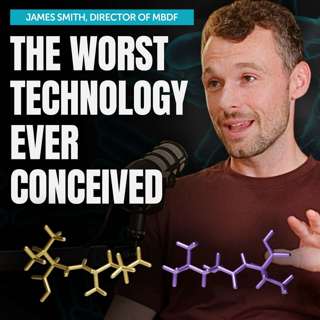
When James Smith first heard about mirror bacteria, he was sceptical. But within two weeks, he’d dropped everything to work on it full time, considering it the worst biothreat that he’d seen described. What convinced him?

Mirror bacteria would be constructed entirely from molecules that are the mirror images of their naturally occurring counterparts. This seemingly trivial difference creates a fundamental break in the tree of life. For billions of years, the mechanisms underlying immune systems and keeping natural populations of microorganisms in check have evolved to recognise threats by their molecular shape — like a hand fitting into a matching glove.

Learn more, video, and full transcript: https://80k.info/js26

Mirror bacteria would upend that assumption, creating two enormous problems:

  1. Many critical immune pathways would likely fail to activate, creating risks of fatal infection across many species.
  2. Mirror bacteria could have substantial resistance to natural predators: for example, they would be essentially immune to the viruses that currently keep bacteria populations in check. That could help them spread and become irreversibly entrenched across diverse ecosystems.

Unlike ordinary pathogens, which are typically species-specific, mirror bacteria’s reversed molecular structure means they could potentially infect humans, livestock, wildlife, and plants simultaneously. The same fundamental problem — reversed molecular structure breaking immune recognition — could affect most immune systems across the tree of life. People, animals, and plants could be infected from any contaminated soil, dust, or species.

The discovery of these risks came as a surprise. The December 2024 Science paper that brought international attention to mirror life was coauthored by 38 leading scientists, including two Nobel Prize winners and several who had previously wanted to create mirror organisms.

James is now the director of the Mirror Biology Dialogues Fund, which supports conversations among scientists and other experts about how these risks might be addressed. Scientists tracking the field think that mirror bacteria might be feasible in 10–30 years, or possibly sooner. But scientists have already created substantial components of the cellular machinery needed for mirror life. We can regulate precursor technologies to mirror life before they become technically feasible — but only if we act before the research crosses critical thresholds. Once certain capabilities exist, we can’t undo that knowledge.

Addressing these risks could actually be very tractable: unlike other technologies where massive potential benefits accompany catastrophic risks, mirror life appears to offer minimal advantages beyond academic interest.

Nonetheless, James notes that fewer than 10 people currently work full-time on mirror life risks and governance. This is an extraordinary opportunity for researchers in biosecurity, synthetic biology, immunology, policy, and many other fields to help solve an entirely preventable catastrophe — James even believes the issue is on par with AI safety as a priority for some people, depending on their skill set.

The Mirror Biology Dialogues Fund is hiring!

This episode was recorded on November 5-6, 2025.

Chapters:

  • Cold open (00:00:00)
  • Who's James Smith? (00:00:49)
  • Why is mirror life so dangerous? (00:01:12)
  • Mirror life and the human immune system (00:15:40)
  • Nonhuman animals will also be at risk (00:28:25)
  • Will plants be susceptible to mirror bacteria? (00:34:57)
  • Mirror bacteria's effect on ecosystems (00:39:34)
  • How close are we to making mirror bacteria? (00:52:16)
  • Policies for governing mirror life research (01:06:39)
  • Countermeasures if mirror bacteria are released into the world (01:22:06)
  • Why hasn't mirror life evolved on its own? (01:28:37)
  • Why wouldn't antibodies or antibiotics save us from mirror bacteria? (01:31:52)
  • Will the environment be toxic to mirror life? (01:39:21)
  • Are there too many uncertainties to act now? (01:44:18)
  • The potential benefits of mirror molecules and mirror life (01:46:55)
  • Might we encounter mirror life in space? (01:52:44)
  • Sounding the alarms about mirror life: the backstory (01:54:55)
  • How to get involved (02:02:44)

Video and audio editing: Dominic Armstrong, Milo McGuire, Luke Monsour, and Simon Monsour
Music: CORBIT
Camera operators: Jeremy Chevillotte and Alex Miles
Coordination, transcripts, and web: Katy Moore

Episoder(326)

#36 - Tanya Singh on ending the operations management bottleneck in effective altruism

#36 - Tanya Singh on ending the operations management bottleneck in effective altruism

Almost nobody is able to do groundbreaking physics research themselves, and by the time his brilliance was appreciated, Einstein was hardly limited by funding. But what if you could find a way to unlo...

11 Jul 20182h 4min
#35 - Tara Mac Aulay on the audacity to fix the world without asking permission

#35 - Tara Mac Aulay on the audacity to fix the world without asking permission

"You don't need permission. You don't need to be allowed to do something that's not in your job description. If you think that it's gonna make your company or your organization more successful and mor...

21 Jun 20181h 22min
Rob Wiblin on the art/science of a high impact career

Rob Wiblin on the art/science of a high impact career

Today's episode is a cross-post of an interview I did with The Jolly Swagmen Podcast which came out this week. I recommend regular listeners skip to 24 minutes in to avoid hearing things they already ...

8 Jun 20181h 31min
#34 - We use the worst voting system that exists. Here's how Aaron Hamlin is going to fix it.

#34 - We use the worst voting system that exists. Here's how Aaron Hamlin is going to fix it.

In 1991 Edwin Edwards won the Louisiana gubernatorial election. In 2001, he was found guilty of racketeering and received a 10 year invitation to Federal prison. The strange thing about that election?...

1 Jun 20182h 18min
#33 - Anders Sandberg on what if we ended ageing, solar flares & the annual risk of nuclear war

#33 - Anders Sandberg on what if we ended ageing, solar flares & the annual risk of nuclear war

Joseph Stalin had a life-extension program dedicated to making himself immortal. What if he had succeeded?  According to our last guest, Bryan Caplan, there’s an 80% chance that Stalin would still be ...

29 Mai 20181h 24min
#32 - Bryan Caplan on whether his Case Against Education holds up, totalitarianism, & open borders

#32 - Bryan Caplan on whether his Case Against Education holds up, totalitarianism, & open borders

Bryan Caplan’s claim in *The Case Against Education* is striking: education doesn’t teach people much, we use little of what we learn, and college is mostly about trying to seem smarter than other peo...

22 Mai 20182h 25min
#31 - Allan Dafoe on defusing the political & economic risks posed by existing AI capabilities

#31 - Allan Dafoe on defusing the political & economic risks posed by existing AI capabilities

The debate around the impacts of artificial intelligence often centres on ‘superintelligence’ - a general intellect that is much smarter than the best humans, in practically every field. But according...

18 Mai 201848min
#30 - Eva Vivalt on how little social science findings generalize from one study to another

#30 - Eva Vivalt on how little social science findings generalize from one study to another

If we have a study on the impact of a social program in a particular place and time, how confident can we be that we’ll get a similar result if we study the same program again somewhere else? Dr Eva V...

15 Mai 20182h 1min

Populært innen Fakta

fastlegen
dine-penger-pengeradet
relasjonspodden-med-dora-thorhallsdottir-kjersti-idem
foreldreradet
treningspodden
rss-strid-de-norske-borgerkrigene
mikkels-paskenotter
jakt-og-fiskepodden
sinnsyn
takk-og-lov-med-anine-kierulf
hverdagspsyken
rss-sunn-okonomi
gravid-uke-for-uke
rss-kunsten-a-leve
rss-bisarr-historie
tomprat-med-gunnar-tjomlid
rss-kull
hagespiren-podcast
rss-var-forste-kaffe
fryktlos