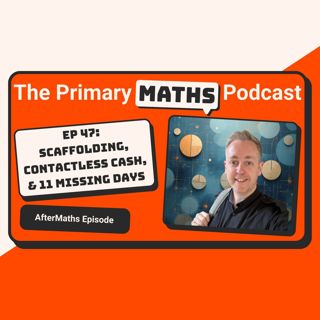

AfterMaths: Scaffolding, Contactless Cash and 11 Missing Days

AfterMaths: Scaffolding, Contactless Cash and 11 Missing Days

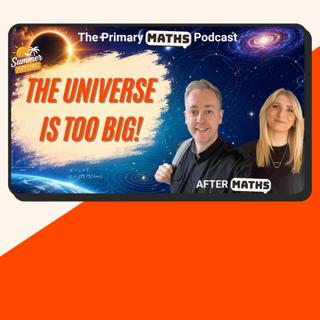
In this week’s Aftermaths, Jon and Becky unpick two words that are everywhere right now — scaffolding and adaptations — and ask whether we’re accidentally reinventing differentiation under a new name. Then we share listener stories about children’s “money logic” (including the belief that you can simply tap your phone to summon infinite dinosaurs). Finally, Jon takes us down a brilliant history rabbit hole: the year Britain “lost” 11 days when the calendar changed — and we round off with quick takeaways from this week’s interview on problem solving.

In this episode
  1. Scaffolding vs adaptations: what scaffolding is (temporary, for everyone, faded), and what it isn’t (a permanent crutch or a euphemism for tiered tasks).
  2. A construction-site analogy for scaffolding — and why “for all” matters if we care about access and equity.
  3. Money follow-up: three listener stories that reveal how children can misunderstand money in a contactless world (“Santa pays for the expensive stuff”, “just tap your phone”, and “free cash”).
  4. History of maths / time mystery: how Britain ended up going to bed on 2 September 1752 and waking up on 14 September 1752 — and why it links back to Julian vs Gregorian calendars (and a March New Year).
  5. Problem solving takeaways from this week’s interview episode (Tom Manners & Steve Lomax): mindset, collaboration/communication before “strategies”, and the power of noticing and wondering — even when it’s hard to “evidence” in the moment.

Key takeaways
  1. Scaffolding should help learners reach the maths — then be removed. If the support becomes the method, we’ve stolen the thinking.
  2. Not all support is scaffolding. Some needs require specific adaptations, but that’s different from whole-class scaffolds designed into instruction.
  3. Children’s money misconceptions are completely rational given what they see: money as a tap, a beep, or a sign that literally says “free cash”.
  4. Problem solving grows from culture as much as content: curiosity, talk, and collaborative habits aren’t bolt-ons — they’re prerequisites.

Mentioned / coming up
  1. Next Tuesday’s interview: Dominique from “Sums of Anarchy” on engaging pupils in maths — worth checking out her content ahead of the episode.

Get in touch

Share your best child logic (money or otherwise), or tell us what “scaffolding” looks like in your school: primarymathspodcast@twinkl.co.uk (Twinkl without the “e”).

If you enjoyed the episode…

Follow/subscribe, leave a rating, and (on YouTube) like the video — it really helps more teachers and leaders find the show.

Denne episoden er hentet fra en åpen RSS-feed og er ikke publisert av Podme. Den kan derfor inneholde annonser.

Episoder(85)

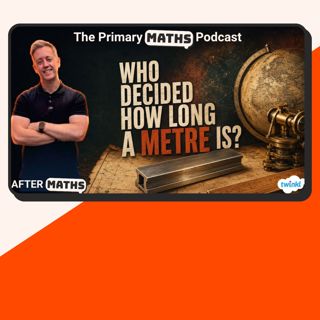
Who Decided How Long a Metre Is? AfterMaths Summer Special 3

Who Decided How Long a Metre Is? AfterMaths Summer Special 3

Who decided how long a metre should be? Why is a mile 1,760 yards? And what connects the French Revolution, an expedition from Dunkirk to Barcelona and the speed of light?In this AfterMaths Summer Spe...

7 Aug 22min
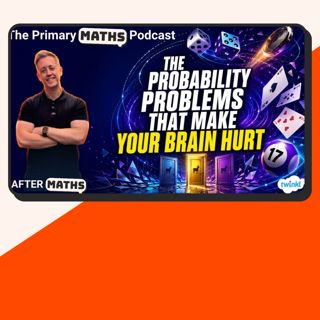
The Probability Problems That Make Your Brain Hurt - AfterMaths Summer Special 2 2026

The Probability Problems That Make Your Brain Hurt - AfterMaths Summer Special 2 2026

Probability often feels as though it should be intuitive, right up until the mathematics tells us that our instincts are completely wrong.In this AfterMaths Summer Special, Jon and Becky explore the s...

31 Jul 30min
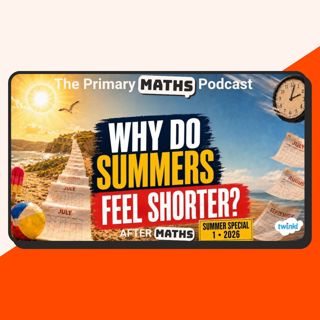
Why Do Summer Holidays Feel Shorter As We Get Older? Summer Special 1 2026

Why Do Summer Holidays Feel Shorter As We Get Older? Summer Special 1 2026

Why did the six-week summer holiday feel endless when we were children, yet now seems to disappear almost as soon as it begins?In the first of the 2026 Aftermaths Summer Specials, Jon and Becky explor...

28 Jul 29min

KS2 SATs Results, AI and Outsourcing Mathematical Thinking

KS2 SATs Results, AI and Outsourcing Mathematical Thinking

What do this year’s KS2 SATs results really tell us about primary maths—and what might they be hiding?Jon and Becky examine the newly released national data, including the rise in maths attainment, th...

17 Jul 37min

Teaching in a Heatwave and is there a Place for Maths Hacks?

Teaching in a Heatwave and is there a Place for Maths Hacks?

In this episode of the Primary Maths Podcast, Jon and Becky ask whether we need to change the way we teach maths during a heatwave.With classrooms getting hotter and the end of term in sight, they exp...

10 Jul 30min

World Cup Maths, Equity and Oracy in the Primary Classroom

World Cup Maths, Equity and Oracy in the Primary Classroom

World Cup Maths, Equity and Oracy in the Primary ClassroomIn this episode of the Primary Maths Podcast, Jon and Becky talk end-of-year school chaos, transition days, classroom moves, and the strange j...

3 Jul 33min

Escape Rooms and Problem Solving (AfterMaths)

Escape Rooms and Problem Solving (AfterMaths)

In this episode of The Primary Maths Podcast, Jon and Becky reflect on the realities of summer term: heatwaves, report writing, and the heroic act of trying to teach when everyone is melting.They then...

26 Jun 37min

What We Can Learn from This Year’s Maths SATs?

What We Can Learn from This Year’s Maths SATs?

In this aftermaths episode of The Primary Maths Podcast, Jon and Becky take a look back at this year’s KS2 maths SATs papers and ask what teachers and maths leads might learn from them.They discuss wh...

18 Jun 33min

Populært innen Fakta

fastlegen
dine-penger-pengeradet
relasjonspodden-med-dora-thorhallsdottir-kjersti-idem
treningspodden
foreldreradet
jakt-og-fiskepodden
mikkels-paskenotter
rss-strid-de-norske-borgerkrigene
rss-kunsten-a-leve
sinnsyn
hverdagspsyken
gravid-uke-for-uke
fryktlos
ryddepodden
babyverden
rss-var-forste-kaffe
tomprat-med-gunnar-tjomlid
rss-sarbar-med-lotte-erik
lederskap-nhhs-podkast-om-ledelse
rss-impressions-2