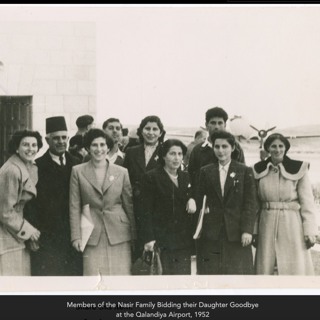
Nakba #56 - Samia Nasir Khury

Nakba #56 - Samia Nasir Khury

“My father worked as a governor for the British government, and the rest of the family followed him. He was later transferred to Safad. There we had good relations with our Jewish neighbors. That was normal. Women exchanged baked goods with one another during different holidays and celebrations. In 1946 it finally became clear to him what the British were doing—that they were preparing the way for the Jews to take over. His job became impossible, and he decided to resign. He went to the King David Hotel to submit his letter of resignation. As he stepped over the threshold of the hotel, he looked at his watch and realized he was early. He decided to visit a friend in Mamilla in the meantime. Shortly after he left the hotel, it was blown to pieces. The man my father was going to visit was not as lucky. He had gone to the hotel and was killed by the bomb. This was in 1946. Irgun was responsible for the attack, but the various Zionist organizations constantly blamed one another. This was only the beginning. Then came the bombing of the Semiramis Hotel and the massacre in Dayr Yasin. That was when people began to feel real fear. After my father resigned, he began teaching physics. We remained in al-Quds. I was a happy teenager. I went to parties, and my aunts and cousins lived there. It was a wonderful time. We used to go to the YMCA, where we were members. They had leadership courses, tennis courts, a gym, and a swimming pool. It was a fantastic place. In 1948, the family moved to Birzeit, where my father taught and where I attended a boarding school—it felt like my second home. Suddenly, rumors spread that something was wrong. People began pouring in from al-Ramla and Lydda. They were fleeing and had been walking for two or three days. I will never forget that sight. Everything was so sad; people were utterly exhausted. Someone told us they had lost a son. One man was confused and rambling; he did not understand what was happening. I especially remember a woman who had lost all her belongings. Despite that, she was grateful to have survived. She said: “Furniture can be replaced, but not people.” My aunt told my cousins and me to cook food for the refugees. We boiled eggs and potatoes, sliced tomatoes and cucumbers—everything we could get hold of. My aunt also helped prepare a school building where some of the refugees could find shelter. My aunts and cousins had come to Birzeit to escape the unrest in al-Quds. Everyone believed this would be over in a few weeks, and that we would be able to return. But in October, we began to understand that this was no picnic. After the war in 1967, East al-Quds was annexed by Jordan. It then became possible again for my mother and me to visit our house. The house had become a daycare center, so it was easy to enter. My mother began explaining to a woman sitting in the office that it had once been her bedroom. It was painful to see our house again. I had hoped, for as long as possible, that we would be allowed to return. We never went back again. The Nakba is still ongoing; the displacement is still ongoing. Everything here is so hard to predict under the Israeli occupation. When you get up in the morning and put your right foot down, you do not know whether your left foot will follow. In 1993, during the first intifada, my son produced a song and made cassette copies of it. He was arrested by the police and taken for interrogation at Moscobiyeh in al-Quds. He was accused of spreading music that glorified the intifada. He was imprisoned for six months. First he was held in Ayalon prison in al-Ramla. He went through hell there. We were allowed to visit him, but I was not allowed to touch him. He sat behind a net. Later he was transferred to Prison Six, outside Atlit. The time in prison made my son more enthusiastic and determined than before. He continues to make music.

Denne episoden er hentet fra en åpen RSS-feed og er ikke publisert av Podme. Den kan derfor inneholde annonser.

Episoder(323)

Nakba #40 - Mahmud al-Hissi

Nakba #40 - Mahmud al-Hissi

“We lived in a house in al-Hilwa in Jaffa, next to the Jabaliya Mosque. Jaffa was largely Arab, but we also had some neighbors who were Palestinian Jews. My parents have told me that people celebrated...

7 Jan 1h 3min
Nakba #39 - Hilwa Iskander

Nakba #39 - Hilwa Iskander

1936 “At the beginning of the Arab uprising against the British, my father was shot in the back. A couple of years later, the British killed my uncle.” 1938 “My mother was called Husn, and she was a g...

7 Jan 1h 7min
Nakba #38 - Munhir Fahoum

Nakba #38 - Munhir Fahoum

1934 “I was born in Irbid, in al-Urdunn, but my family comes from al-Nasira. We have lived there for 300 years. I was a wild child. When my father had guests, I would go outside and take one of the gu...

7 Jan 35min
Nakba #37 - Amin Awayda

Nakba #37 - Amin Awayda

1948 “After the massacre in Dayr Yasin, which was a suburb of al-Quds, we were forced to flee. Most people were afraid of suffering the same fate. But my grandfather and his brother refused; they said...

7 Jan 35min
Det judiska Högalid #25 - Mattias Sackrén

Det judiska Högalid #25 - Mattias Sackrén

- Min pappa Jerry föddes 1939. När han var sex månader övergav farfar familjen. De sågs aldrig igen, säger Mattias Sackrén. - Pappa kom att jobba med reklam, bland annat åt sin morbror, Nathan Sackrén...

6 Jan 1h 51min
Det judiska Högalid #24 - Mirjam Ettlinger Frajnd

Det judiska Högalid #24 - Mirjam Ettlinger Frajnd

- Min pappa var född i Sverige och vi bodde på eleganta Östermalm. När jag kom till judiska lekskolan så minns jag att de här föräldrarna såg annorlunda ut, dom såg liksom rädda ut och kunde inte tala...

2 Jan 55min
Nakba #36 - Nabiha Hammad Abu Jamus

Nakba #36 - Nabiha Hammad Abu Jamus

1945 “My mother milked the sheep and sold the milk in ‘Akka. Just a few days after she had given birth, she started working again. Our house was always full of people. We had enormous wedding celebrat...

2 Jan 34min
Nakba #35 - Muhammad Abu Hashem

Nakba #35 - Muhammad Abu Hashem

1946 “There were some Jews living in my village, and we were friends with them. In Akka there were more Jews. If I got sick, I used to go to a Jewish doctor in Akka named Nathan. As children, we did n...

1 Jan 1h 14min

Populært innen Fakta

fastlegen
dine-penger-pengeradet
relasjonspodden-med-dora-thorhallsdottir-kjersti-idem
rss-bisarr-historie
rss-strid-de-norske-borgerkrigene
foreldreradet
treningspodden
jakt-og-fiskepodden
rss-sunn-okonomi
mikkels-paskenotter
rss-kunsten-a-leve
hverdagspsyken
rss-kull
sinnsyn
gravid-uke-for-uke
rss-sarbar-med-lotte-erik
hagespiren-podcast
fryktlos
rss-bak-luftfarten
rss-impressions-2