Why We Drink Too Much: The Impact  of Alcohol on our Bodies & Culture with Dr. Charles Knowles

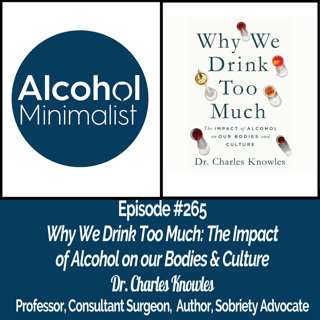
Why We Drink Too Much: The Impact of Alcohol on our Bodies & Culture with Dr. Charles Knowles

In this episode of the Alcohol Minimalist Podcast, Molly sits down with Dr. Charles Knowles, professor of surgery at Queen Mary University of London and author of Why We Drink Too Much.

This is a deep, science-forward conversation about why humans drink alcohol, why some people lose control while others don’t, and how culture, biology, psychology, and learning all intersect in our relationship with alcohol.

Dr. Knowles shares his personal journey through alcohol dependence, recovery, and ultimately peace—alongside the neuroscience, history, and behavioral science that explain why alcohol can quietly shift from pleasure to reliance.

If you’ve ever wondered “Why me?”, questioned your own drinking without fitting neatly into a label, or felt stuck in the gray area between “fine” and “not fine,” this conversation offers clarity, compassion, and perspective.

What You’ll Learn in This Episode

  • Why problematic drinking is not a moral failure or lack of willpower
  • The difference between reward drinking and relief drinking—and why that shift matters
  • Why consumption alone is a poor measure of alcohol’s impact
  • The Three C’s of Drinking: Consumption, Consequences, and Control
  • What “alcohol reliance” means—and why so many people live in this gray area
  • Why sobriety, abstinence, and neutrality are not the same thing
  • How emotional sobriety and peace are built after (or alongside) behavior change
  • Why understanding the brain can help some people change—and why action still matters
  • The role of culture, normalization, and storytelling in how we relate to alcohol
  • Why a period of alcohol-free time can be valuable, regardless of long-term goals

Key Concepts Discussed

  • Alcohol as a learned behavior, not a character flaw
  • Psychological dependence vs. physical dependence
  • Cognitive dissonance in gray-area drinking
  • Neuroplasticity and habit reinforcement
  • Emotional sobriety as a state of mind, not a rule set
  • Identity, agency, and discovering who you are without alcohol driving the story

Notable Quote

“Peace is an incredibly important thing—and it’s not until you find it that you realize you never had it.”

About the Guest

Dr. Charles Knowles is a professor of surgery at Queen Mary University of London, a consultant colorectal surgeon, and the author of over 300 peer-reviewed scientific publications. Why We Drink Too Much is his first popular science book, combining rigorous research with lived experience to challenge how we think about alcohol, addiction, and recovery.


Recommended Resource

Final Takeaway

Changing your relationship with alcohol isn’t about labels, perfection, or deprivation. It’s about understanding what’s driving your behavior, questioning old narratives, and creating enough space to build peace—mentally, emotionally, and physically.

This episode is an invitation to look at alcohol with curiosity instead of judgment—and to remember that meaningful change is always possible.

Low risk drinking guidelines from the NIAAA:

Healthy men under 65:

No more than 4 drinks in one day and no more than 14 drinks per week.

Healthy women (all ages) and healthy men 65 and older:
No more than 3 drinks in one day and no more than 7 drinks per week.

One drink is defined as 12 ounces of beer, 5 ounces of wine, or 1.5 ounces of 80-proof liquor. So remember that a mixed drink or full glass of wine are probably more than one drink.

Abstinence from alcohol
Abstinence from alcohol is the best choice for people who take medication(s) that interact with alcohol, have health conditions that could be exacerbated by alcohol (e.g. liver disease), are pregnant or may become pregnant or have had a problem with alcohol or another substance in the past.

Benefits of “low-risk” drinking
Following these guidelines reduces the risk of health problems such as cancer, liver disease, reduced immunity, ulcers, sleep problems, complications of existing conditions, and more. It also reduces the risk of depression, social problems, and difficulties at school or work.


★ Support this podcast ★

Denne episoden er hentet fra en åpen RSS-feed og er ikke publisert av Podme. Den kan derfor inneholde annonser.

Episoder(374)

Think Thursday:  Why Your Brain Needs to Move

Think Thursday: Why Your Brain Needs to Move

On this Think Thursday episode of the Alcohol Minimalist Podcast, Molly explores the strange kind of exhaustion that happens when your brain is overstimulated but your body has barely moved.Inspired b...

14 Mai 15min

Revisiting: I Come from a Long Line of Drinkers

Revisiting: I Come from a Long Line of Drinkers

In this episode of the Alcohol Minimalist Podcast, Molly revisits the powerful belief so many people carry: “I come from a long line of drinkers.” Whether that story comes from family history, cultura...

11 Mai 19min

Think Thursday: Sleep, Mental Health & The Science of Flourishing

Think Thursday: Sleep, Mental Health & The Science of Flourishing

Sleep, Mental Health, and the Science of FlourishingThis week on Think Thursday, Molly revisits a topic that has shown up many times on the podcast: sleep. But this conversation takes a different angl...

7 Mai 13min

Revisiting: The Five Things I Needed to Change Before I Could Change My Drinking

Revisiting: The Five Things I Needed to Change Before I Could Change My Drinking

In this episode of the Alcohol Minimalist Podcast, Molly revisits episode 100: “5 Things I Had to Change Before I Changed My Drinking.” Originally released in November 2022, this conversation is just ...

4 Mai 21min

Think Thursday: Living Alongside Mental Illness-The Hidden Impact on Your Brain & Behavior

Think Thursday: Living Alongside Mental Illness-The Hidden Impact on Your Brain & Behavior

Episode SummaryWhat is it like to live with someone who is struggling with their mental health?In this Think Thursday episode, Molly explores the often-overlooked experience of living alongside mental...

30 Apr 11min

Alcohol Awareness Month:  What Alcohol Awareness Really Means

Alcohol Awareness Month: What Alcohol Awareness Really Means

As Alcohol Awareness Month comes to a close, Molly reflects on what alcohol awareness really means and why it is about more than fear, labels, or all-or-nothing thinking. Drawing on this month’s episo...

27 Apr 21min

Think Thursday: The Story Your Brain Tells First

Think Thursday: The Story Your Brain Tells First

Your brain doesn’t wait to tell a story about your life—it creates one in real time.In this Think Thursday episode, Molly builds on the foundational concept of “the gap and the gain” and takes it one ...

23 Apr 11min

Alcohol Awareness Month: How Curious Elixirs Is Redefining What Drinking Less Can Look Like with J.W. Wiseman

Alcohol Awareness Month: How Curious Elixirs Is Redefining What Drinking Less Can Look Like with J.W. Wiseman

In this episode of the Alcohol Minimalist Podcast, Molly talks with J.W. Wiseman, founder of Curious Elixirs, about the rise of craft non-alcoholic cocktails and why they matter so much for people who...

20 Apr 40min

Populært innen Fakta

fastlegen
dine-penger-pengeradet
rss-bisarr-historie
relasjonspodden-med-dora-thorhallsdottir-kjersti-idem
foreldreradet
treningspodden
rss-strid-de-norske-borgerkrigene
rss-kunsten-a-leve
jakt-og-fiskepodden
rss-sunn-okonomi
mikkels-paskenotter
sinnsyn
hverdagspsyken
gravid-uke-for-uke
rss-bak-luftfarten
rss-sarbar-med-lotte-erik
hagespiren-podcast
rss-kull
fryktlos
rss-mind-body-podden