Kiliii Yüyan details 'Guardians of Life' and how we can learn from them

Kiliii Yüyan details 'Guardians of Life' and how we can learn from them

National Geographic photographer Kiliii Yuyän returns to the Mongabay Newscast to share his experience creating his new book, Guardians of Life: Indigenous Knowledge, Indigenous Science, and Restoring the Planet from specialty publisher Braided River. This book documents the traditional ecological knowledge (TEK) of nine Indigenous communities worldwide, featuring contributions and essays from many members of these communities, along with Yüyan's own photography.

TEK, Yüyan says, isn't exactly traditional so much as it is ecological knowledge that is place-based. While it draws on thousands of years of knowledge, it also innovates in society as we know it, and can offer social, cultural and ecological benefits that neoliberal economics does not.

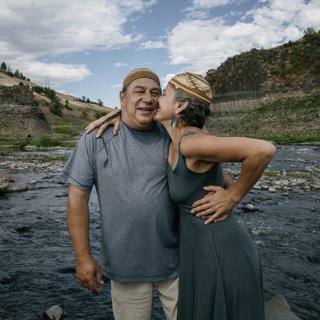
Yüyan highlights that some of the most significant environmental victories of the past few years, such as the removal of the Klamath River dams in the United States — the largest dam removal project ever — were led by Indigenous people. Yüyan's imagery captures the essence of the decades it took for Lisa Moorehead-Hillman, Leaf Hillman and others to advocate for their removal.

"I think what the great power of the book is in a lot of ways is the power of photography … actually seeing it. That this is what it means when we're talking about what is shamanism, what does it mean when you remove a dam … and you see it in people's faces."

Please take a minute to let us know what you think of our podcast, here.

Mike DiGirolamo is the host & producer for the Mongabay Newscast based in Sydney. Find him on LinkedIn and Bluesky.

Image Credit: Lisa Morehead-Hillman and Leif Hillman, both Karuk, celebrate the removal of the dams on the newly exposed reservoir floor in 2024. The former head of the Karuk Natural Resources Department, Leif spent two decades working with other Indigenous groups, environmental organizations and government officials to bring back the Klamath River. Image courtesy of Kiliii Yüyan.

—-

Timecodes

(00:00) What is traditional ecological knowledge?

(08:00) When values and governance go together

(17:38) Why and when hunters share their bounty in Greenland

(27:26) In Mongolia ceremonies are conservation

(39:12) How to get a dam removed

(46:08) Why the buffalo is the best environmentalist

Denne episoden er hentet fra en åpen RSS-feed og er ikke publisert av Podme. Den kan derfor inneholde annonser.

Episoder(369)

Historic fire seasons are the 'new normal' without 'serious action' on climate change

Historic fire seasons are the 'new normal' without 'serious action' on climate change

Elizabeth Goldman is a co-director of Global Nature Watch, previously known as Global Forest Watch, a database measuring forest loss that's frequently cited in Mongabay reporting. She joins this week'...

11 Aug 28min

The 'quiet revolution' inspired by Delhi's urban wildlife

The 'quiet revolution' inspired by Delhi's urban wildlife

In her upcoming book, My Wild City: Finding Nature, Meaning, and Hope in India's Capital, conservation biologist Neha Sinha takes readers to the hidden and not-so-hidden ecosystems of India's largest...

4 Aug 54min

Why are forests in Liberia disappearing?

Why are forests in Liberia disappearing?

On this week's episode of the Mongabay Newscast, we speak with features writer Ashoka Mukpo, who traveled to southeastern Liberia to investigate what satellite images indicated was a spike in deforest...

28 Jul 38min

Oil has brought destruction to the Niger Delta; women and human rights may save it

Oil has brought destruction to the Niger Delta; women and human rights may save it

On this week's episode of the Mongabay Newscast, I speak with travel writer Noo Saro-Wiwa. She has documented the violence and natural destruction that the presence of oil companies have brought to th...

21 Jul 42min

The Mediterranean Sea's beauty hides an ecosystem under pressure

The Mediterranean Sea's beauty hides an ecosystem under pressure

The Mediterranean Sea accounts for less than 1% of the world's ocean surface water, but it contains roughly 18% of global marine biodiversity. It is home to 150 million people along its coastline (rou...

14 Jul 33min

Wildlife crossings are having a moment

Wildlife crossings are having a moment

Nearly three years ago, Newscast guest, author and journalist Ben Goldfarb discussed his book Crossings, which is about wildlife crossings and road ecology. Wildlife crossings help reconnect habitats...

7 Jul 37min

The radical plan to rethink work, wealth and planetary well-being

The radical plan to rethink work, wealth and planetary well-being

A group of more than 40 researchers spent 20 months devising a plan for the world to achieve ecological sustainability within planetary boundaries, all while seeing incomes rise for 98% of the global ...

30 Jun 52min

Addressing the 'toxic legacy' of mining in Bougainville

Addressing the 'toxic legacy' of mining in Bougainville

Theonila Roka Matbob grew up next to what was — at the time — the world's largest open-pit mine in Bougainville, an autonomous island in Papua New Guinea, operated by a subsidiary of Rio Tinto. This m...

16 Jun 33min

Populært innen Vitenskap

fastlegen
tingenes-tilstand
romkapsel
rss-nysgjerrige-norge
liberal-halvtime
rekommandert
jss
villmarksliv
dekodet-2
abels-tarn
sinnsyn
vett-og-vitenskap-med-gaute-einevoll
fjellsportpodden
rss-overskuddsliv
rss-rekommandert
rss-paradigmepodden
tomprat-med-gunnar-tjomlid
diagnose
rss-inn-til-kjernen-med-sunniva-rose
nordnorsk-historie