
Think Thursday: The Brain's Need for Coherence

Think Thursday: The Brain's Need for Coherence

In this week’s Think Thursday, Molly builds on last week’s conversation about overwhelm and takes it one level deeper—into uncertainty and the brain’s fundamental need for coherence.

Many people say, “I’m overwhelmed by everything.” But often, what they’re describing isn’t simply busyness. It’s destabilization. The pace of technological change, the relentless news cycle, economic uncertainty, global conflict, and cultural instability create a steady stream of input that the human brain was not designed to process.

Our brains evolved for village-level information flow—not constant global exposure in real time.

The Brain as a Prediction Machine

Modern neuroscience describes the brain as a prediction engine. Researchers such as Karl Friston (predictive processing theory) suggest that the brain’s primary job is not just to react to reality, but to anticipate it.

Your brain is constantly generating internal forecasts about what is likely to happen next. It builds models of what is safe, familiar, and probable. When those models align with experience, the brain operates efficiently. Monitoring decreases. Stress drops. Calm increases.

But when prediction fails—when the future feels unstable or unclear—the brain increases vigilance. Cortisol rises. The amygdala becomes more reactive. Monitoring intensifies.

Uncertainty is not just emotionally uncomfortable. It is neurologically expensive.

Research comparing predictable and unpredictable stressors shows that unpredictable stress can create stronger physiological responses than predictable stress—even when the predictable stressor is objectively worse. The brain often prefers a known negative outcome to an unknown one because predictability allows preparation, and preparation reduces perceived threat.

Coherence vs. Ambiguity

Researchers such as Travis Proulx and Steven Heine have explored how disruptions in meaning and narrative coherence increase anxiety and motivate the brain to restore order. Coherence stabilizes the nervous system. Ambiguity destabilizes it.

When someone says, “I’m overwhelmed by everything,” that word everything represents a collapse of hierarchy and narrative. The brain cannot model everything at once. It cannot prioritize everything simultaneously. So it defaults to alarm.

Language plays a powerful role here. Molly revisits her recent quote:

“Every time you replace ‘I’m overwhelmed’ with ‘I need to decide what matters most and go slow,’ your brain stops firing alarm signals and starts organizing information again.”

While this shift does not immediately shut down the amygdala, research on cognitive reappraisal by psychologist James Gross shows that reframing increases prefrontal cortex activity and decreases amygdala activation over time. Changing language changes the predictive model the brain uses.

Molly also revisits a core Alcohol Minimalist concept: thoughts are both descriptive and prescriptive. Repeating “I’m overwhelmed” reinforces a future expectation. The brain uses repeated thoughts as data. Language influences prediction.

Why This Feels Amplified Now

The modern nervous system is metabolizing more information than at any point in human history. Our brains evolved to monitor a small social circle, not global crises, economic forecasts, political unrest, and technological revolutions delivered instantly.

When input exceeds the brain’s capacity to construct stable models:

  • Uncertainty rises
  • Scanning increases
  • Stress increases
  • Cognitive flexibility decreases

This is not fragility. It is neurobiology.

And it has direct implications for behavior change.

The brain invests effort when it believes the future is navigable. When the future feels chaotic, it shifts toward short-term safety behaviors—scrolling, avoidance, comfort-seeking, and returning to familiar habits—not because discipline has disappeared, but because predictability feels safer than uncertainty. Coherence builds confidence. Confidence supports effort. Effort sustains behavior change.


When coherence drops, consistency often drops with it.

Five Ways to Restore Coherence

While you cannot eliminate global uncertainty, you can restore local coherence. The brain does not require certainty everywhere. It requires stability somewhere.

Here are five actionable steps:

  1. Narrow the time horizon.
    Focus on today or tomorrow rather than the entire month or year. Short predictive loops are easier for the brain to manage.
  2. Identify what is controllable.
    Research shows perceived control reduces amygdala activation. Even one controllable action restores agency.
  3. Establish one predictable ritual.
    A consistent morning routine, defined work block, or nightly wind-down creates stability the brain can model.
  4. Limit interpretive overload.
    Too many possible explanations increase cognitive load. Choose the most useful interpretation instead of entertaining every hypothetical scenario.
  5. Build one daily evidence loop.
    Follow through on one manageable commitment each day. Predictable behavior strengthens the brain’s trust in its own forecasting.

Each of these steps restores hierarchy. Each reduces prediction error. Each sends a stabilizing signal to the nervous system.

You are telling your brain: “The world may be uncertain, but my behavior has structure.”

The Bottom Line

Your brain does not require absolute certainty in order to function well. It requires enough pattern to feel oriented. Enough structure to reduce constant monitoring. Enough stability to believe its predictions will not be continuously disrupted.

You cannot calm the entire world. But you can restore order in your immediate sphere.

When coherence returns, clarity follows.

★ Support this podcast ★

Denne episoden er hentet fra en åpen RSS-feed og er ikke publisert av Podme. Den kan derfor inneholde annonser.

Episoder(413)

More Sober October: Make it An Experiment, Not an Exam

More Sober October: Make it An Experiment, Not an Exam

What if the goal of More Sober October isn’t a perfect calendar—but learning something about your relationship with alcohol?In this episode, Molly shares how to approach October as an experiment inste...

28 Sep 23min
Think Thursday: Alzheimer’s Prevention and What the Latest Research Tells Us

Think Thursday: Alzheimer’s Prevention and What the Latest Research Tells Us

World Alzheimer’s Day is a good reminder that the story around Alzheimer’s disease is changing.In this Think Thursday episode, Molly looks at what we know now about earlier diagnosis, blood-based biom...

24 Sep 18min
How Much Alcohol is Safe? Rethinking Drinking Guidelines

How Much Alcohol is Safe? Rethinking Drinking Guidelines

What does “drink less” actually mean?In this episode of the Alcohol Minimalist podcast, Molly explores the changing alcohol guidelines and why there isn’t one simple number that guarantees a “safe” le...

21 Sep 20min
Think Thursday: Why Familiar Feels True-When Thoughts Become Beliefs

Think Thursday: Why Familiar Feels True-When Thoughts Become Beliefs

What happens when a thought gets repeated so often that it stops feeling like a thought and starts feeling like a fact?In this Think Thursday episode, Molly explores the illusory truth effect, process...

17 Sep 15min
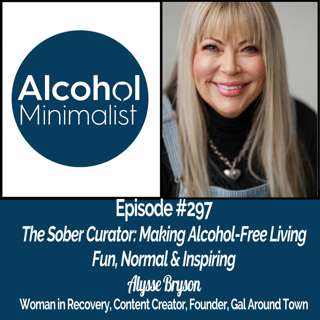
The Sober Curator: Making Alcohol-Free Living Fun, Normal & Inspiring with Alysse Bryson

The Sober Curator: Making Alcohol-Free Living Fun, Normal & Inspiring with Alysse Bryson

What does it look like to build a fun, fulfilling life with less alcohol—or none at all?In this episode of the Alcohol Minimalist Podcast, Molly talks with Elise Bryson, CEO and curator of The Sober C...

14 Sep 45min
Revisiting Think Thursday: Neurodivergence and The Brain's Energy Economy

Revisiting Think Thursday: Neurodivergence and The Brain's Energy Economy

In this revisited Think Thursday episode, Molly explores ADHD through the lens of the brain’s energy economy—how neurodivergent brains may use mental fuel differently, and why that matters for motivat...

10 Sep 13min
Summer's Greatest Hits: Alcohol & ADHD

Summer's Greatest Hits: Alcohol & ADHD

This week on the Alcohol Minimalist Podcast, we’re revisiting the most-downloaded episode from the Alcohol & series: Alcohol & ADHD.ADHD is a personal topic for me, and it also comes up often with coa...

7 Sep 35min
Think Thursday: Hearing Health is Brain Health

Think Thursday: Hearing Health is Brain Health

We tend to think of hearing as something that happens in our ears, but hearing is really a partnership between the ears and the brain. And growing research suggests that when hearing begins to decline...

3 Sep 12min

Populært innen Fakta

fastlegen
dine-penger-pengeradet
relasjonspodden-med-dora-thorhallsdottir-kjersti-idem
rss-strid
treningspodden
rss-bisarr-historie
foreldreradet
jakt-og-fiskepodden
rss-orjasater
tomprat-med-gunnar-tjomlid
takk-og-lov-med-anine-kierulf
hverdagspsyken
sinnsyn
mikkels-paskenotter
rss-impressions-2
rss-kull
gravid-uke-for-uke
rss-kunstig-intelligens-med-elisabeth-maren-og-morten
rss-kunsten-a-leve
fryktlos