Artemis II Gets Its Launch Date: April 1 | Magnetar Born | Planets Collide | S05E62

Artemis II Gets Its Launch Date: April 1 | Magnetar Born | Planets Collide | S05E62

It’s a bumper Friday edition of Astronomy Daily. NASA gives Artemis II the official green light to launch on April 1st, marking the first crewed lunar mission in over 53 years. Astronomers witness the birth of a magnetar for the very first time, confirming a decade-old theory and demonstrating Einstein’s general relativity in a supernova. A star 11,000 light-years away shows evidence of two planets catastrophically colliding in real time. A bus-sized asteroid buzzed past Earth last night closer than the Moon, discovered just five days ago. A fast solar wind stream from a coronal hole could bring auroras to higher latitudes tonight. And scientists may have identified the source of the most energetic neutrino ever recorded.

Story 1: Artemis II — Green Light for April 1 Launch NASA completed its Flight Readiness Review on 12 March 2026, with all mission teams voting unanimously ‘go’ for launch. The Space Launch System and Orion capsule will roll out to Launch Complex 39B on 19 March, with the primary launch window opening on 1 April at 6:24pm ET. Backup windows exist on 2–6 April and 30 April. The crew of four — Reid Wiseman, Victor Glover, Christina Koch, and Jeremy Hansen — will fly a 10-day figure-eight loop around the Moon. It will be the first crewed mission beyond low Earth orbit since Apollo 17 in December 1972. The previously planned Moon landing on Artemis III has been moved to Artemis IV, though NASA’s 2028 goal for a lunar landing remains unchanged. • NASA Artemis II Mission Page: https://www.nasa.gov/mission/artemis-ii/ • CNN coverage of FRR outcome: https://www.cnn.com/2026/03/12/science/nasa-artemis-2-launch-date-risk-assessment

Story 2: First-Ever Observed Birth of a Magnetar Astronomers have for the first time directly observed the birth of a magnetar — a highly magnetized, rapidly spinning neutron star — confirming it as the power source behind some of the universe’s brightest stellar explosions. The discovery, published in Nature on 11 March 2026, centres on superluminous supernova SN 2024afav, located approximately one billion light-years from Earth. Graduate student Joseph Farah at UC Santa Barbara, working with Las Cumbres Observatory’s global telescope network, detected a distinctive ‘chirp’ pattern in the supernova’s fading light — four oscillations with shortening intervals. This pattern is explained by a wobbling accretion disc around the newborn magnetar, driven by Lense-Thirring precession — a general relativistic effect. The finding confirms a 2010 theory by UC Berkeley physicist Dan Kasen, and marks the first time general relativity has been required to explain supernova mechanics. • Berkeley News: https://news.berkeley.edu/2026/03/11/astronomers-capture-birth-of-a-magnetar-confirming-link-to-some-of-universes-brightest-exploding-stars/ • Space.com: https://www.space.com/astronomy/stars/astronomers-witness-colossal-supernova-explosion-create-one-of-the-most-magnetic-stars-in-the-universe-for-the-first-time

Story 3: Two Planets Caught Colliding 11,000 Light-Years Away Researchers at the University of Washington have published evidence of a catastrophic planetary collision observed in real time around star Gaia20ehk, located approximately 11,000 light-years from Earth near the constellation Puppis. The star began flickering erratically from 2016, before its light output went ‘completely bonkers’ around 2021 — the signature of a massive debris cloud from two colliding worlds passing in front of the star. The debris orbits at roughly one astronomical unit from the star — the same as Earth’s distance from the Sun — and may eventually coalesce into new planetary bodies resembling an Earth-Moon system. The paper was published 11 March in The Astrophysical Journal Letters. • University of Washington: https://www.washington.edu/news/2026/03/11/uw-astronomers-spot-planet-collision-evidence/ • ScienceDaily: https://www.sciencedaily.com/releases/2026/03/260311213429.htm

Story 4: Asteroid 2026 EG1 Flies Past Earth A bus-sized asteroid designated 2026 EG1 made its closest approach to Earth at 11:27pm EDT on 12 March 2026, passing just 197,466 miles away — closer than the Moon. Estimated at 32–72 feet (10–22 metres) across and travelling at over 21,500 mph, it posed no threat. Notably, the asteroid was only discovered on 8 March — five days before its flyby — highlighting the ongoing challenge of detecting small near-Earth objects with short warning times. NASA’s Vera Rubin Observatory has already catalogued over 2,000 previously unknown solar system bodies since beginning operations. • Space.com: https://www.space.com/stargazing/bus-sized-asteroid-will-fly-past-earth-tonight-mere-days-after-being-discovered-heres-what-to-expect-march-12-2026

Story 5: Solar Wind & Aurora Alert A fast-moving stream of solar wind from a large coronal hole on the Sun is expected to reach Earth on 13 March 2026, potentially triggering G1 (minor) geomagnetic storm conditions. Auroras may be visible from...

Denne episoden er hentet fra en åpen RSS-feed og er ikke publisert av Podme. Den kan derfor inneholde annonser.

Episoder(500)

Tiny Robots, Alien Caves: NASA’s Plan for Titan

Tiny Robots, Alien Caves: NASA’s Plan for Titan

Anna and Avery cover NASA's newly funded concept for spherical, propeller-free "aerobots" that could one day explore the methane-carved cave systems of Saturn's moon Titan. Plus: SpaceX breaks its own...

17 Aug 18min
Exploring Moons with Atmospheres, Hot Jupiters, and the Mysteries of Black Holes | Space Nuts:...

Exploring Moons with Atmospheres, Hot Jupiters, and the Mysteries of Black Holes | Space Nuts:...

Sponsor Link: This Q&A episode of Space Nuts is brought to you with the support of NordVPN (https://www.nordvpn.com/spacenuts) . When you decide to get serius about your security online, do what we ...

17 Aug 34min
Is Empty Space Really Empty? A 90-Year-Old Mystery Gets Its Answer (S05E168 — The Weekend Wrap)

Is Empty Space Really Empty? A 90-Year-Old Mystery Gets Its Answer (S05E168 — The Weekend Wrap)

Today's episode — S05E168, Saturday August 15, 2026, our "Weekend Wrap": **Main story: a magnetar confirms 90-year-old vacuum birefringence prediction.** A team led by Rachael Stewart (George Washin...

15 Aug 15min
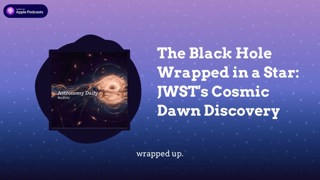
The Black Hole Wrapped in a Star: JWST’s Cosmic Dawn Discovery

The Black Hole Wrapped in a Star: JWST’s Cosmic Dawn Discovery

Anna and Avery break down JWST's discovery of MoM-BH*-1, the earliest known "black hole star" — a black hole shrouded in dense gas, glowing from just 660 million years after the Big Bang, that might e...

14 Aug 16min
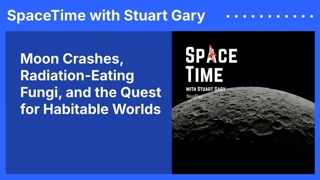
Moon Crashes, Radiation-Eating Fungi, and the Quest for Habitable Worlds

Moon Crashes, Radiation-Eating Fungi, and the Quest for Habitable Worlds

SpaceTime Series 29 Episode 97 The world watches as a SpaceX rocket crashes into the Moon A disused SpaceX Falcon 9 upper stage has crashed into the Moon providing astronomers with useful data on the ...

14 Aug 20min
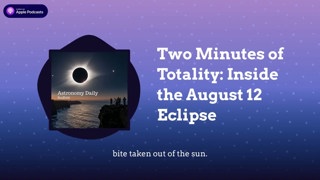
Two Minutes of Totality: Inside the August 12 Eclipse

Two Minutes of Totality: Inside the August 12 Eclipse

Anna and Avery break down yesterday's total solar eclipse — a 182-mile-wide shadow that swept from the Arctic through Greenland and Iceland to northern Spain, giving millions of people up to 2 minutes...

13 Aug 15min
The Galaxy’s Sugary Center Could Change How Life Began | Space Nuts: Astronomy Insights & Cosmic...

The Galaxy’s Sugary Center Could Change How Life Began | Space Nuts: Astronomy Insights & Cosmic...

13 Aug 27min
Galactic Giants: Unveiling the Mysteries of IC 1101 and Liquid Streams on Pluto

Galactic Giants: Unveiling the Mysteries of IC 1101 and Liquid Streams on Pluto

13 Aug 21min

Populært innen Vitenskap

fastlegen
tingenes-tilstand
romkapsel
jss
liberal-halvtime
rekommandert
forskningno
villmarksliv
rss-paradigmepodden
sinnsyn
tomprat-med-gunnar-tjomlid
fjellsportpodden
rss-nysgjerrige-norge
rss-inn-til-kjernen-med-sunniva-rose
rss-kunstig-intelligens-med-elisabeth-maren-og-morten
dekodet-2
rss-overskuddsliv
rss-fuglehundfolk
rss-rekommandert
smart-forklart